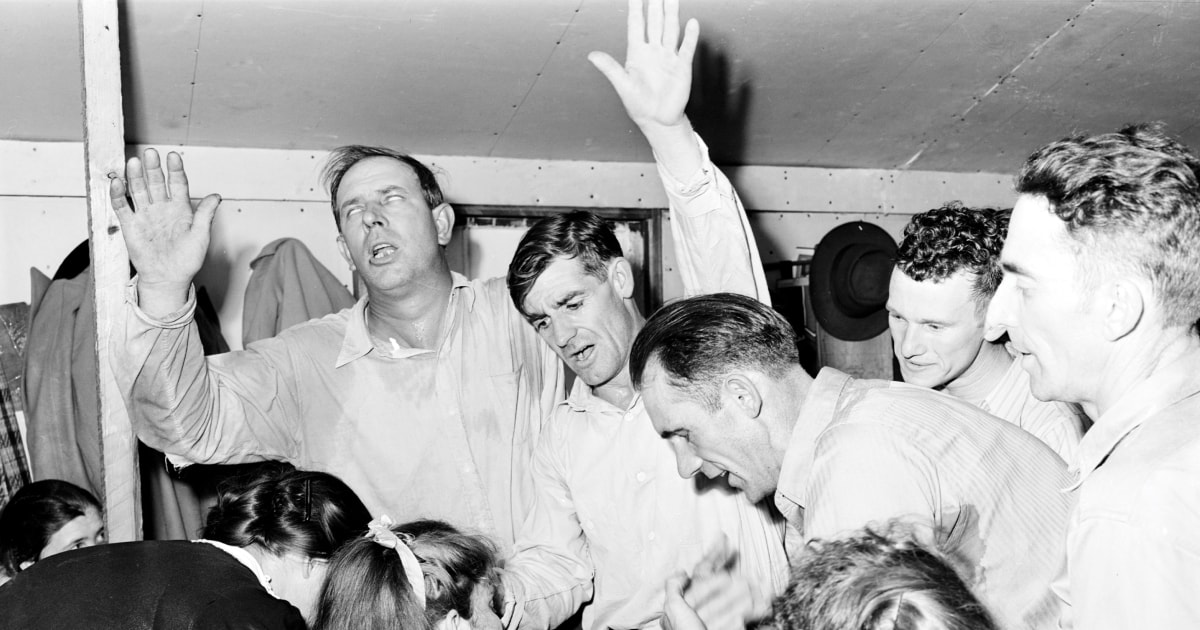


In 2019, seminarians at my institution reported being pressured to attend charismatic meetings to learn to ‘speak in tongues’ and receive ‘Spirit baptism’. The rector formed a commission, and the pressuring momentarily ceased. Having no background in the subject, curiosity led me to devote an entire sabbatical to it in 2020.
This research led me to Charles Sullivan, a Canadian linguist with a fluent reading knowledge of Latin and Greek, as well as Hebrew, Aramaic and Syriac, which he studied at Hebrew University in Jerusalem. With a 30-year background of involvement in the Pentecostal movement, Sullivan initially sought support for the Pentecostal practice of glossolalia as a ‘personal prayer language’ by combing through electronic databases of patristic sources in the original languages, such as Migne’s Patrologia Graeca and Patrologia Latina, and Syriac sources. To his dismay, however, he found no such support.
The Greek word for ‘tongue’, glossa, as found in the Church Fathers, meant either (1) the physical tongue, or (2) human language – nothing more. The same result was yielded by the Latin word, lingua, and the Syriac leshan. No mysterious quality is associated with the word such as we find in today’s Pentecostal-Charismatic references to ‘speaking in tongues’. Further, no lexical basis exists for the claim that Church Fathers began referring to ‘tongues’ as ‘jubilation’.
By the time I met Sullivan, he had already devoted well over a decade of study to his now widely consulted online Gift of Tongues Project. We joined our efforts in 2019, the yield of which is our four-volume series, Speaking in Tongues: A Critical Historical Examination (2022-2026). Our inquiry takes the form of an archaeological excavation: starting at the ‘surface’ level with contemporary glossolalic practices, we then dig down into Church history to find where these contemporary beliefs and practices came from.
Our first volume examines the rise of tongues as a ‘personal prayer language’, a redefinition that did not exist before the 20th century. Both the Irvingite revivalists in London (1830) and the Pentecostals in Topeka and Azusa Street (1900-1909) believed ‘tongues’ referred to human languages. The Irvingites drew such large crowds in London that they took to selling tickets, with audiences including celebrities such as Charles Dickens, Ralph Waldo Emerson, Alfred Tennyson, John Stuart Mill, Thomas Carlyle and even members of the Royal Family. Interest exploded across Europe, where German higher-critical theologians, concluding that tongues were irrational ecstatic utterances, coined a neologism by joining the Greek words glossa (‘tongue’ or ‘language’) and lalein (‘to speak’ or ‘to babble’), which they called ‘glossolalia’. This term was introduced into English by the Dean of Canterbury, Frederic Farrar, in his 1879 book, The Life and Work of St. Paul. Yet the first Pentecostal missionaries who went to India in 1906, still believing God would grant them a miraculous gift of foreign languages, found their attempts at preaching thwarted by uncomprehending audiences. Consequently, Alfred Garr and other Pentecostals began quietly redefining their understanding of tongues as a non-human ‘heavenly language’.
One fascinating discovery is that idioms such as ‘unknown tongues’, which litter the pages of Protestant translations of 1 Corinthians, are simply nonexistent in the original Greek, which has only glossais (‘languages’). These idioms were interpolations in Reformation-era translations meant to indict the Catholic Church’s use of Latin in its liturgy and Vulgate Bible. They had no relation to glossolalia.
The history of tongues is traced in our second volume, from the notable 18th-century treatise by Pope Benedict XIV, De Servorum Dei, back to St Irenaeus (c. 125-202). One takeaway is that the only debate was whether tongues involved a gift of speaking or hearing. Either way, it was always assumed to be a means of communication and evangelism. One Church Father, Origen (c. 185-254), claimed that St Paul said ‘I speak in tongues more than all of you’ (1 Cor 14:18) because he was graced with the natural gift of many languages he used in his missionary journeys. He also interpreted ‘singing with one’s spirit’ (1 Cor 14:15) as referring to psalmody in a liturgical setting. Further, in Contra Celsum, where he quotes Celsus’s reference to prophets who speak ‘strange… quite unintelligible words’ (which charismatics often assume refers to glossolalia), there is no reference to glossa (‘tongue’ or ‘language’), no indication that these prophets were Christian, and Origen critically dismisses their utterances as giving ‘occasion to every fool or impostor to apply them to suit his own purposes’.
Cyril of Jerusalem notably identifies the human languages spoken by the Apostles on Pentecost: Peter and Andrew, he writes, spoke Persian and Median, and the Apostle John and others spoke various other languages.
Our third volume dispels the myth that the tongues of Corinth were ecstatic utterances, showing instead that they involved a Jewish liturgical convention of a sacred language requiring bilingual interpreters. Beginning with the English divine and Talmud scholar John Lightfoot (1602-1675), who identified the uninterpreted tongues of Corinth with Hebrew, we go back to Moses Maimonides (d. 1204), who relates a tradition in synagogue liturgy of employing an interpreter, called a meturgeman, who would stand beside the lector and orally translate the Hebrew into the vernacular. From there, we delve back through the Babylonian Talmud, which confirms that this practice subsisted in synagogue liturgy for roughly a millennium, starting at the time of Ezra (5th century BC). As related in Nehemiah 8, when Ezra stood to read from the Torah in Hebrew to the Jews repatriated from captivity in Babylon, he placed Levite interpreters among them since the younger generation no longer understood Hebrew and knew only Aramaic (cf. Neh 13:24).
Chrysostom, Epiphanius, Cyril of Alexandria and Ambrosiaster – as well as Egeria, a 4th-century Christian pilgrim to Palestine – all confirm that this practice persisted in early Christian liturgies for several centuries. An interpreter would stand beside the bishop and interpret his unknown sacred language into the vernacular for the congregation. The language of early Christian liturgy in the Jewish diaspora was largely Hebrew (as confirmed by Benedict XIV and Johannes Eck), with Aramaic and Greek interpretation. Only after Hadrian’s suppression of the Bar Kokhba rebellion in AD 136 did Greek replace Hebrew as the sacred liturgical language of Christians. The Syrian Church even had a dedicated minor order – alongside acolytes and exorcists – for interpreters. The role of Jewish halakhot (religious law) in Paul’s letters offers strong support for the claim that Paul’s references to ‘tongues’ and ‘interpreters’ in 1 Corinthians 12-13 represent a mundane problem of a sacred liturgical language that could not be understood by many in the Corinthian assembly without interpretation.
The fourth volume of our research offers a substantial commentary on 1 Corinthians 14 with related essays in response to numerous requests by readers. These additional essays address voluminous new material that came to our attention since 2023 on the higher-critical theory of glossolalia, the evolution of the Pentecostal redefinition of ‘tongues’, the influence of Jewish religious law (halakha) in the Corinthian liturgical practices addressed by Paul, and the sociocultural context in which the modern practice of ‘tongues’ evolved in contemporary Protestant and Catholic circles.
All the evidence at hand, then, suggests that ‘speaking in tongues’ refers not to ecstatic utterance, but to supernatural comprehension at Pentecost and to natural translation in Corinth. The reality is something far simpler – and far more intelligible – than many modern Christians assume.