July 26, 2026

St John Henry Newman and the gorilla

Dominic Perrem
More
Related
Min read
share

Nearly two centuries ago, in 1841, Sir Robert Peel argued that scientific understanding of the universe suggested “that the material and the moral world are connected… bespeaking the uniformity and completeness of a system of divine contrivance, the centre of which is man.”

He was speaking at the opening of the Tamworth Library and Reading Room. It was to be a place where books on “religious controversy”, or anything on the subject of religious doctrine, would not be kept. Members would instead pursue what had been dubbed “rational recreation”.
Peel, a Conservative, would become Prime Minister for the second time a few months after this speech. Although a man of Christian faith, he was promoting what many in his day believed: that scientific education, knowledge and higher pursuits of leisure might replace bad habits in society and elevate moral standards.

It may seem purely utilitarian but, to Peel, God would not be neglected by this. Rather, he would be found in the order, knowledge, power and proofs of the material world, and in the educated mind of his created being, man. Though shorn of the possibility of religious and spiritual pursuit in his intellectual life, man would find in the material world all that he needed in order to know God, the Creator.

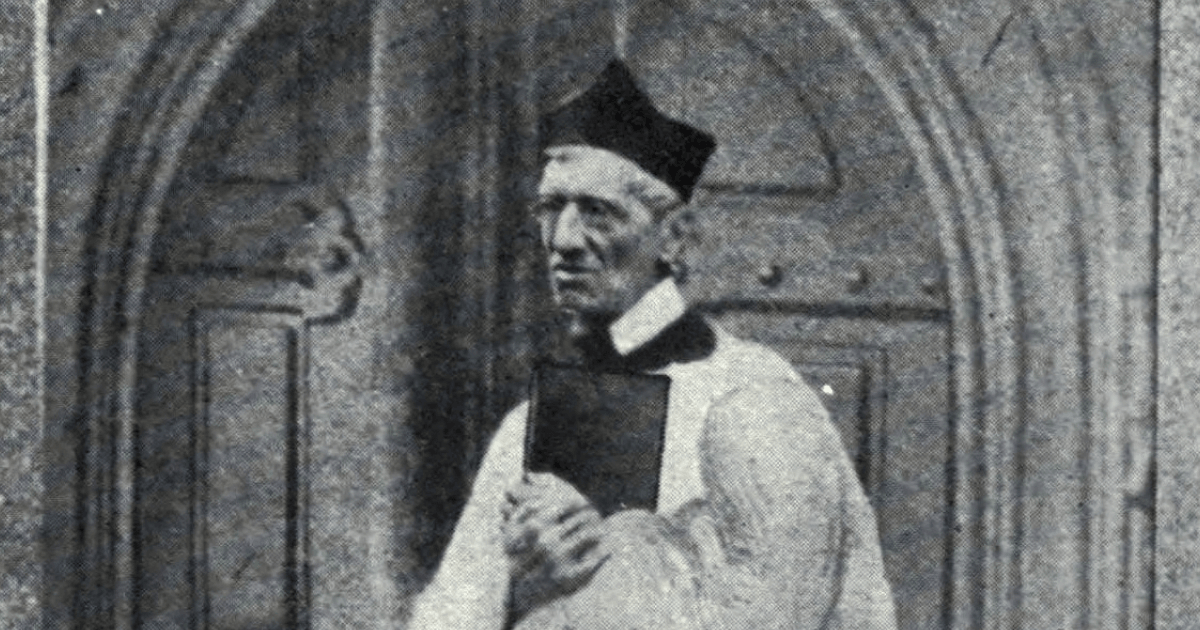
Writing for The Times under the pseudonym “Catholicus”, St John Henry Newman disagreed. He found Peel’s arguments so dangerous that he took the time to refute them in seven separate letters. They are collectively known today as The Tamworth Reading Room, and they are well worth reading if you have the time.

Newman categorically rebuked Peel’s assertion that proofs and knowledge would lead us to God:

“Science gives us the grounds or premisses from which religious truths are to be inferred; but it does not set about inferring them, much less does it reach the inference;—that is not its province.”

Pointing out that knowledge alone cannot reach faith, he argued that man must look beyond his own powers of measurement:

“Life is for action. If we insist on proofs for everything, we shall never come to action: to act you must assume, and that assumption is faith.”

To Newman, the true pursuit of man was deeper purpose, with faith as its true motivator, and God moving the heart towards goodness. Knowledge for its own sake, elevated into a pursuit of self-esteem and material dominance, would not lead man to betterment:

“To know is one thing, to do is another; the two things are altogether distinct.”

All of this is profoundly interesting because it sums up the dominant personal ideal of our own age. We now live in Peel’s reading room. Our paradigm is the person who pursues knowledge and thereby presumes its mastery to be a moral achievement. Man’s identity should consist in his supposedly rational self-assertions. Self-reverence, and trust in one’s own conclusions, is valued above all.

Look around you today and you will see many well-educated, scientifically literate, health-conscious men and women. They will speak with interest about the evidence they can point to and the conclusions they have reached. As Newman observed, “Many a man will live and die upon a dogma: no man will be a martyr for a conclusion.”

Newman understood that Peel’s dismissal of the deep moral questions surrounding faith and doctrine as mere “controversy” would introduce an unnatural vision of the human person, who would eventually regard himself as reasonable and powerful in ways he should not. “Man is not a reasoning animal,” Newman concluded. “He is a seeing, feeling, contemplating, acting animal.”

This deliberately agnostic intellectual pragmatism would quickly move beyond cosy utilitarian ideals towards mere self-reliance and an inflated view of our own powers. Far from the material world leading us to God, we instead seek to become its masters, concluding with great certainty that our dominion somehow makes us moral.

If we are moral by virtue of our knowledge, are we not also reasonable? Peel’s assertion that man is the ultimate realisation of the material world has merely led man to worship his material conclusions and desires within that world. Even those conclusions, though, ought to be treated with suspicion, for how much can we truly observe and fully know?

My favourite study of human behaviour is entitled “Gorillas in Our Midst: Sustained Inattentional Blindness for Dynamic Events”. This glorious paper investigates the limits of our attention. Participants are invited to watch a video of basketball teams and asked to count how many times one team passes the ball. According to the results, most of us will proudly tell the researcher the correct number of passes.

But when asked, “Did you notice that a man dressed in a full-size gorilla costume walked across the court?”, we will, with a sort of sullen, wounded look on our faces, have to admit that we did not.

I am sure it is a common experience to witness the kind of intellectual blindness into which we can all fall. I, for one, am failing to see many gorillas. It seems to me that I often see only what I wish to see. I may strive for a tidy house and polite children, yet fail to notice that my grumpy insistence on “no elbows on the table” and on maintaining a perfectly manicured lawn has made me cross and unapproachable to those very people whose hearts I hope to draw towards God.

Still, I, and you, and all of us, are tempted to persist in the idea that we have examined a problem from every angle and arrived at the correct conclusions. We convince ourselves that our reason will determine our morality and, without intending to, begin missing the most vital things. In seeking the proofs that interest us, and that demonstrate our own accomplished personhood, we may indeed be missing everything.

If you have wondered why the human person in our culture struggles to understand others, or why so many experience such profound isolation, much of the answer lies here. We have been taught to trust only ourselves and so, in the end, other people become unimportant. We have been encouraged to place mere measurement and personal conclusions above everything else.

Thankfully, Newman offers us a solution in his Tamworth letters: “You must go to a higher source for renovation of the heart and of the will.” We cannot help ourselves, but God can. It is our insistence that, though we were made by him, we should become masters without his help that has caused so much trouble in our world. In truth, we are far from mastering anything, and often cannot even see what is directly before our own noses.

As for the gorilla study, it seems likely to me that young children, who might approach the counting exercise in a rather half-hearted fashion, would immediately spot the gorilla and squeal with delight. Like them, I earnestly hope that all my measuring and self-confidence may melt away, so that I might allow God to show me what I do not see, always asking to be led instead by his kindly Light.

Continue reading with a free account

Create a free account to read up to five articles each month
Create free account

You have # free articles remaining this month.

Subscribe to get unlimited access.
Sign up

subscribe to the catholic herald today

Our best content is exclusively available to our subscribers. Subscribe today and gain instant access to expert analysis, in-depth articles, and thought-provoking insights—anytime, anywhere. Don’t miss out on the conversations that matter most.
Subscribe