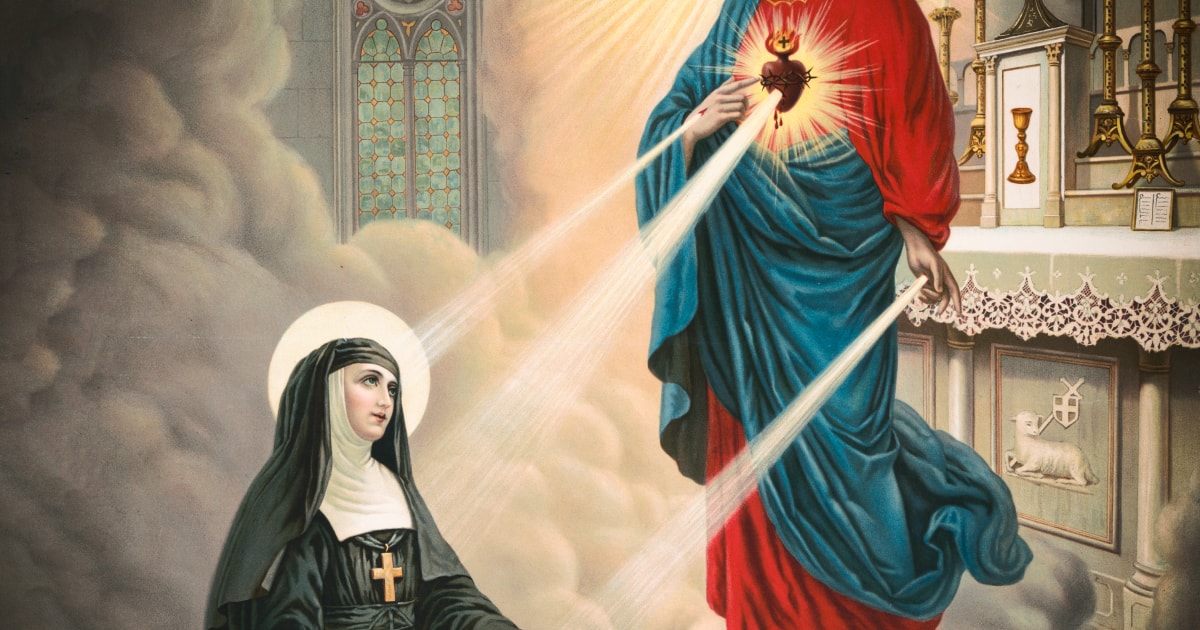


“My Lord, appearing before me, revealed to me His loving Heart: ‘Here is the Master I give you, who will teach you all that you must do for my love. That is why you shall be His beloved disciple.’”
Thus Marguerite-Marie (1647–1690) recounts in her autobiography the words of Christ as He offered her His Divine Heart to be “her refuge and her strength in her weaknesses”. What happiness it is to have such a refuge. Yet nothing in the life of the young Visitandine is simple or self-evident, as she herself adds: “Finding myself overwhelmed with suffering and pain, caused by His holy justice, which reduced me to within two fingers of death […] when He saw me in this extremity, He said to me: ‘Come and take rest, so that you may suffer more courageously.’” The rest in question is beyond price: Marguerite-Marie then feels herself “plunged into this furnace of love, where she thinks of nothing but loving Him”.
How are we to understand a life marked at once by trials and by times of divine communion? Born on 22 July 1647 in Verosvres in the Charolais, Marguerite-Marie chose God from early childhood. At barely five years old, she decided to consecrate herself to Him with these words, without fully understanding their meaning: “O my God, I consecrate my purity to You and I vow to You perpetual chastity.” Christ would later make her understand, through an interior locution, that He Himself had inspired these words in order to keep her pure for the mission He wished to entrust to her.
The family environment, however, was neither conducive to piety nor to the gentleness of a loving home. Claude Alacoque, Marguerite-Marie’s father, a royal notary, died suddenly when she was eight years old, leaving her the only daughter among five children. At the age of ten, she suffered from a mysterious illness that left her unable to walk for four years, until she asked the Virgin Mary to heal her, promising to “become one of her daughters”. But the most “cruel of her crosses”, she would later write, was being unable to ease her mother’s suffering from erysipelas, a disease that consumed her face.
With her brothers absent, Marguerite-Marie found herself alone in begging for what was needed to feed and care for the sick woman. Since her father’s death, the two women had shared the family estate with Marguerite-Marie’s aunt, grandmother and great-aunt on her father’s side, yet these relatives mistreated her. The child, so joyful at having made her First Communion, was prevented from going to Mass or spending time in prayer. Her supports during these youthful trials were the Virgin Mary, the Eucharist and contemplation of the Passion of Christ. Like Saint John, she loved to remain at the foot of the Cross, loving her Lord and finding consolation there. At eighteen, she was confirmed and chose a second name: Mary. The symbolism was strong. Like the beloved apostle, she thus took the Mother of Jesus into her home.
From a young age she aspired to religious life, but once again the path was strewn with thorns. Her brothers did everything they could to divert her from this intention, while her mother hoped for a good marriage. Marguerite-Marie began to seek diversion, while being inwardly torn by the temptation of worldly pleasures. A vision of Christ delivered her from this spiritual struggle: “In the evening, when I was leaving behind those accursed liveries of Satan […] my Sovereign Master appeared to me as He was during His scourging, all disfigured, reproaching me in a terrible way […] that I was betraying and persecuting Him after He had given me so many proofs of His love and of His desire that I should conform myself to Him.”
From that moment on, the young woman felt free to embrace her choice of a consecrated life. Yet after many family obstacles, it required another message from Christ to guide her to the Visitation monastery of Paray-le-Monial, not far from Verosvres: “It is here that I want you,” she heard in her heart. On 20 June 1670, at the age of 24, Marguerite-Marie bade farewell to the world, convinced that she was entering a place where all the Visitandines aspired, as she did, to holiness.
Life in the monastery, however, was far from an antechamber of paradise. It was a succession of struggles, each one overcome through the mystical favours granted to her by Jesus. There was the struggle to obey her superiors when their orders did not always appear to correspond to those of her Lord; the struggle with other sisters who went so far as to treat her harshly, convinced that “the devil was the author of all that was happening in her”; and finally, direct attacks by the demon himself, targeting “her pride, her despair and her gluttony”, as she records in her writings.
After this time of purification came the time of mission as a disciple of the Heart of Jesus. On 27 December 1673, the feast of Saint John the Evangelist, while praying before the tabernacle, Jesus revealed to her the love of His Heart “like a furnace”, plunging the heart of His servant into His own and saying: “My Divine Heart is so passionately in love with men […] that, no longer able to contain within itself the flames of its burning charity, it must spread them through you.”
Six months later, in June 1674, came the second great apparition: “Jesus Christ, my gentle Master, appeared to me all radiant with glory, His five wounds shining like five suns, showing me His pierced Heart, which receives nothing but ingratitude and neglect.” Christ asked for two acts of reparation: Holy Communion on the first Friday of each month, and the Holy Hour on Thursday evening. On that day, Marguerite-Marie was called to console Jesus and to intercede for the souls in purgatory.
Then, in June 1675, she received a new mission. Jesus revealed to her His Heart “which has loved men so much that it has spared nothing, even to exhaustion and self-consumption, in order to show them His love”. Christ asked for the institution of a particular feast to honour His Divine Heart and to make reparation for the outrages He had received in the Holy Eucharist, on the first Friday within the octave of the feast of Corpus Christi, in the month of June. Marguerite-Marie did not see how such a work could be accomplished, but Jesus invited her to turn to the Jesuit Claude La Colombière, whom He had sent to her for the fulfilment of this design.
Marguerite-Marie’s final struggle was an interior one. She, who longed only for a hidden life, was called by Christ to write her autobiography in order, He told her, “to save souls from perdition”. After fulfilling this last mission, on her forty-third birthday, Marguerite-Marie began a forty-day retreat which she described as a preparation for death, so deeply did she feel herself stirred by “a great desire to die”. Three months later, on 16 October 1690, she entered definitively into the Heart of her Lord.
This article is reproduced with the kind permission of France Catholique.