May 28, 2026

The false divide between “pelvic theology” and Catholic social teaching

Noelle Mering
More
Related
Min read
share

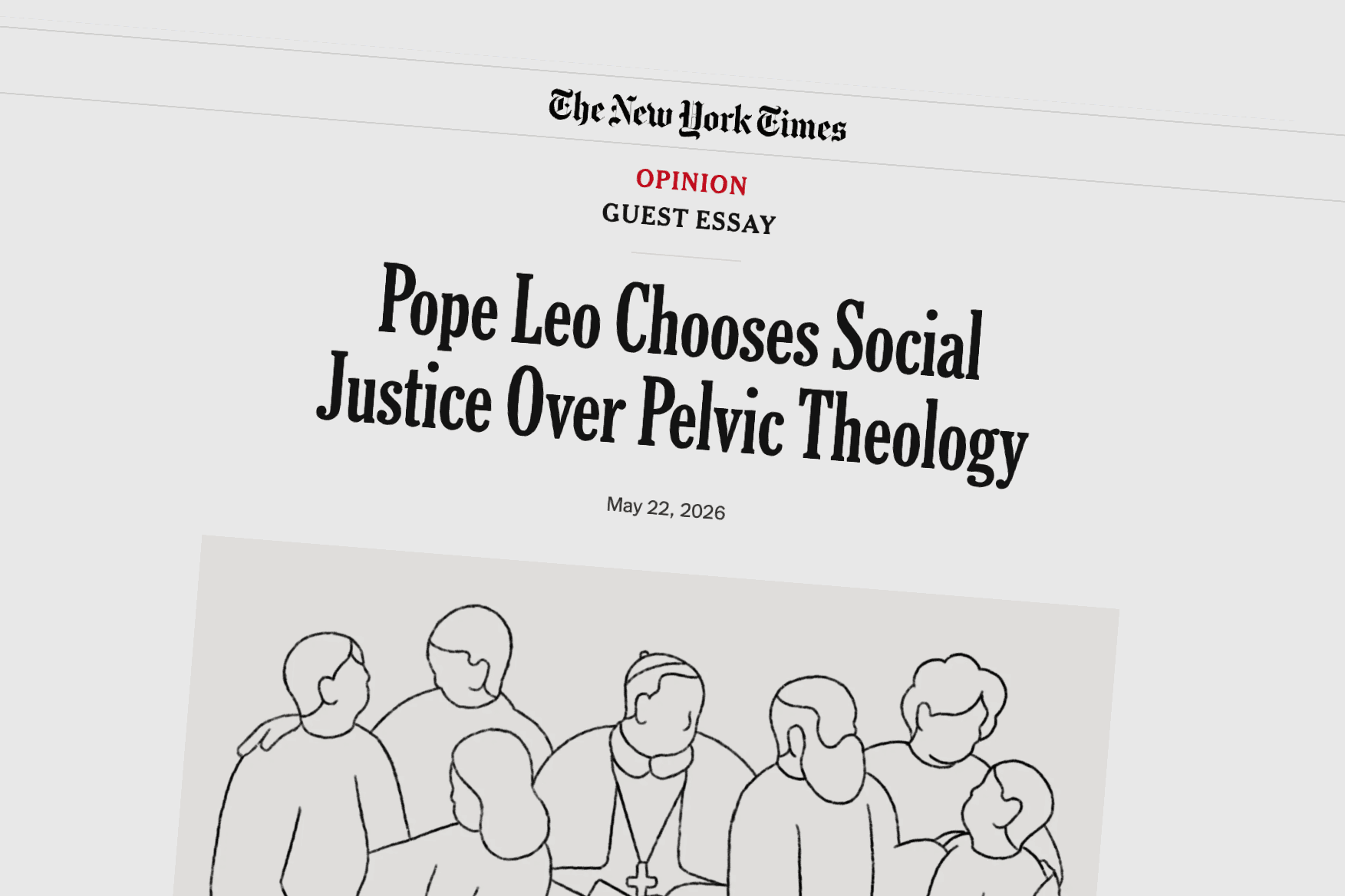
The New York Times recently argued that Pope Leo XIV’s first encyclical on artificial intelligence and social justice could help shift Catholicism away from what the article described as its longstanding fixation on “pelvic theology”, a derisive moniker for the Church’s teachings on sexual morality. According to the piece, decades of emphasis on “sins below the waist” have fuelled culture wars, distracted from the Gospel and weakened the Church’s moral voice on behalf of workers and the marginalised against “the predations of powerful financial interests”.

But this framing rests on a profound misunderstanding of Catholic teaching on sexuality and its relationship to Catholic social doctrine. It assumes that sexual morality belongs to a private realm of personal behaviour while economics and justice belong to the public realm of social concern. The Church has always held that this dichotomy is false. Sex creates obligations. It creates mothers, fathers, children, dependencies, attachments and vulnerabilities. In other words, it creates the fundamental relationships upon which every society depends. Far from distracting from social justice, the Church’s teachings on sexuality are inseparable from it.

Is the exploitation exposed by the MeToo movement merely a “pelvic issue”? What about the heartbreak of a wife discovering her husband’s affair or pornography addiction? Does the epidemic of fatherlessness not reveal the connection between chastity, charity and social stability? And are our epidemics of loneliness, social distrust and fractured communities not deeply connected to the reduction of sex and intimacy to private preference and personal fulfilment?

The Church’s sexual ethic belongs to the same moral tradition that defended workers against exploitation during the Industrial Revolution: both insist that human beings must never be reduced to objects of use, profit or power. The same civilisation that commodified labour eventually commodified the body. Pope Leo XIII recognised in Rerum Novarum that workers could not be treated merely as instruments of production or units of economic utility. That logic of utility that the Church rejects did not stop at the factory floor. It expanded into every corner of human life.

This is why the Church’s so-called “pelvic theology” is integral to Catholic social teaching. Women bear children. Children arrive radically dependent. The unborn possess no economic utility and no political voice. The strong are always tempted to treat such dependence as a burden instead of a claim upon us.

Social cohesion cannot survive the collapse of the family any more than a tree might flourish while its roots rot underground. The family is where we first learn that we are vulnerable and obligated to others. A society that abandons those lessons at home will not discover or recover them in politics, economics or public life.

Indeed, many of the gravest injustices of our age occur precisely where sexuality, technology and power converge. Recently, a Texas man was arrested after secretly placing abortion pills into his pregnant girlfriend’s drink in an attempt to induce an abortion without her knowledge. Such an act does not emerge from nowhere. It is the culmination of a series of smaller moral collapses: intimacy detached from real love and responsibility, fertility treated as a burden to be technologically managed and the child in the womb rendered disposable. At every stage, the Church’s teaching insists upon the irreducible dignity of the human person. Research from my colleagues at the Ethics and Public Policy Center documenting serious complications for women associated with the abortion pill only underscores how easily women and children disappear when questions involving sex are no longer understood as matters of profound social consequence.

Many modern progressives recognise the dangers of commodification in economics while overlooking it almost entirely in the realm of sex and family life. They rightly object when workers become disposable yet celebrate a sexual revolution that has generated enormous profits for industries built upon instability, appetite and alienation. Hookup apps exploit, reduce and deform the desire for intimacy. Pornography industrialises loneliness and detachment. Pharmaceutical companies profit from sex-rejecting procedures born of gender ideology. And Planned Parenthood stands as one of the most powerful institutional beneficiaries of a culture that rejects the Church’s vision of sex, love and obligation while profiting from the brokenness left in its wake.

Pope Leo XIV’s newly released encyclical, Magnifica Humanitas, on artificial intelligence reinforces rather than replaces this moral framework. The encyclical repeatedly warns against reducing the human person to data, utility or technological raw material. In this sense, the AI revolution stands in continuity with the same dehumanising impulses unleashed by both the Industrial and Sexual Revolutions.

This is precisely why an encyclical from Pope Leo XIV on artificial intelligence stands in continuity, not contrast, with the Church’s teachings on sexual morality. The Industrial Revolution risked reducing man to labour. The Sexual Revolution risked reducing him to appetite. The AI revolution risks reducing him to a machine: programmable and ultimately replaceable.

In every age, the Church returns to the same defence: that the human person is not raw material for the ambitions of the powerful, but a creature made in the image of God, possessing an inviolable dignity that no market, state, ideology or technology may erase.

Noelle Mering is a fellow at the Ethics and Public Policy Center and the author of the books Awake, Not Woke, Theology of Home, and a forthcoming book, No Contact, on the politics of estrangement. She is a wife and mother of six in California.

Continue reading with a free account

Create a free account to read up to five articles each month
Create free account

You have # free articles remaining this month.

Subscribe to get unlimited access.
Sign up

subscribe to the catholic herald today

Our best content is exclusively available to our subscribers. Subscribe today and gain instant access to expert analysis, in-depth articles, and thought-provoking insights—anytime, anywhere. Don’t miss out on the conversations that matter most.
Subscribe