May 24, 2026

The fire that remakes

Gavin Ashenden
More
Related
Min read
share

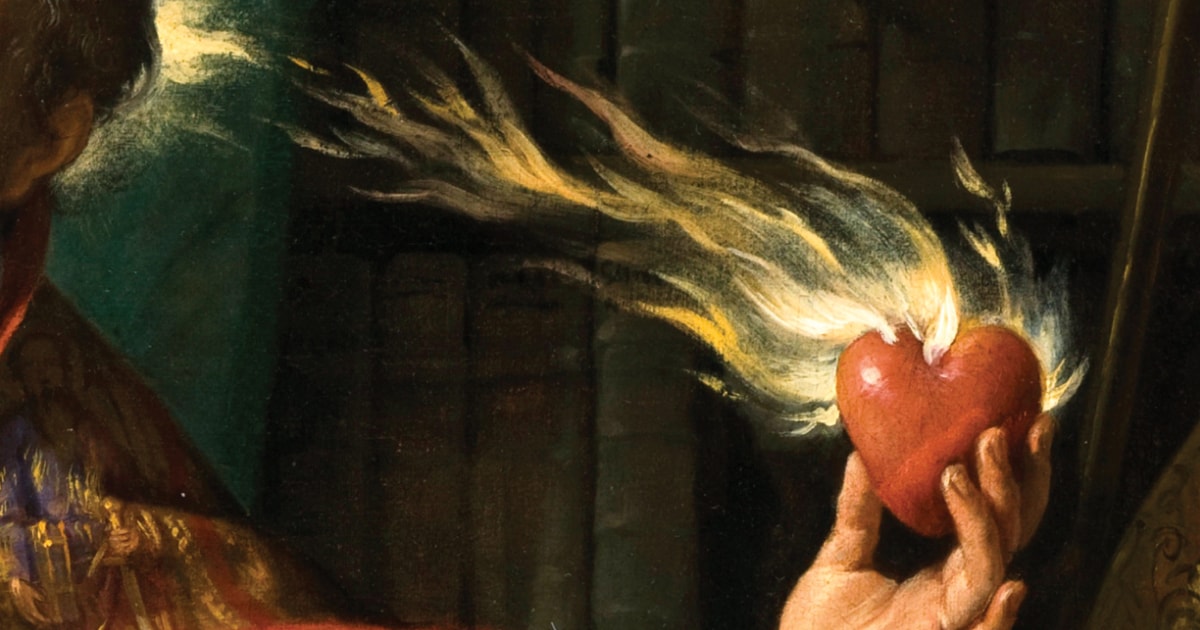
There is a temptation, at Pentecost, to domesticate the Holy Spirit. We speak of Him as Comforter, as Counsellor, as the gentle breath that stirs the soul – and so He is. But the liturgy will not let us rest there for long. He is more dangerous and more dynamic. Wind and fire: these are the signs of His coming. Not a warm draught and a candle flame, which we too often settle for, but the kind of wind that bends trees and the kind of fire that changes the nature of whatever or whoever He touches. The Church has always known, even when she has been reluctant to say so plainly, that the Spirit is, and should be, dangerous. Especially dangerous to our complacency.

Two men, separated by three centuries, knew this with a particular intensity. Together they illuminate something essential about how the Spirit moves in history: not as a permanent condition of institutional life, but as a periodic, disruptive, re-energising presence. He comes most powerfully to those who have been, in one way or another, broken open to receive Him.

Jacopone da Todi, one of my favourite mystics, was not supposed to become what the Spirit made of him. He was a prosperous notary and lawyer in 13th-century Umbria. Seriously successful, socially ambitious, absorbed in the world of contracts and property and civic standing. Then, in 1268, a terrible tragedy took place. As so often, God does His deepest work through tragedy.

His young wife, Vanna, died when a platform collapsed at a feast. To everyone’s great surprise, but especially her husband’s, when they removed her gown, they found beneath it a hair shirt she had been wearing in secret penance. The contrast between the surface of his life and this hidden reality overwhelmed, we might say destroyed, him. He spent the next 10 years as a wandering penitent, half mad with grief and compunction, before entering the Franciscans as a lay brother.

It is out of this wreckage that his Laude – his great cycle of spiritual poems – emerge. What they describe is not the Spirit as consoler but the Spirit as consuming energy, as the force that will not leave a person unchanged.

Amor de caritate, he writes – love of charity – and the word amor in Jacopone carries a charge that barely survives translation into English. It is not affection; it is a fire that “sets hearts ablaze” and “engulfs the soul entire”. The Spirit, in Jacopone’s pneumatology, is the engine of a total transformation that feels, from the inside, more like destruction than renewal.

What gives Jacopone’s vision its particular force is its ecclesial urgency. He was writing in an age of profound institutional crisis: the conflicts between the Spiritual and Conventual Franciscans, the corruption of the papal court under Boniface VIII – for whose deposition Jacopone was imprisoned and excommunicated – and the slow bureaucratisation of religious life. His pneumatology is polemical. Against a Church that has learned to manage and administer grace, he insists that the Spirit should not be managed and cannot be controlled. Against a religion of forms and offices, he bears witness to an experience of divine fire that blows through forms like wind thrusting open doors that should never have been locked. He spent years in a papal dungeon for it.

Three hundred and eighty years later, on the night of November 23, 1654, Blaise Pascal also became undone. He too had an experience he could not explain and could not stop writing about. He wrote for two hours – and what he produced was not philosophy. It was a document of pure encounter. Feu. Fire. The word stands alone at the top of the parchment, capitalised, isolated. What follows is not an intellectual’s argument but a series of broken exclamations: joy, joy, joy, tears of joy – God of Abraham, God of Isaac, God of Jacob, not of the philosophers and scholars.

Pascal had been one of the finest minds in Europe. He had written the Pensées, invented the calculating machine and made fundamental contributions to mathematics and physics. None of it counted that night. What happened to him in those two hours was not the conclusion of an argument; it was the collapse of argument itself before something that could only be called fire. He sewed the parchment into his coat and kept it against his skin until he died. No one knew it existed until his servant found it after his death.

The echo of Jacopone is not accidental. Both men were, before their encounters, in command of their worlds: one through property and social position, the other through intellectual mastery. Both were stripped – Jacopone by grief and humiliation, Pascal by an overwhelming visitation in the night. And in both cases, what the Spirit brought was not a new set of ideas but a new mode of being: a self reconstituted around a fire it had not lit and could not extinguish.

Continue reading with a free account

Create a free account to read up to five articles each month
Create free account

You have # free articles remaining this month.

Subscribe to get unlimited access.
Sign up

subscribe to the catholic herald today

Our best content is exclusively available to our subscribers. Subscribe today and gain instant access to expert analysis, in-depth articles, and thought-provoking insights—anytime, anywhere. Don’t miss out on the conversations that matter most.
Subscribe