

Traditionalists, despite their zeal and growth, remain a remarkably small fraction of the 1.4 billion Catholics worldwide. Yet this strange faction within the Church casts an outsized shadow. This surprisingly disproportionate influence is nowhere better demonstrated than in US politics.
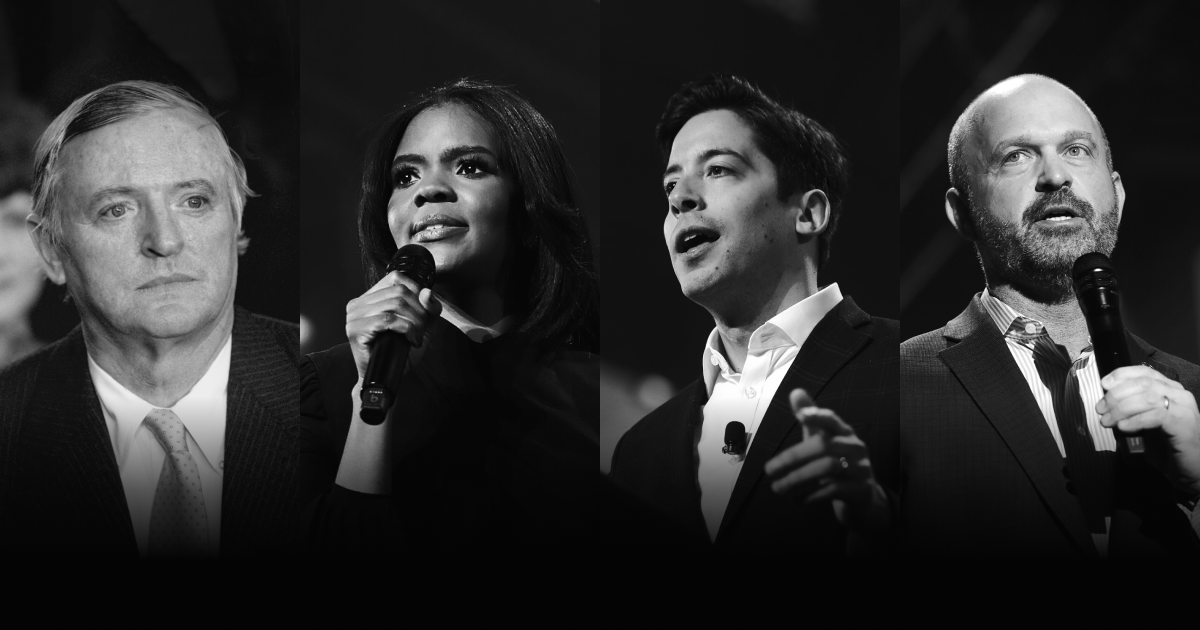
From the likes of William F Buckley to Michael Knowles, from Russell Kirk to Pat Buchanan and Candace Owens, these may not be conservative America’s most recognised names (losing out to the globally iconic figureheads of Donald Trump and Ronald Reagan) but they’re certainly up there.
And make no mistake, the intellectual movements and factions these individuals founded, pioneered or represent have become the driving forces that have been carrying the ideational platforms of presidential elections and administrations for decades.
Despite starkly different personas, each share in common exceedingly rare attributes: traditionalist Catholic Faith and sympathy for (or devotion to) the old Latin Mass.
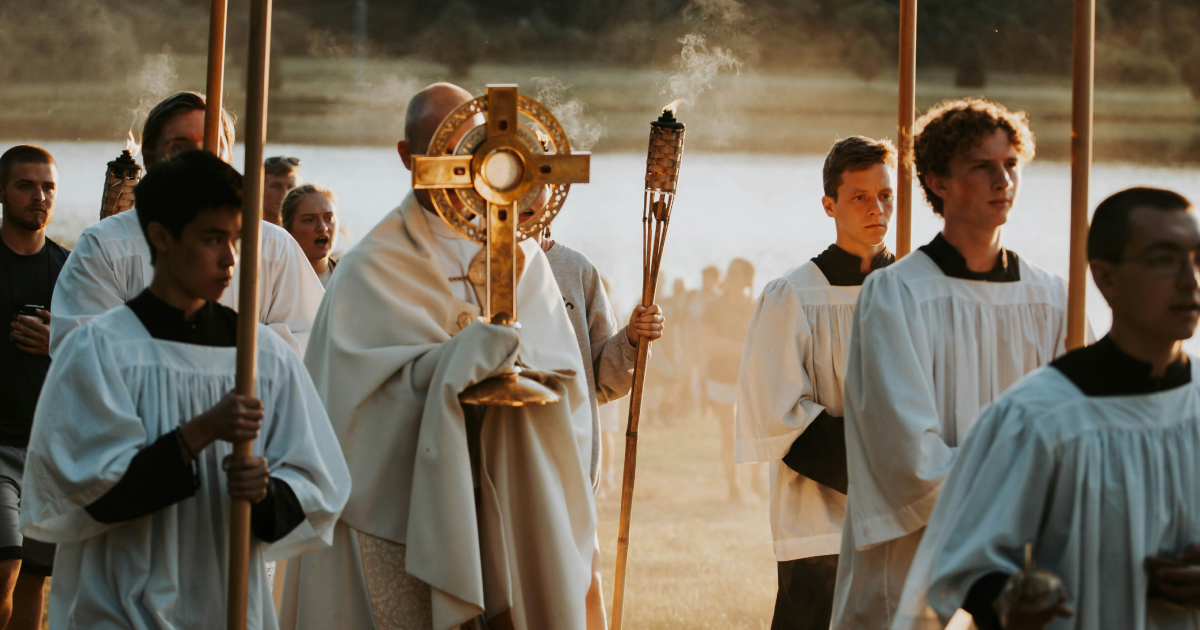
Statistics today suggest that only around 1-2 per cent of Masses celebrated globally are according to this mystical, ancient, prayerful rite (which once served 98 per cent of the Catholic world). So the fact there exists a curious thread running from the suppressed Mass of St Pius V all the way to people formerly or presently prominent in US politics might first appear to only warrant a raised eyebrow from observers for the sheer fact of its statistical rareness.
But, there is another, more pressingly topical, reason why we should turn our attention to this often unspoken connection: the recent outbreak of civil war on the Right of US politics.
The foremost conservative think tank in Washington DC – The Heritage Foundation – has recently been embroiled in controversy as a result of this very conflict. Its president, Kevin Roberts, sparked outrage last month by publicly defending Tucker Carlson’s decision to interview Nick Fuentes – the foul-mouthed far-right firebrand whose radically anti-Zionist views have long been anathema to mainstream conservatism – against what he called a “venomous coalition” of critics.
Though Roberts – an observant Opus Dei Catholic who has himself made sympathetic overtures on behalf of the Traditional Latin Mass – quickly apologised, claiming ignorance of Fuentes and blaming a now-resigned aide for the script, the backlash included resignations from his “antisemitism task force” as well as a board member resigning, exposing the deepening rift between the old-guard establishment and the surging “America First” insurgents.
What began as a defence of a “close friend” [Carlson] swiftly revealed the deeper fault line now splitting the American Right in two – and, once again, we must observe how the traditionalist Catholic current runs prominently straight through both sides of the divide.
Related to this, is how the American Left-Right divide we know today is, in truth, a comparatively recent invention: the conservative South was Democratic well into the 20th century. By the 1950s, however, a distinct intellectual Right had begun to crystallise – and its first great prophet was Russell Kirk, a convert to Catholicism who attended the Latin Mass daily when he could.
From his rambling Gothic house in rural Michigan, Kirk wrote The Conservative Mind (1953), a book that almost single-handedly gave American conservatism a traditionalist, old-world flavour and a respectable genealogy stretching back to Burke, Aquinas and Aristotle.
At the height of his influence he advised presidents, shaped the 1964 presidential campaign of Republican candidate Barry Goldwater – and warned ceaselessly against the “behemoth state” and the deracinating acids of modernity.
Iconically archaic, Kirk would be found dressed in his three-piece tweed suit, sitting at the desk of his nostalgically-built home “Piety Hill” where he frequently hosted the homeless – a living rebuke to the suburban industrial optimism of Eisenhower’s America.
William F Buckley Jr – no convert, rather an Irish-German American who was educated in English Catholic independent schools – took a different path. From the Manhattan office that doubled as the headquarters of National Review (the influential magazine he founded which would be regularly read by sitting presidents), he forged what became known as “fusionism”: a grand alliance of traditionalists, libertarians and anti-communist ex-Trotskyists prepared to fight the Cold War by almost any means.
Buckley’s fusionism would come to dominate the thinking of the Thatcher and Reagan administrations. He continued attending the Latin Mass throughout his life, even arranging for a private Tridentine rite said weekly in a chapel near his Stamford home by a sympathetic priest.
Both Kirk and Buckley grieved the liturgical upheaval. Kirk lamented the replacement of Latin by “awkward English” and the “tampering with the traditional liturgy”, warning that such changes inflicted “strife and change” upon the Church. He was a founding member of Una Voce America, a branch of the lay traditional Catholic advocacy organisation now led by English academic Joseph Shaw, who is also chair of the Latin Mass Society.
Buckley, more diplomatically, simply continued to attend the Tridentine Mass privately, though he hosted traditionalist critics on Firing Line – his prime-time high-brow TV discussion show – and published anguished symposia in National Review on the “loss of the sacred”.
Yet the political conclusions of these two men diverged sharply. Kirk’s was a parochial, sacramental conservatism of little platoons and permanent things. Buckley’s – shaped by his years in the CIA and his friendships with the neoconservative ex-leftists – became a compromise and consensus model. He criticised multiculturalism as a “religion”, but the alliances he forged and ideas he put forth nevertheless built an inclusive, fighting faith meant to steer the American empire, global finance and perpetual war against the Evil One abroad.
Kirk’s lineage runs forward to Pat Buchanan. He was another daily Mass-goer and defiant devotee of the old rite whose 1992 presidential campaign voiced themes more conservative-minded – trade protection, immigration restriction, hostility to forever wars and “Zionist” funding) – than the Buckleyite era; a baton which would eventually be taken over by the “America First” movement.
Buchanan’s traditionalism was unapologetic: he defended the Latin Mass in print, and warned that a conservatism that forgot Christendom would perish. Though he was viciously attacked – in a pre-Internet age, he was effectively frozen out of the mainstream – his movement can be considered a prefiguration of the Carlson-Fuentes axis today.
Buckley’s heirs, by contrast, are the colour-blind, market-worshipping, fiercely Zionist conservatives of so-called “Conservative Inc.” (the label an accusation of its leaders’ compromised, establishment connections).
This faction – the opposite side of the conflict to Fuentes, Owens and Carlson’s loosely and tenuously united “America First” coalition – is broadly unconcerned about demographic change and presents itself as unwaveringly committed to particularly secular and liberal interpretations of America’s founding philosophy and principles.
Its leaders are behind the National Review of today: the Daily Wire (led by Ben Shapiro) and constitute much of The Heritage Foundation’s leadership class.
For decades the Buckley dispensation reigned supreme: Kirk, Buchanan and their successors were excommunicated as “paleocons” or worse. Yet the wind has shifted with startling speed. Nick Fuentes’s America First Political Action Conference drew thousands in 2024; his nightly livestream routinely exceeds 100,000 concurrent viewers – numbers that dwarf the legacy conservative outlets on the same platforms. On Instagram his offensive and brazen tirades are a sensation with youth tired of overcorrect speech.
Meanwhile, Tucker Carlson – who while not Catholic is a Christian – commands the largest audience of any political commentator in America and advances many of the arguments made by America First Christian nationalists like Fuentes.
Candace Owens – baptised and confirmed in 2024, and a regular at the Latin Mass – has seen her YouTube channel surge past 5.5 million subscribers while she denounces “Frankism” and the “pornographic” nature of liberal modernity.
Even those who try to straddle the divide feel the gravitational pull. Michael Knowles – another traditional Latin Mass Catholic who has appeared in the Mass of the Ages films advocating its place in the Church – is one of the most influential political commentators in America. He can boast 2.5 million subscribers on YouTube and over 1.26 billion cumulative views there.
Working for Shapiro’s Daily Wire, Knowles is conspicuously mute on the debates that serve today as the primary proxy conflict territory between the two American conservative factions: Zionism and interventionism. But he quite radically quotes Aquinas and Louis IX on the state’s duty to suppress public blasphemy and has called for pornography to be banned outright (a heinous affront to civil liberties for Buckley-era liberal conservatives). He is, in effect, the highest-profile post-liberal voice inside the old citadel.
So there you have it, the American Right has been shaped – divided, energised and very nearly conquered – by a thin scarlet thread of traditionalist Catholicism. The Mass attended by scarcely one per cent of the Church’s children has, again and again, supplied the intellectual energy for conservatism’s most consequential rebellions and counter-rebellions.
As a result, one thing is quite clear: the kingmakers still wear mantillas – or, at the very least, remember what a mantilla is for.


.jpg)