December 3, 2025
December 3, 2025

Why are Gen Z returning to the Church?

Min read
share

Since 2023, the international press has been paying ever closer attention to the surprising resurgence of Christian faith, alongside its recovered relevance in public discourse. High-profile conversions from figures like Shia LeBeouf, Ayaan Hirsi Ali and Russell Brand followed by findings that — in certain regions and for specific “denominations” — church attendance picking up has led to stunned reaction from the commentariat press.

In Britain, for example, Pentecostalism and Catholicism have been found to have reversed decades of decline and grown remarkably from 2018 to 2025 – drawing intrigue from the likes of the Guardian and Reuters. In France, since 2020, the bishops’ conference (typically assiduous in collecting and releasing data) have confirmed consistently remarkable and accelerating year-on-year increases in the number of adult converts they are drawing in and baptising – many from irreligion and Islam. And even last month, adding to a compounding list of evidence, in the United States it was reported by FOX News and the New York Post that Manhattan’s Catholic churches were witnessing a surge in Mass attendance.
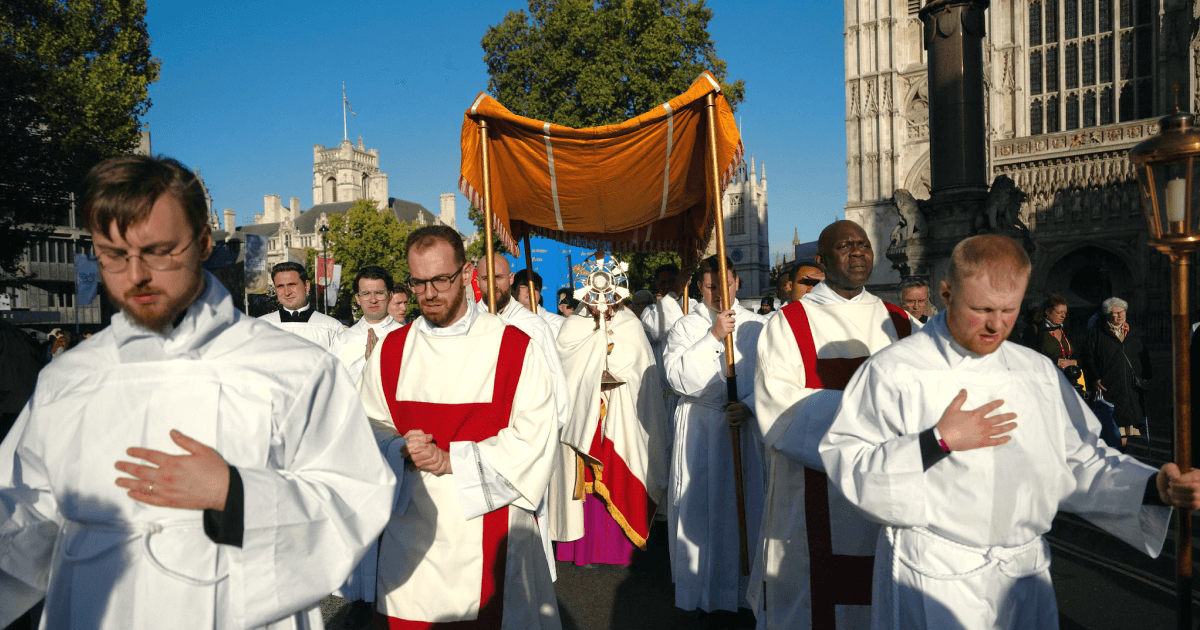
I am somewhat qualified to chime in and provide perspective here – not only because as a Catholic journalist I’ve been closely following and reporting on these trends for a few years now – but because, as a believer, I’ve been part of them.

When I started attending Mass as a curious university student in 2019, I did so on the light encouragement of a Christian friend named Chris. I was looking for, and arriving at belief in, God but at that stage I hadn’t yet decided between my childhood Anglicanism, Catholicism, the aesthetically traditional charms of Orthodoxy – or even Islam. Within two years, however, I was a robustly convinced Catholic attending the Traditional Latin Mass.

But, more curiously, I have witnessed these trends on the ground around me for some time. When I began my conversion in 2019, Chris was the only seriously observant Christian I knew. Two years later, the year of my reception as a Catholic, I had many new friends, a substantial proportion of whom were young converts like myself. Even so, within our five-person friendship group, in 2021 Chris and I were still the only two practising believers. Today, in 2025, the other three, who had been irreligious, have found belief, and all five of us are Christians.

It is easy to see why talk of revival has gathered pace. But that is not the full picture. Something important keeps getting buried in the noise: this is not a universal Christian revival. It is a highly selective one. Some parts of the Christian world are flourishing, others are still shrinking.

The “Quiet Revival” report, published by the Bible Society – in tandem with reputable pollster and researcher YouGov – in April 2025 which (correlating with news of conversions at this year’s Easter Vigil) produced one of the biggest media splashes yet seen in discourse surrounding Christian revival – and itself revealed many of the points I think important to emphasise.

Although a few parishes are the exception, the Church of England’s trajectory – both in proportion of the nation’s Christians and in raw numbers – has continued downwards. This year’s findings remarkably showed there is now double the amount of Catholic Christians than Anglican ones among 18–25 year olds in the UK – and just as many Charismatic, Evangelical , Pentecostal, non-denominational types (when grouped together) as those of the state-religion.

If certain groups are leading the charge of the revival and bringing in new converts, it isn’t the Anglican Church (for all its institutional prominence and privileges here in Britain). The United States, the Netherlands and Switzerland are witnessing similar trends – the mainline Protestant churches are staring down the abyss, having continually waned for generations at a far faster rate than their Catholic counterparts.

If the likes of Catholicism and Pentecostalism are witnessing growth and displaying signs of life, we might ask: why? What accounts for the difference? If the revival were merely the result of cultural shifts in attitudes, we might expect it to affect all churches equally. But it does not.

Professor Steven Bullivant, whose research from St Mary’s, Twickenham, focuses on Christian demographics, has contrasted “dead strains of Christianity”, where decline continues, with “live ones”, where it is “once again possible to encounter the gospel as something new and exciting.” I believe the contrast captures much of what is unfolding.

GK Chesterton in The Everlasting Man once argued: “A dead thing can go with the stream, but only a living thing can go against it”. We all sense this. Those who go unresistantly with the flow in every scenario, who are most uncritically impressionably influenced by outside forces, who never make a stand or demonstrate initiative and independent thought, show the least vitality – and are the type of people least appropriate to be held up as good leaders.

And this analogy – of the dead strain of Christianity, like driftwood in the river – matches closely the spirituality of the Christian institutions that have somehow shielded themselves from benefiting from the revival. As the culture changed, so too did their principles. In 2015, the Episcopal Church in the US contravened clear Scriptural instruction and centuries of teaching to embrace same-sex marriage. On difficult issues like sexuality, abortion and life virtually all of the historical Protestant institutions have followed suit.

While the flotsam offers only more of the same cultural attitudes the young are aggressively inaugurated into by default, they negate their roles as teachers. Young people who already have Netflix, TikTok and the Guardian for moral relativism are not desperately seeking a fourth source. By contrast, the fact the conservative Christian bodies have insistently refused to be carried by the winds of change at least invites intrigue: maybe here is not a lump of dead wood. Could there be deep roots underneath, sourcing the tree with life and supernatural grace or power?

Still, this doesn’t explain all. For Catholicism and Pentecostalism, their language and style couldn’t be more different from one another. And however much doctrinal compromise may undermine credibility – most converts don’t find faith over the finer points of dogma. (If indignant commitment to a position or ideal was enough to be persuasive, the flat-earthers should have inherited the earth by now.)

There can be a trend in these kinds of analyses to attempt to explain in human terms what may not, in fact, have a human origin. So, acknowledging that the Holy Ghost may be working alongside or through what I am about to describe, I believe the following helps us understand what is going on.

For the charismatic Protestants, their greatest strength is their zeal and insistence on a “personal relationship with Jesus”. Unlike the sleepier, liberal mainline Protestant world that – in its eagerness to embrace and tolerate all – is often unwilling to assert Christ as more important than Muhammad or to teach that refraining from sin, asking for forgiveness, or rendering honour and love to God is anything but optional, these charismatic movements instead treat prayer, spiritual reading and intimacy as foundational.

For prospective Christians seeking something substantial, and a new introduction into their life with power and wisdom and insight, it is obvious how this might excite and inflame passions. It does so by rResonating more powerfully than the passionless ritual of folk who likely long ago lost the convictions of the Christian Faith but simply never shirked the habit of attending church (and want something agreeable while they do) – as the sinking mainline traditions often feel like.

Ironically, although Catholics would disagree with the charismatics’ repudiation of “vain ritual” – their devotion to Scripture and vibrant involvement in the spiritual life is something the Doctors of the Church and saints and mystics would highly approve.

If Charismatic zeal can account for their growth (combined with emotionally-charged worship songs and concerts) then doctrinal, historical, theological certainty and the supernatural sacramental enchantment of the Catholic world can explain theirs.

In an era of profound existential angst in matters social and metaphysical, it cannot be underestimated how much the Catholic Church benefits from having clear, intelligent answers and convictions to the questions of the day.

If young people, feeling adrift in a chaotic and disordered world, are looking for clarity and solidity – then in Catholicism they can find it. What is marriage? Between a man and a woman for the procreation of children. What is sin? Here is a clear list and their conditions; we can also absolve you of them if you repentantly cooperate willingly. What is virtue? Here, we have thousands of years of wisdom about this, helpfully condensed. Why should I be a Catholic or listen to what you say? Because Jesus Christ is God, he appointed St Peter to be the foundation and leader of the Church who died on Vatican Hill in Rome – having set in motion the papacy which holds the divine authority and power to teach on behalf of the Faith.

One may disagree with those answers, but it cannot be denied they are robust, clear and cannot be dismissed easily. In a world which often seems unable to offer the young clear answers regarding what a woman is, such confidence stands out.

Then, the Catholic and Orthodox world share a strong sense of enchantment and liturgy – of angels and demons and holy water – in a world increasingly agonised by the cold mechanism of materialist thinking. Ever more holed up in boxy apartments, fed with ultra-processed foods, commuting in dreary cities which often feel more like storage containers than settlements, people who seek for the God who lingers behind the veil are not looking for more materialism – which pretends only the body has needs and things like beauty, hierarchy, mystery, love, truth, adventure are not necessary to the human condition. The ancient rites and sounds and images of the apostolic Christian world feeds deracinated moderns something the contemporarymodern world starves them of.

As if to confirm my analysis here, it must be acknowledged that the revival is not happening evenly even within these Christian strains themselves.

In the United Kingdom, signs of vitality – alongside droves of young professionals and converts – can be found in the Oratories of London, York, Birmingham, Oxford, Bournemouth, Cardiff, Manchester and Edinburgh (all known for elaborate and reverent liturgy). The United Kingdom’s eight Oratorian Houses have more priests in training than any diocese across the country. Similarly, the traditionalist Gregorian-chant-devoted Benedictines of Mary, Queen of the Apostles have tripled in size in only a few years.

Meanwhile, the United Reformed Church, not known for its clear morality or emphasis on beautiful liturgy, has seen a 20 per cent reduction in 20 years and 50 per cent reduction in its congregation.

There is a re-emergence of grace, both conceptually and actually, against the overemphasis of nature. The churches which are tanking have reduced the Faith to a merely human thing, where moral example and tolerance and comforting but largely hollow sentiments are emphasised, as if the natural world around us is the only place our concerns and focus should lie. Meanwhile the places that are inflamed are rediscovering that far more powerful and enticing and primary is the invisible God who animates all things.

When I converted in 2021 the traditional Catholic world was still a well-kept secret; there were murmurs about its strength but nothing had yet gained the attention of national and international press. I discovered a robust infrastructure – books, podcasts, university lectures, rosary meetings, pub trips, pilgrimages, movie nights – and an entire network led by competent, wise people with convincing answers and illuminating truths, coherently conveyed in a movement picking up momentum.

Although crude statistics tell us traditionalists make up a fraction of Mass-attendees around the world, they have an outsized involvement in the production of Catholic apologetics, materials, vocations, podcasts, art and culture. The (largely traditional) Catholic world, with the help of the airwaves, set up a counter-culture with celebrities and entertainment and community. I could see very quickly that here was a force to be reckoned with, which armed with grace and eternal truths, could sweep all before it (if only allowed to).

Which is why, I contend, the real epicentre of the revival is in the traditional corner of the Catholic Church. It is traditional and traditional-friendly Catholics, with their liturgy, certainty, conviction, and enthusiasm, who have shifted the culture. Dynamic Christian podcasts such as those of Matt Fradd, Taylor Marshall and Timothy Flanders, the political philosophy of thinkers like Patrick Deneen, the witness of public figures such as Harrison Butker, and Catholic arguments in contemporary social and political discourse against pornography, abortion, adultery, and the quasi-prostitution of OnlyFans, have set the tone.

Perhaps it is not a coincidence that the charismatic and non-denominational Protestants, despite their sacramental poverty, invariably dominate the population of pro-life organisations alongside Catholics. Their podcasters (see John Mark Comer) more and more quote the likes of Aquinas and the Catechism ; their worship, however raucous, honours the same crucified God as ours, recognised as one who makes demands.

With the revival being a mostly traditional Catholic-led phenomenon, it makes sense that those who are closest to us in principles and practice benefit most. The ones who manage to piggyback off our momentum and success do so by emulating our conservative zeal or mysticism. For those who do neither, remaining doctrinally malleable or supernaturally deaf (or, worst, both), signs of life are very rare indeed.

Since 2023, the international press has been paying ever closer attention to the surprising resurgence of Christian faith, alongside its recovered relevance in public discourse. High-profile conversions from figures like Shia LeBeouf, Ayaan Hirsi Ali and Russell Brand followed by findings that — in certain regions and for specific “denominations” — church attendance picking up has led to stunned reaction from the commentariat press.

In Britain, for example, Pentecostalism and Catholicism have been found to have reversed decades of decline and grown remarkably from 2018 to 2025 – drawing intrigue from the likes of the Guardian and Reuters. In France, since 2020, the bishops’ conference (typically assiduous in collecting and releasing data) have confirmed consistently remarkable and accelerating year-on-year increases in the number of adult converts they are drawing in and baptising – many from irreligion and Islam. And even last month, adding to a compounding list of evidence, in the United States it was reported by FOX News and the New York Post that Manhattan’s Catholic churches were witnessing a surge in Mass attendance.
I am somewhat qualified to chime in and provide perspective here – not only because as a Catholic journalist I’ve been closely following and reporting on these trends for a few years now – but because, as a believer, I’ve been part of them.

When I started attending Mass as a curious university student in 2019, I did so on the light encouragement of a Christian friend named Chris. I was looking for, and arriving at belief in, God but at that stage I hadn’t yet decided between my childhood Anglicanism, Catholicism, the aesthetically traditional charms of Orthodoxy – or even Islam. Within two years, however, I was a robustly convinced Catholic attending the Traditional Latin Mass.

But, more curiously, I have witnessed these trends on the ground around me for some time. When I began my conversion in 2019, Chris was the only seriously observant Christian I knew. Two years later, the year of my reception as a Catholic, I had many new friends, a substantial proportion of whom were young converts like myself. Even so, within our five-person friendship group, in 2021 Chris and I were still the only two practising believers. Today, in 2025, the other three, who had been irreligious, have found belief, and all five of us are Christians.

It is easy to see why talk of revival has gathered pace. But that is not the full picture. Something important keeps getting buried in the noise: this is not a universal Christian revival. It is a highly selective one. Some parts of the Christian world are flourishing, others are still shrinking.

The “Quiet Revival” report, published by the Bible Society – in tandem with reputable pollster and researcher YouGov – in April 2025 which (correlating with news of conversions at this year’s Easter Vigil) produced one of the biggest media splashes yet seen in discourse surrounding Christian revival – and itself revealed many of the points I think important to emphasise.

Although a few parishes are the exception, the Church of England’s trajectory – both in proportion of the nation’s Christians and in raw numbers – has continued downwards. This year’s findings remarkably showed there is now double the amount of Catholic Christians than Anglican ones among 18–25 year olds in the UK – and just as many Charismatic, Evangelical , Pentecostal, non-denominational types (when grouped together) as those of the state-religion.

If certain groups are leading the charge of the revival and bringing in new converts, it isn’t the Anglican Church (for all its institutional prominence and privileges here in Britain). The United States, the Netherlands and Switzerland are witnessing similar trends – the mainline Protestant churches are staring down the abyss, having continually waned for generations at a far faster rate than their Catholic counterparts.

If the likes of Catholicism and Pentecostalism are witnessing growth and displaying signs of life, we might ask: why? What accounts for the difference? If the revival were merely the result of cultural shifts in attitudes, we might expect it to affect all churches equally. But it does not.

Professor Steven Bullivant, whose research from St Mary’s, Twickenham, focuses on Christian demographics, has contrasted “dead strains of Christianity”, where decline continues, with “live ones”, where it is “once again possible to encounter the gospel as something new and exciting.” I believe the contrast captures much of what is unfolding.

GK Chesterton in The Everlasting Man once argued: “A dead thing can go with the stream, but only a living thing can go against it”. We all sense this. Those who go unresistantly with the flow in every scenario, who are most uncritically impressionably influenced by outside forces, who never make a stand or demonstrate initiative and independent thought, show the least vitality – and are the type of people least appropriate to be held up as good leaders.

And this analogy – of the dead strain of Christianity, like driftwood in the river – matches closely the spirituality of the Christian institutions that have somehow shielded themselves from benefiting from the revival. As the culture changed, so too did their principles. In 2015, the Episcopal Church in the US contravened clear Scriptural instruction and centuries of teaching to embrace same-sex marriage. On difficult issues like sexuality, abortion and life virtually all of the historical Protestant institutions have followed suit.

While the flotsam offers only more of the same cultural attitudes the young are aggressively inaugurated into by default, they negate their roles as teachers. Young people who already have Netflix, TikTok and the Guardian for moral relativism are not desperately seeking a fourth source. By contrast, the fact the conservative Christian bodies have insistently refused to be carried by the winds of change at least invites intrigue: maybe here is not a lump of dead wood. Could there be deep roots underneath, sourcing the tree with life and supernatural grace or power?

Still, this doesn’t explain all. For Catholicism and Pentecostalism, their language and style couldn’t be more different from one another. And however much doctrinal compromise may undermine credibility – most converts don’t find faith over the finer points of dogma. (If indignant commitment to a position or ideal was enough to be persuasive, the flat-earthers should have inherited the earth by now.)

There can be a trend in these kinds of analyses to attempt to explain in human terms what may not, in fact, have a human origin. So, acknowledging that the Holy Ghost may be working alongside or through what I am about to describe, I believe the following helps us understand what is going on.

For the charismatic Protestants, their greatest strength is their zeal and insistence on a “personal relationship with Jesus”. Unlike the sleepier, liberal mainline Protestant world that – in its eagerness to embrace and tolerate all – is often unwilling to assert Christ as more important than Muhammad or to teach that refraining from sin, asking for forgiveness, or rendering honour and love to God is anything but optional, these charismatic movements instead treat prayer, spiritual reading and intimacy as foundational.

For prospective Christians seeking something substantial, and a new introduction into their life with power and wisdom and insight, it is obvious how this might excite and inflame passions. It does so by rResonating more powerfully than the passionless ritual of folk who likely long ago lost the convictions of the Christian Faith but simply never shirked the habit of attending church (and want something agreeable while they do) – as the sinking mainline traditions often feel like.

Ironically, although Catholics would disagree with the charismatics’ repudiation of “vain ritual” – their devotion to Scripture and vibrant involvement in the spiritual life is something the Doctors of the Church and saints and mystics would highly approve.

If Charismatic zeal can account for their growth (combined with emotionally-charged worship songs and concerts) then doctrinal, historical, theological certainty and the supernatural sacramental enchantment of the Catholic world can explain theirs.

In an era of profound existential angst in matters social and metaphysical, it cannot be underestimated how much the Catholic Church benefits from having clear, intelligent answers and convictions to the questions of the day.

If young people, feeling adrift in a chaotic and disordered world, are looking for clarity and solidity – then in Catholicism they can find it. What is marriage? Between a man and a woman for the procreation of children. What is sin? Here is a clear list and their conditions; we can also absolve you of them if you repentantly cooperate willingly. What is virtue? Here, we have thousands of years of wisdom about this, helpfully condensed. Why should I be a Catholic or listen to what you say? Because Jesus Christ is God, he appointed St Peter to be the foundation and leader of the Church who died on Vatican Hill in Rome – having set in motion the papacy which holds the divine authority and power to teach on behalf of the Faith.

One may disagree with those answers, but it cannot be denied they are robust, clear and cannot be dismissed easily. In a world which often seems unable to offer the young clear answers regarding what a woman is, such confidence stands out.

Then, the Catholic and Orthodox world share a strong sense of enchantment and liturgy – of angels and demons and holy water – in a world increasingly agonised by the cold mechanism of materialist thinking. Ever more holed up in boxy apartments, fed with ultra-processed foods, commuting in dreary cities which often feel more like storage containers than settlements, people who seek for the God who lingers behind the veil are not looking for more materialism – which pretends only the body has needs and things like beauty, hierarchy, mystery, love, truth, adventure are not necessary to the human condition. The ancient rites and sounds and images of the apostolic Christian world feeds deracinated moderns something the contemporarymodern world starves them of.

As if to confirm my analysis here, it must be acknowledged that the revival is not happening evenly even within these Christian strains themselves.

In the United Kingdom, signs of vitality – alongside droves of young professionals and converts – can be found in the Oratories of London, York, Birmingham, Oxford, Bournemouth, Cardiff, Manchester and Edinburgh (all known for elaborate and reverent liturgy). The United Kingdom’s eight Oratorian Houses have more priests in training than any diocese across the country. Similarly, the traditionalist Gregorian-chant-devoted Benedictines of Mary, Queen of the Apostles have tripled in size in only a few years.

Meanwhile, the United Reformed Church, not known for its clear morality or emphasis on beautiful liturgy, has seen a 20 per cent reduction in 20 years and 50 per cent reduction in its congregation.

There is a re-emergence of grace, both conceptually and actually, against the overemphasis of nature. The churches which are tanking have reduced the Faith to a merely human thing, where moral example and tolerance and comforting but largely hollow sentiments are emphasised, as if the natural world around us is the only place our concerns and focus should lie. Meanwhile the places that are inflamed are rediscovering that far more powerful and enticing and primary is the invisible God who animates all things.

When I converted in 2021 the traditional Catholic world was still a well-kept secret; there were murmurs about its strength but nothing had yet gained the attention of national and international press. I discovered a robust infrastructure – books, podcasts, university lectures, rosary meetings, pub trips, pilgrimages, movie nights – and an entire network led by competent, wise people with convincing answers and illuminating truths, coherently conveyed in a movement picking up momentum.

Although crude statistics tell us traditionalists make up a fraction of Mass-attendees around the world, they have an outsized involvement in the production of Catholic apologetics, materials, vocations, podcasts, art and culture. The (largely traditional) Catholic world, with the help of the airwaves, set up a counter-culture with celebrities and entertainment and community. I could see very quickly that here was a force to be reckoned with, which armed with grace and eternal truths, could sweep all before it (if only allowed to).

Which is why, I contend, the real epicentre of the revival is in the traditional corner of the Catholic Church. It is traditional and traditional-friendly Catholics, with their liturgy, certainty, conviction, and enthusiasm, who have shifted the culture. Dynamic Christian podcasts such as those of Matt Fradd, Taylor Marshall and Timothy Flanders, the political philosophy of thinkers like Patrick Deneen, the witness of public figures such as Harrison Butker, and Catholic arguments in contemporary social and political discourse against pornography, abortion, adultery, and the quasi-prostitution of OnlyFans, have set the tone.

Perhaps it is not a coincidence that the charismatic and non-denominational Protestants, despite their sacramental poverty, invariably dominate the population of pro-life organisations alongside Catholics. Their podcasters (see John Mark Comer) more and more quote the likes of Aquinas and the Catechism ; their worship, however raucous, honours the same crucified God as ours, recognised as one who makes demands.

With the revival being a mostly traditional Catholic-led phenomenon, it makes sense that those who are closest to us in principles and practice benefit most. The ones who manage to piggyback off our momentum and success do so by emulating our conservative zeal or mysticism. For those who do neither, remaining doctrinally malleable or supernaturally deaf (or, worst, both), signs of life are very rare indeed.

share

subscribe to the catholic herald today

Our best content is exclusively available to our subscribers. Subscribe today and gain instant access to expert analysis, in-depth articles, and thought-provoking insights—anytime, anywhere. Don’t miss out on the conversations that matter most.
Subscribe