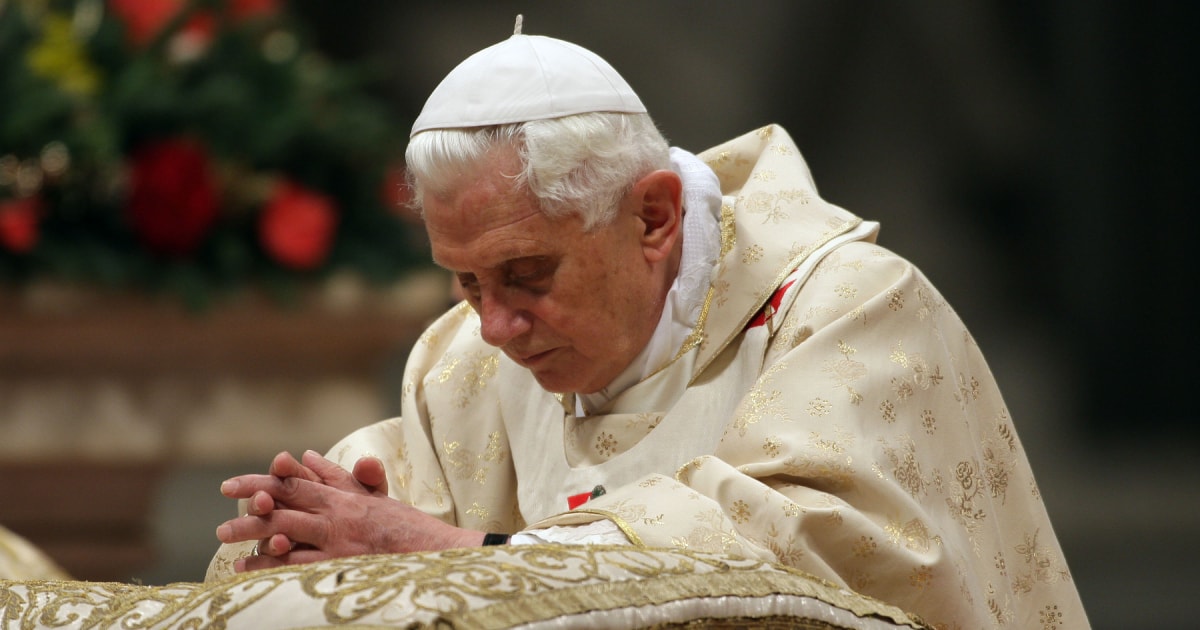
An unpublished letter by Pope Benedict XVI, written little more than a year before his death, has been released in a new Italian book, offering an insight into the late pontiff’s theology and view of the future of the Faith at the end of his life.
The text appears in La fede del futuro, the fourth instalment in a collection of previously unpublished and hard-to-find writings by Joseph Ratzinger, issued by the Siena-based publishing house Edizioni Cantagalli. The series is introduced by a preface from the Vatican Secretary of State, Cardinal Pietro Parolin.
Cardinal Parolin writes that “the theme of the future is increasingly becoming the subject of theological reflection on faith, because it is by no means certain that humanity will continue to believe in God”. He notes that Ratzinger’s concerns in the essay are not limited to the fate of faith alone, but also embrace “the uncertainty and confusion prevailing in the world, which are causes of the loss of hope and of widespread fear”. The question of what lies ahead, he observes, is not confined to believers but touches all humanity.
Referring to the unprecedented acceleration of historical development in recent years, the cardinal says that humanity has been confronted with “extreme possibilities but also with extreme dangers”. The future, he says, “is no longer awaited with hope but with apprehension; it has even become a nightmare for many”. Against this backdrop he asks if “faith still has a role to play in shaping the world of tomorrow? Will the Church continue to exist?”
The unpublished letter by Benedict, dated Vatican City, 27 April 2021, is titled “Introduction: Thoughts on Christian Prayer” and sets out a concise yet theologically dense meditation on the nature of prayer as the fundamental religious act. Written in the final period of his life, the text returns to themes that characterised his theological work over decades, including Christ as mediator, the centrality of the Eucharist and the purification of human desire.
Pope Benedict XVI begins by defining prayer in general terms as “the fundamental religious act” and “the attempt to enter concretely into contact with God”. He immediately distinguishes Christian prayer from other forms by stating that it is conducted “together with Jesus Christ and, at the same time, prays to Him”. Christ, he writes, is both man and God and therefore “can thus be the bridge, the pontifex, who makes it possible to overcome the infinite abyss between God and man”.
In this sense, he continues, Christ is “the ontological possibility of prayer” and also its “practical guide”. Benedict recalls the Gospel scene in which the disciples, having seen Jesus at prayer, ask: “Lord, teach us to pray” (Lk 11:1). He notes that they were aware that even John the Baptist had instructed his followers in prayer, but that Jesus was “infinitely closer to God than even the greatest religious figure: John the Baptist”. From this he draws out what he calls the two fundamental characteristics of prayer, that which relates to being and that which relates to awareness, intertwined in a profound bond with God that consists in abiding with Him.
Turning to what he describes as mistaken or insufficient forms of prayer, Benedict recalls the prophetic words of Samuel: “To obey is better than sacrifice, to heed is better than the fat of rams” (1 Sam 15:22). He writes that the juxtaposition with the Cross is evident throughout Christ’s proclamation and that Christian prayer, united to Jesus, is inseparable from His self-offering.
He states that Christian prayer, insofar as it is prayer together with Christ, “is always anchored in the Eucharist, leads to it, and takes place within it”. The Eucharist, he writes, is “prayer fulfilled with one’s whole being” and represents the “critical synthesis of cult and true worship”. In it, Jesus has pronounced His definitive “no” to mere words and to animal sacrifices, placing in their stead “the great ‘yes’ of His life and death”.
For this reason, Benedict describes the Eucharist as both “the definitive critique of cult” and “the cult in the broadest sense of the term”. He notes that the Fathers of the Church characterised it on the one hand as the end of pagan custom and on the other as that which defines Christianity itself as prayer. He adds: “I believe we ought to reflect much more deeply on this fundamental opposition.”
The letter proceeds to emphasise the realism of Jesus’s teaching on prayer. Citing the parable of the friend who refuses to rise from his bed to give bread, Benedict writes that prayer is “always also an overcoming of our inertia, which inspires so many excuses for not rising”. To pray, he says, “means to push against this inertia of the heart” and involves the humility of bringing even “the small things of our daily life” before God and asking for His help.
In a concluding reflection, he addresses what he calls objections to petitionary prayer, namely the view that true prayer should consist solely of praise rather than repeated requests. Such a position, he writes, would be foolish if it assumes that God should not be troubled with human needs. On the contrary, “we need God precisely in order to be able to live our everyday life starting from Him and oriented toward Him”.
He points to the structure of the Lord’s Prayer, which consists of seven petitions, as evidence that asking is intrinsic to Christian prayer. “Asking God also and above all means purifying our desires so that we can place them before God and so that they may be inserted into the ‘we’ of the family of Christ,” he writes.
The publication of the letter in La fede del futuro offers a final glimpse into the spiritual mind of Pope Benedict XVI in the closing phase of his life, when, in retirement and physical frailty, he remained intellectually precise. The full letter is reproduced below with kind permission of Edizioni Cantagalli:
—
INTRODUCTION THOUGHTS ON CHRISTIAN PRAYER by Benedict XVI In general terms, prayer is the fundamental religious act: it is, in some way, the attempt to enter concretely into contact with God. The peculiarity of Christian prayer lies in the fact that one prays together with Jesus Christ and, at the same time, prays to Him. Jesus is at once man and God and can thus be the bridge, the pontifex, who makes it possible to overcome the infinite abyss between God and man. In this sense, Christ is also, generally speaking, the ontological possibility of prayer. For this reason, He is also the practical guide to prayer. That is why His disciples, who had seen Him pray, addressed this request to Him: “Lord, teach us to pray” (Lk 11:1). They recalled that John the Baptist had taught his disciples to pray, knowing well that He is infinitely closer to God than even the greatest religious figure: John the Baptist. Thus emerge the two fundamental characteristics of prayer: that relative to being and that relative to awareness. They are intertwined with one another. The profound bond with God, in general terms, consists in abiding with Him. In Jesus’ school of prayer, our knowledge of Him grows, as does our closeness to Him. In this regard, we must also keep in mind Jesus’ criticism of mistaken or insufficient ways of praying. The juxtaposition with the Cross, evident throughout His proclamation and even in the prophetic words that had marked the tenor of prophecy up to Jesus—“To obey is better than sacrifice, to heed is better than the fat of rams” (1 Sam 15:22)—is already clear. Moreover, Christian prayer, insofar as it is prayer together with Jesus Christ, is always anchored in the Eucharist, leads to it, and takes place within it. The Eucharist is prayer fulfilled with one’s whole being. It is the critical synthesis of cult and true worship. In it, Jesus has said His definitive “no” to mere words and His “no” to animal sacrifices, and He has placed in their stead the great “yes” of His life and death. Thus the Eucharist represents the definitive critique of cult and, at the same time, the cult in the broadest sense of the term. The Fathers of the Church rightly characterized it on the one hand as the end of paganism, as consuetudo [custom], and on the other as characterizing Christianity itself as prayer. I believe we ought to reflect much more deeply on this fundamental opposition. This fundamental orientation of Jesus’ dramatic history of prayer enables us to understand the whole realism with which He went about His proclamation. The parable of the man who did not want to get up to give bread to his friend clearly says that prayer is always also an overcoming of our inertia, which inspires so many excuses for not rising. To pray means to push against this inertia of the heart and therefore also means the humility of bringing before God even the small things of our daily life, asking for His help. One final point. Often, the realistic and humble way of praying is presented as an objection to petitionary prayer as such: that adequate prayer should always and only be praise of God, not continual begging. This would already be foolish, since God could not and should not be bothered with our small things. In our daily life, however, we must think of ourselves. Yet in reality we need God precisely in order to be able to live our everyday life starting from Him and oriented toward Him. Precisely in not forgetting that our Father is the one in whom we trust, the Lord’s Prayer consists of seven petitions. Asking God also and above all means purifying our desires so that we can place them before God and so that they may be inserted into the “we” of the family of Christ.