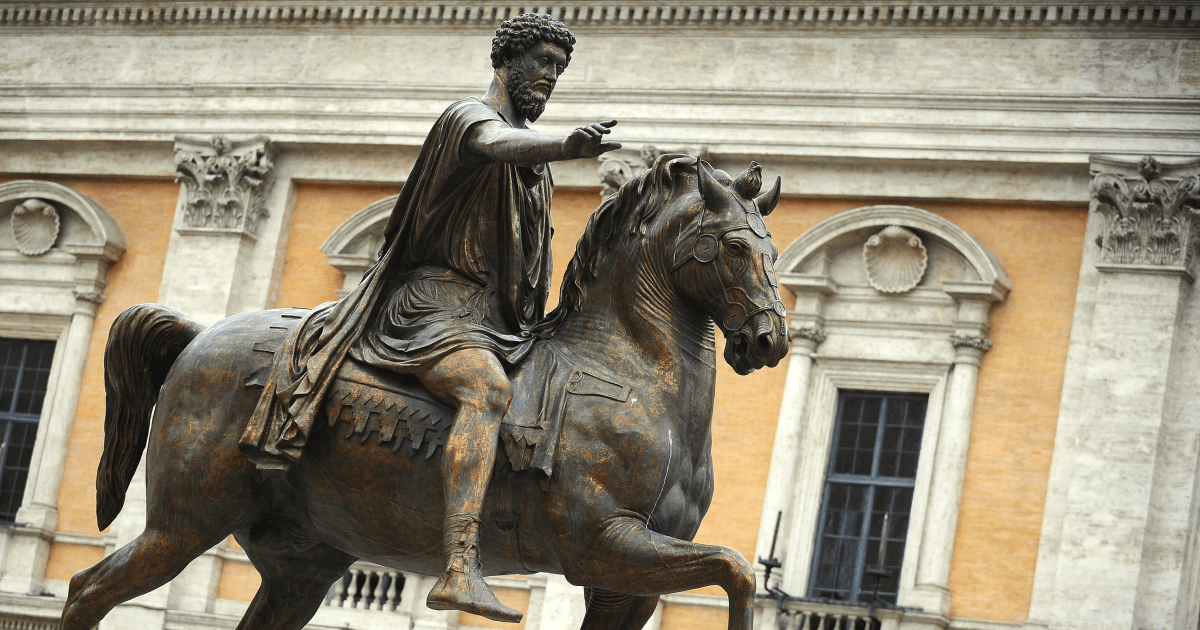


The great Enlightenment sceptic Edward Gibbon once claimed that the period of world history during which “the human race was most happy and prosperous” was the time between the death of Domitian in AD 96 and the accession of Commodus in AD 180. This period coincided with the end of the 200-year-long Pax Romana, and it was characterised by what Machiavelli famously described as the “five good emperors.”
The last of these was Marcus Aurelius. Aurelius was the father of Commodus, and he reigned from AD 161 to 180. His admirers in antiquity include Tertullian, the father of Latin Christianity. And whatever we make of Gibbon’s view of history, it is certainly true that Aurelius exhibits a remarkably advanced moral and religious outlook on life. His Meditations take the form of an unpublished private journal, and they offer tremendous insight into the principles of the Stoic philosophy that he sought to live by.

Christian readers of the Meditations are often taken aback at how edifying the work is. Time and again, the author evinces a deep awareness of the natural law, summed up in the Stoic doctrine of homologoumenos, meaning to live “in agreement with” nature. In the Penguin edition translated by Martin Hammond, Aurelius observes that “Any movement towards acts of injustice or self-indulgence, to anger, pain, or fear is nothing less than apostasy from nature” (XI.20.2). Like Aristotle before him, Aurelius looks to the natural order of things to establish that man is “both rational and political” (VI.14.1), and therefore “the good of a rational creature is community” (V.16.1).
Aurelius also recognises that man is a religious being. He enjoins frequent prayer and sacrifice to the gods, and recommends a Job-like confidence in their providential care: “Do not blame the gods: they do no wrong, willed or unwilled” (XII.12.1). Instead of blaming the gods for one’s difficulties, we are to thank them for all the good things we have received.
No less significant are Aurelius’s pregnant references to the “fragment of divinity” that exists inside every human being. He describes this as “that fragment of himself which Zeus has given each person to guard and guide him” (V.27.1). We find here an echo of the biblical notion of the Imago Dei, and it’s striking to see how Aurelius’s theological anthropology becomes the basis for his broader social ethics: “I have reflected that the nature of the offender himself is akin to my own – not a kinship of blood or seed, but a sharing in the same mind, the same fragment of divinity” (II.1.1).
Virtue ethics is one of the hallmarks of the Stoic philosophers, and Aurelius is no exception. Acknowledging the frailties of human nature, he stresses the necessity of setting good habits and building virtues. To that end, we must resist “the promptings of the flesh” which would distract or hamper our efforts to grow in self-mastery: “Good or ill for the rational social being lies not in feeling but in action” (IX.16.1).
Throughout his work, Aurelius highlights numerous different virtues that are deeply concordant with a Gospel ethic: humility, forgiveness, intellectual honesty, love of children, love of family, simplicity of living, cheerfulness in all circumstances, avoidance of idle thoughts, and adherence to tradition. Underlying all of these is the keystone virtue of magnanimity (literally, “great-soul-ness”) that informs Aurelius’s whole outlook on life. Again and again the emperor reminds us that life is short, and we must therefore make the most of the time we have been given: “No, you do not have thousands of years to live. Urgency is on you. While you live, while you can, become good” (IV.17).
In a culture as unmoored as ours, Aurelius’s message is refreshingly simple. Since man was created to do good, he must learn to employ his God-given talents while he still can: “Remember how long you have been putting this off, how many times you have been given a period of grace by the gods and not used it” (II.4.1). The great Spanish priest St Josemaría Escrivá was fond of telling his pupils Esto vir! (“Be a man!”). The sentiment is one with which Aurelius would doubtless agree: “No more roundabout discussion of what makes a good man. Be one!” (X.16.1).
Nor is this the only point of connection between Escrivá and Aurelius. Whereas the former famously advocated the “heroic minute” as a form of self-mortification in the morning, the latter likewise voices his contempt for the ancient equivalent of the snooze button:
“At break of day, when you are reluctant to get up, have this thought ready to mind: ‘I am getting up for a man’s work. Do I still then resent it, if I am going out to do what I was born for, the purpose for which I was brought into the world? Or was I created to wrap myself in blankets and keep warm?’… The point is that you do not love yourself – otherwise you would love both your own nature and her purpose for you” (V.1.1-3).
Clearly there is plenty of material in the Meditations that will find the Christian reader nodding in agreement. But it’s also important to recognise what’s missing in Aurelius’s worldview. Despite his appreciation for the natural law and the role of the gods, his philosophy remains metaphysically shallow. He believes in gods but not in God, and he lacks any conception of divine revelation. As a result, he is forced to resort to speculation on some of the most pressing questions of human existence.
While Aurelius rightly affirms that we are “made of body and soul” (VI.32.1), he remains uncertain as to what awaits us after death. At times he betrays a more Gnostic perspective, where death is viewed as the liberation of the soul from its bodily prison. On other occasions, he ruminates that perhaps the gods have in store some kind of “return to existence” (XII.5.1) for those who serve them faithfully.
The one thing the emperor is certain of is that we must be fearless in the face of death. But it isn’t immediately obvious what rationale he can offer for adopting this frame of mind. Interestingly, it is during his discussion of death that Aurelius makes his only explicit reference to the Christian faith:
“What a noble thing is the soul ready for its release from the body, if now must be the time, and prepared for whatever follows – extinction, dispersal, or survival! But this readiness must come from a specific decision: not in mere revolt, like the Christians, but thoughtful, dignified, and – if others are to believe it – undramatic” (XI.3.1).
The passage is somewhat opaque, but it appears the emperor has heard reports of Christian martyrs going joyfully to their deaths. While he can admire the courage of these Christians, he resents what he views as their obstinacy towards Roman law and their desire to make a scene. Here the contrast is stark. The Christian overcomes his fear of death because he knows his Beloved, and this gives him the firm hope of eternal life. The Stoic, on the other hand, seeks to overcome his fear despite having no idea what awaits him after death. As such, his only recourse is to grit his teeth and repress all emotion.
This divergence is worth reflecting on. Whereas the Christian knows that reality is a divine comedy, the Stoic is forced to admit that life might be nothing but a tragedy, or indeed a satire. This shortcoming is especially pronounced in the way Aurelius treats the problem of suffering. Like every worldview that lacks the Cross, his philosophy cannot conceive how suffering could be redemptive. Consequently, his proposed solution to the problem of pain is simply to try to ignore it: “remove the thought ‘I am hurt’, and the hurt itself is removed” (IV.7.1). This approach is not without its appeal in our modern snowflake culture. And yet, in a world filled with evil and injustice, Aurelius’s Stoic theodicy remains inescapably depressing.
Whereas the Christian says we were created by God in order to return to God, the Stoic can offer no account for where reality comes from or where it is going. Whereas the Christian says we are destined for everlasting happiness, the Stoic professes uncertainty as to whether our lives have any objective meaning. Whereas the Christian says all our suffering is allowed by God for some deeper purpose of love, the Stoic can’t help but view suffering as a reflection of a violent cosmos that is, in the final analysis, chaotic and absurd. And whereas the Christian says the model for human life – and the path to ultimate fulfilment – is found in the God who became man, the Stoic insists that “the infallible man does not exist” (V.10.1).
In the end, the strength and the limitation of Stoicism lies in the fact that it gestures towards ideals it cannot itself fulfil. It recognises the brokenness of human nature, but it can’t supply the grace that’s needed to heal it. It correctly perceives that man is ordered towards virtue, self-mastery, and transcendence, but it can’t explain why these things matter or where they lead. Christianity answers these longings not so much with a system as with a Person. The Stoic seeks to live according to reason, or logos, but the Christian maintains that the Logos has become flesh. It is by entering into a loving relationship with that incarnate Logos that we learn to face the vicissitudes of life not merely with endurance but with hope.

.png)