

“The heart of Notre Dame goes out to you in your grief, but it is a heart full of hope – prayerful hope that God will give you the strength to be resigned to His Holy Will, and that His mercy will grant eternal rest to the soul of your beloved son. That was the prayer of sixteen hundred Notre Dame men this morning as they knelt at the altar rail to receive their God in Holy Communion; that is the prayer that goes from the motherly heart of Our Lady’s school to a mother who has known affliction.”
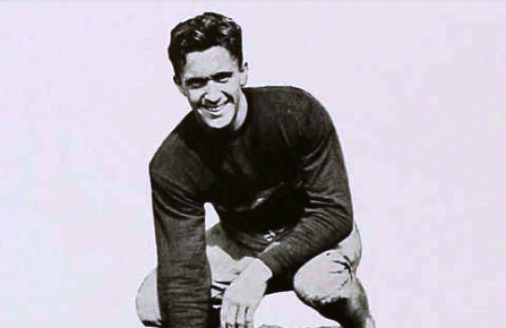
Before the Army-Fighting Irish game, Notre Dame’s religious bulletin reminded students that “a month ago tomorrow they sounded taps for Dick Sheridan. In your Holy Communion tomorrow ask God’s protection for both teams, and say an extra Requiem for the repose of Dick Sheridan’s soul.” The bulletin indulges a bit of football hagiography while imagining the legendary Coach Knute Rockne meeting the cadet in heaven. But the bulletin’s poet honored the cadet:A boy’s voice rang sweet upon the airThe litany of the dead – Your farewell prayer,Each head leaned low; each gray-clad shoulder bent;And lo! each stalwart, would-be soldier wept.You were a comrade lost in tragic war,And so all West Point mourned.
One month later, their eyes were filled with the tears of victory as Army honored Dick Sheridan with a shutout win against Notre Dame in front of 78,000 fans in Yankee Stadium. In New Haven, Dean of Yale College Clarence Mendell offered his memorial for Cadet Sheridan. He rejected A.E. Housman‘s poem “To An Athlete Dying Young” as a cynical attempt to “poison our ideals with one more shaft of venom”. The Sterling Professor of Latin Language and Literature often defended the importance of athletics in the formation of young men and Sheridan’s memorial was another rhetorical opportunity: “If football is the testing ground where the real man is revealed, if in that laboratory along with a clean, hard contest, develops that sportsmanship which makes life worth the living, are we then to abandon it because Death intrudes even there?” Mendell thought not, and offered as evidence Dick Sheridan’s brief life lived to the fullest without fear or hope for death. In the same year of Sheridan’s death, Yale University Press published Mendell’s poem “Jeanne d’Arc at Rouen”. Mendell anticipates Dick Sheridan’s classmates reading West Point graduate Dwight D. Eisenhower’s D-Day letter on their “Great Crusade” to liberate France:How far away it seems. How little thenI dreamed the meaning of those other words,That I must go to France.
Mendell’s maiden warrior vowed in her final hours at Rouen “to His keeping do I commit myself, my king, my France” and within a decade many of his students would make the ultimate sacrifice “For God, For Country, and For Yale.” Hilaire Belloc ends his biography of St Joan of Arc with her death in Rouen: “So they threw into the river the ashes of that Maiden and her heart, which the fire had not consumed.” The select group of Yale men who served in both World Wars had the same flame within their breasts. Many of them literally felt their hearts break with love of home and freedom as they died of heart attacks in their final tours of duty. During her first visit to France honorary Yale graduate Willa Cather visited Rouen Cathedral, the burial place of the great crusader, Richard Couer-de-Lion. She writes, “There could scarcely be a better place for so hot a heart to rest.” Dick Sheridan was laid to rest in the West Point cemetery filled with our fallen heroes. Nearby his classmates donated a memorial exedra made of Georgia marble overlooking the Hudson River to perpetuate his memory and to create a quiet place to contemplate Dick Sheridan’s short life. “If we can live as fully as he did, as intelligently, and as wholeheartedly, with a serious purpose, a high minded sense of honour, and a light hearted chivalry,” Dean Mendell ventures, “none of us will complain when we are taken out of the game, nor wish the game to be less well played because we are no longer in it.” Stephen Schmalhofer is a graduate of Yale College, where he played football. He writes from Connecticut