

March 17 is St Patrick’s Day and it is remarkable that the feast of the man who did more than anyone to convert the Irish from paganism to Christianity is celebrated with gusto in a country that is incomparably less Catholic than it was a generation ago. The nature of the festivities in Dublin is now anything but religious and sometimes wilfully counter-Christian, but there is an element of continuity: it is still an excuse for drinking to excess.
This year the organisers of the official St Patrick’s Festival – focused on the parade in Dublin on the day – declare that: ‘Initially, it was a solemn commemorative feast day dedicated to paying tribute to the saint, but over the years, St Patrick’s Day has evolved into a vibrant celebration encompassing the richness of Irish culture. Today, it is a joyful occasion marked by parades, performances and diverse expressions of Irish heritage; a multicultural international event that is committed to displaying contemporary and traditional arts, culture and heritage of the Irish people and the people who call Ireland home.’
Not so Christian, then. Yet in the last poll on beliefs some 69 per cent of Irish described themselves as Christian and, excepting recent immigrants, that owes a great deal to Patrick, apostle to the Irish.
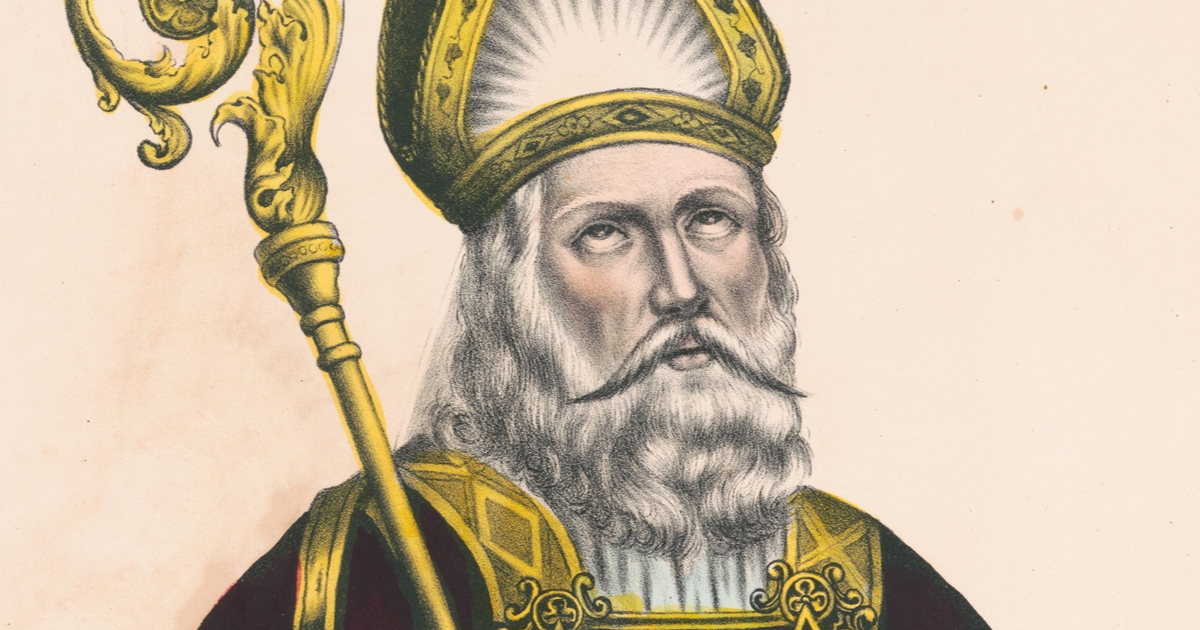
Time was, we thought we were on safe ground with St Patrick. We had a decided idea of what he looked like – green chasuble, a crozier and episcopal headdress – with shamrock in hand, to explain the doctrine of the Trinity, sometimes also pointing to one of the snakes that he expelled from Ireland. He came in 432 and died on March 17. Indeed Archbishop John Healy, in his 1905 biography of the saint, declared as ‘the best established era in his history’ that Patrick died on Wednesday, March 17, 493, aged 120 years. At school we were told that he was not the first missionary to Ireland but the first bishop.
Much of this is now contentious; indeed as Prof Dáibhí Ó Cróinín, the great Patrick expert, observes discouragingly: ‘Most of what we know about Patrick is wrong’. And yet we have his letters, including his famous scorching address to Coroticus, a brutal warlord who enslaved a number of Patrick’s Irish converts, and his famous Confession. That tells us how he was taken a slave by Irish raiders as a youth, escaped back to Britain and then was summoned in a dream by the native Irish calling him to return to them. He did, and began his missionary work among the non-Christian Irish, a resounding success. He was celebrated in any number of legends and stories as well as more sober writings and poems.
But the very fact that we have such substantial writings by St Patrick, including the interesting and self-deprecating Confession (he calls himself uncouth) – for autobiography is not a characteristic genre of the period – means that we know more about him than about almost any other individual of the period. Admittedly the Confession raises any number of questions and is bereft of dates, but it conveys Patrick’s firm sense of God’s guidance, a keen resolve about his mission (which seems to have been questioned by his superiors) and a humility that seems more than conventional protestations about his unworthiness.
As Professor Ó Cróinín told me: ‘The man we know as Patrick, the author of the Confession and the Letter, was a very remarkable man. There should be a copy of his writings in every Irish home.’
Did St Patrick challenge the High King at the great summer fires at Tara? Did he drive the snakes out of Ireland? I should be sorry to think that he didn’t. As for the legend that he used the little three-leaved shamrock to illustrate the concept of the Trinity – three in one, like the three leaves in a single plant – it may or may not be true, but it was a genius way of expressing the inexpressible.
He was not, however, the first bishop who came to Ireland: that was probably Palladius, sent by the then pope to the Irish who were already Christian in 431. The date of 432 – which used to be as well known in Ireland as 1066 in England or 1492 in the US – is derived from the fact that Palladius was considered to have lasted no more than a year in Ireland and 432 was what Professor Ó Cróinín describes as ‘the next available flight’. (This could be tricky with the 1,600th anniversary coming up in six years’ time.) He does, however, think that the date of the feast – so the date of Patrick’s death – on March 17 is sound, since it appeared for the first time in a seventh-century continental (and therefore impartial) source.
Most people take at face value St Patrick’s own description of himself as an unlettered rustic and certainly his Latin is not an entirely easy read. David Howlett, an American scholar, however, thinks that this does not do him justice. He observes that Patrick was author of one of a list of Easter cycles, adapted from the dating of Victorius of Aquitaine, written in AD 457. He observes: ‘My edition of Patrick’s Letters, published in 1994, demonstrated that Patrick was not the bumbling semi-literate earlier scholars had supposed him to be, but a competent author.’
A former slave, a defender of the innocent against their oppressor, a man who followed visions, a Briton: this is the man celebrated on the Irish national day. He deserves veneration. Happy St Patrick’s Day!