In his twelfth homily on the Gospel of Matthew, St John Chrysostom reflects on one of the great paradoxes of the Christian faith: why Christ, who is without sin, submits to baptism. Writing in the late fourth century, Chrysostom addresses an obvious question raised by the Gospel narrative itself—John the Baptist’s hesitation to baptise the one he knows to be greater than himself.
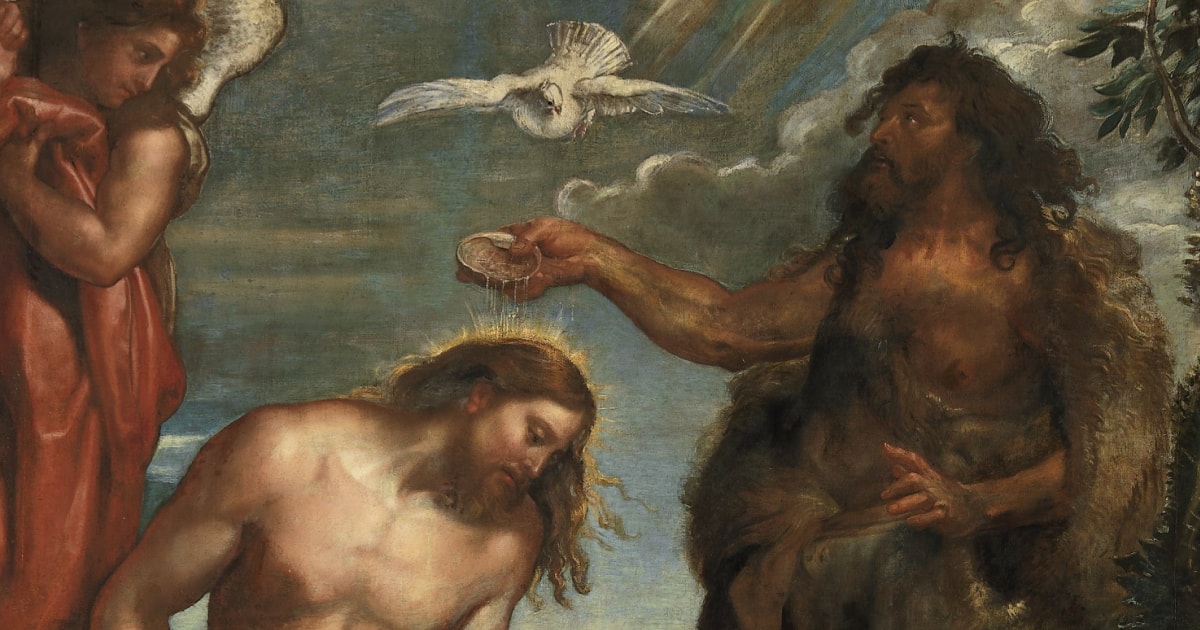
Chrysostom’s answer is both theological and pastoral. Christ is baptised, he explains, not for His own purification but to “fulfil all righteousness”: that is, to complete the law perfectly and to inaugurate the sacrament that would cleanse others. By entering the Jordan, Christ does not receive holiness from the waters; rather, He imparts holiness to them. In this act, the waters of baptism are sanctified, the Trinity is revealed, and the path is opened for Christian baptism as a real participation in Christ’s saving work.
Homily XII on the Gospel of Matthew
(Matthew 3:13–17)
“Then cometh Jesus from Galilee to Jordan unto John, to be baptised of him. But John forbad Him, saying, I have need to be baptised of Thee, and comest Thou to me? And Jesus answering said unto him, Suffer it to be so now: for thus it becometh us to fulfil all righteousness.”
Do you see how great is the virtue of John, and how great the humility of the Lord? John was baptising all others, yet when Christ came he would have prevented Him, saying, “I have need to be baptised of Thee.” He knew Him well, and this he declared, not from any revelation at that moment, but from what had been revealed to him before. For he says not, “I knew Thee not,” but “I have need to be baptised of Thee.”
And what says Christ? “Suffer it to be so now.” This He said not as excusing Himself, nor as conferring a favour on John, but as showing that He does all things in season. For He did not say simply, “Let it be so,” but “Let it be so now.” That is, wait a little; for afterwards thou shalt know clearly who I am.
“For thus it becometh us to fulfil all righteousness.” By righteousness here He means the fulfilment of the law, since righteousness is the keeping of commandments. As therefore He had fulfilled the other commandments, so also this one. For what commandment was there which He did not fulfil? He was circumcised, He kept the Sabbath, He observed the feasts, He obeyed His parents, He paid the tribute money. This only remained, that He should be baptised.
And consider how fitting this was. Baptism was a sign of repentance; but repentance belongs not to Christ. Why then was He baptised? That He might not appear to transgress the law, but fulfil it entirely. This is why He says, “It becometh us to fulfil all righteousness.”
Do you see the humility of the Lord? He persuades the servant to baptise Him. He who was greater submits to the lesser. He who needed no cleansing goes down into the waters. And by this act He teaches us humility, that we should not refuse what is appointed, even if we think ourselves above it.
“Then he suffered Him.”
And after He was baptised, what follows?
“And Jesus, when He was baptised, went up straightway out of the water: and lo, the heavens were opened unto Him, and He saw the Spirit of God descending like a dove, and lighting upon Him.”
Why were the heavens opened? That thou mightest learn that this was for thee also. For when thou art baptised, the heavens are opened, and thou receivest the Spirit. This was not for Him who needed nothing, but for thee.
And why did the Spirit descend in the form of a dove? Because the dove is gentle and pure, and free from bitterness. So also the Spirit comes to show the meekness of Christ. And again, in the time of Noah, the dove brought the olive branch, a sign that the wrath of God had ceased. So here also the dove shows that reconciliation has been made between God and man.
“And lo a voice from heaven, saying, This is My beloved Son, in whom I am well pleased.”
This voice was uttered for the sake of the bystanders. For Christ needed not to be told who He was. But the people needed to learn that He was the Son of God.
And observe how the Trinity is revealed. The Son is baptised; the Spirit descends; the Father speaks from heaven. Do you see the full manifestation of the Trinity? Do you see how Christ begins His work by revealing this mystery?
Thus He sanctified the waters, not by being purified Himself, but by purifying them. He descended into the Jordan, not to wash away His sins (for He had none), but to wash away ours. From that time forth, the waters have received the power of sanctification.
Let us therefore approach baptism with reverence. Let us remember what we receive there: adoption, forgiveness, the Spirit, sonship. Let us not return to our former sins, lest we make the grace void. For if Christ, who was without sin, so honoured baptism, how much more ought we to honour it, and live according to it.