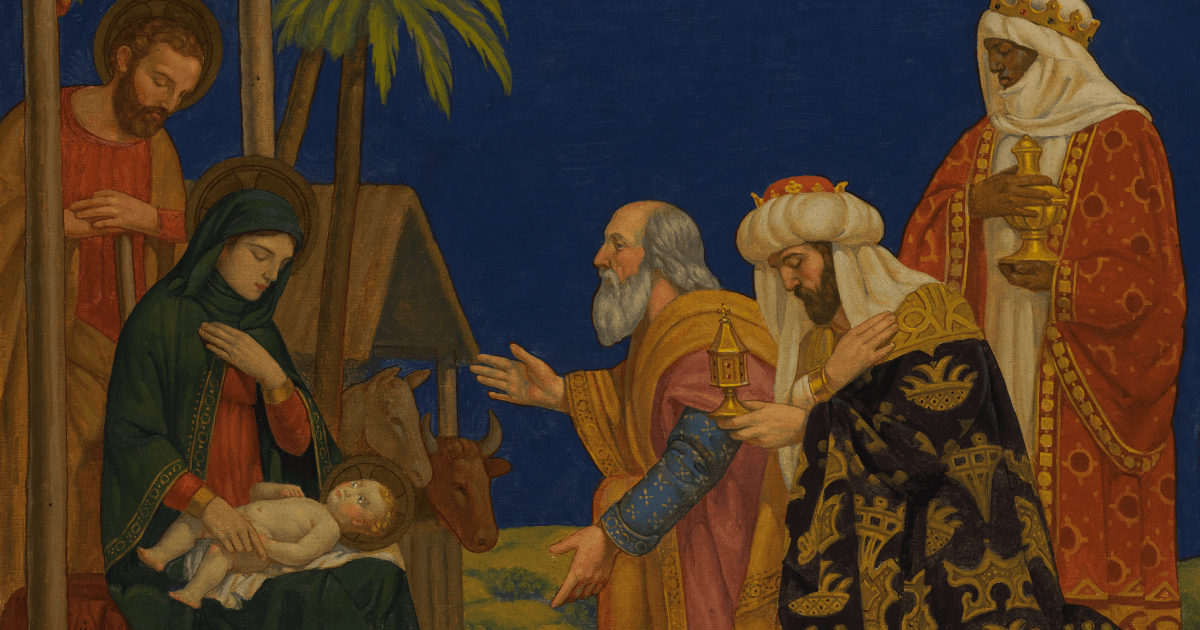



The tradition of opening presents during the Christmas season has a rich history. According to St Matthew, the Magi didn’t just give their treasures of gold, frankincense, and myrrh to Jesus — they opened their treasures. This event inspired the tradition of opening presents to celebrate the Epiphany. In Spain and much of Latin America, this custom continues to this day.
However, another tradition of opening presents arose from the fourth-century story of St Nicholas, who dropped sacks of gold through the window of a poor father so he could pay his daughters’ dowries and thus save them from a life of prostitution. In the Low Countries, children still open presents on the eve or the morning of St Nicholas’s feast day on 6 December.
A further development of this tradition emerged in the 16th century during the Protestant Reformation. In an effort to discourage the veneration of the saints and foster a greater devotion to Christ, the day on which presents were opened was moved from 6 December to 25 December. Then, in the 19th century, there was a rapid commercialisation of Christmas as the Industrial Revolution made gifts and wrapping paper much more affordable.
Although many people today have lost sight of the Christian roots of opening presents during the Christmas season, there is nevertheless a deep symbolism in this tradition. Before Christ was born, He was already incarnate. We celebrate His incarnation on 25 March, the Feast of the Annunciation, exactly nine months before He was born. Yet during these nine months, He was hidden within His mother’s womb. It was only on the day of His birth that the gift of our incarnate God was unwrapped, so to speak.
This symbolism is also reflected in the Epiphany. The word Epiphany literally means a manifestation or striking appearance. So, as the Magi’s gifts were opened and revealed to Christ, this was mirrored in the gift of Christ Himself being revealed to these representatives of the world.
The way we exchange gifts through a process of concealment and manifestation is a uniquely human phenomenon.Some other animals might appear to mimic this behaviour. For example, some male spiders wrap prey in silk as though it were a gift before presenting it to a female mate. However, this behaviour can be understood purely in terms of its practical utility. Human beings, on the other hand, are the only creatures that intentionally cover a gift in order to highlight its manifestation when it is finally opened.
Our uniqueness in this regard can be understood in terms of our rational nature. We are not angels, so we don’t know everything we are capable of knowing from the first moment of our existence. Yet it is in our nature to be truth seekers. Our quest for knowledge is a journey of discovery.
Babies have already begun this journey of discovery when they delight in games such as peekaboo. When a parent covers their face, they are hidden from their baby’s view. But from as early as five months, babies begin to suspect that there is a reality beyond their immediate experience. And the sudden appearance of their smiling parent’s face in a peekaboo game confirms this: objects have a permanence, even when out of sight.
After the age of ten months, when the notion of object permanence has become firmly established, the novelty of peekaboo wears off. However, the desire to uncover what is hidden only increases, and by their first birthday, babies are able to enjoy the thrill of opening presents and discovering what’s inside.
From this age, babies also begin to ask questions such as “where?” and “what’s that?” through gestures such as pointing and inquisitive looks. By the age of three, toddlers’ speech becomes clearer and their curiosity about causes continues to develop, “why?” becomes their favourite question. So much of their environment puzzles them, but they have an insatiable desire to make sense of it.
Some of these toddlers grow up to be men and women who make great discoveries, and this is because they’ve never let their childlike thirst for knowledge subside. The world around us is a gift from God, but God wraps His gifts. Scientists have succeeded in unwrapping some of these gifts as they’ve discovered the hidden realities that can explain so much of the world around us.
However, the deepest mysteries remain concealed from our sight. We hope for what we cannot see, waiting patiently for the redemption of our bodies. In the incarnation, God’s divinity is wrapped in human flesh, and in the Eucharist, the incarnate Word is wrapped in the appearance of bread and wine. We already have the gift of God among us, but the excitement of opening presents during the Christmas season reminds us to look forward to the final unwrapping of this gift of God. This will happen at the end of time, when all will be revealed as we see God face to face.