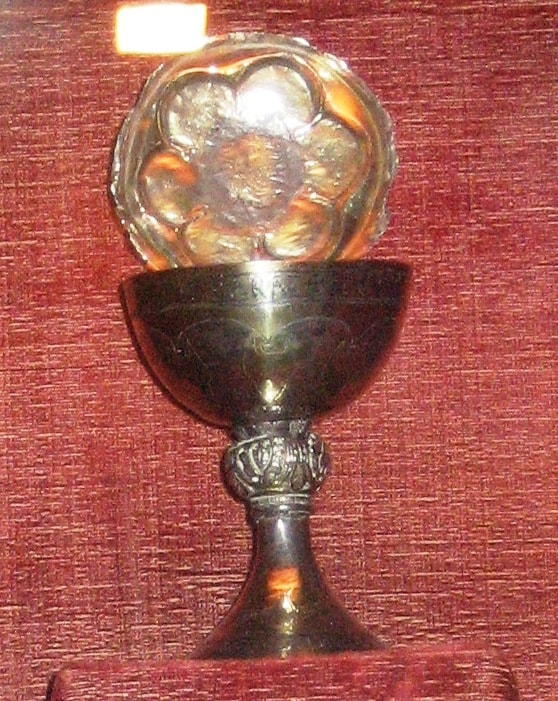


Cover image: Chalice and Paten of O Cebreiro, by FCPB - Own Work, CC BY 3.0
The doubts of a Bohemian priest travelling to Rome on pilgrimage in 1263 led Our Lord to manifest Himself in the famous Eucharistic miracle of the tiny village of Bolseno, near Orvieto, Italy. As a result, Pope Urban IV instituted the Feast of Corpus Christi in the Universal Church and commissioned a Mass and Office for the Feast from St. Thomas Aquinas. A scant thirty-seven years later, the doubts of another priest in a remote mountain pass on the pilgrim’s road to Santiago led to a similar prodigy. Tucked away in the remote hamlet of El Cebrero (O Cebreiro in the regional Galician language), atop a 1293-metre pass some 150 kilometres from the tomb of St. James, is the church of Santa María la Real (St. Mary the Royal). This unremarkable clutch of gray, slate-and-stone buildings comprised of the church, various stone houses, and four, traditional dwellings called pallozas—circular stone houses with a thatched roof comprised of a single room built by pre-Roman Celtic inhabitants of the region—is one of the most enchanting places on the Camino. Frequently shrouded in a foggy mist that obscures it from view and accentuates its mystical ambience, when the clouds withdraw and the sun spills over the mountain top, the views from the summit of the pass are breathtakingly magnificent: jagged mountain peaks to the north, the more rounded profile of the ones to the south, and deep, green valleys stretching out in every direction. The heart rises effortlessly to God in a burst of praise. What better setting for Our Lord to dispel the mists of doubt clouding the human heart and manifest His Hidden Presence in the Eucharist? Like the Colegiata of Roncesvalles in the Pyrenees, the origins of the little church and monastery of O Cebreiro grew out the necessity of providing shelter and relief to the growing number of pilgrims drawn by the rediscovery of the Apostle’s tomb in Compostela. There is evidence of a pilgrims' refuge here from the middle of the ninth century, only decades after the rediscovery of the tomb of St. James in AD 813. In 1072, King Alfonso VI of León and Castile elevated the humble refuge to the status of hospital and entrusted it to the care of Benedictine monks from the abbey St. Geraud d’Aurillac in France. (Others credit the holy French count, St. Geraud of Aurillac, with personally founding the little church and Benedictine monastery here. This is unlikely given that the saint wasn’t born until about 855, around the same time to which archaeological investigations date the remains of the earliest church.) The miracle that made this tiny hamlet famous throughout Europe occurred over 400 years later. The most well-known account of the event comes from the quill of Fray Antonio de Yepes, a Spanish Benedictine monk and chronicler who lived in the late 15th and early 16th centuries, who included it in his General Chronicle of the Order of St. Benedict. Sometime around the year 1300, a certain farmer name Juan Santín, from the nearby hamlet of Barxamaior, “having such great devotion to the Holy Sacrifice that no labour nor inclemency of weather” could prevent him from hearing Mass, battled his way through the ice and snow of a furious winter storm up the steep mountain pass to the little Benedictine monastery and church of Santa María of Cebreiro. Exhausted and soaked through to the skin, he reached the church just as one of the monks was preparing to offer the Mass. The priest, little anticipating that anyone should make their way to the church to hear Mass in such violent weather, had lost faith in the Sacrifice he was preparing to offer. “Who would come all this way in such weather just to gaze upon a bit of bread and wine?” he thought to himself. He belittled the poor man’s faith, admonishing him for what he deemed a foolhardy sacrifice. Confronted with this scandalous lack of faith, the humble farmer offered no response to the priest’s uncharitable rebuke. The priest, in turn, proceeded to offer the Mass, albeit in a careless and hurried fashion. Fray Antonio continues: