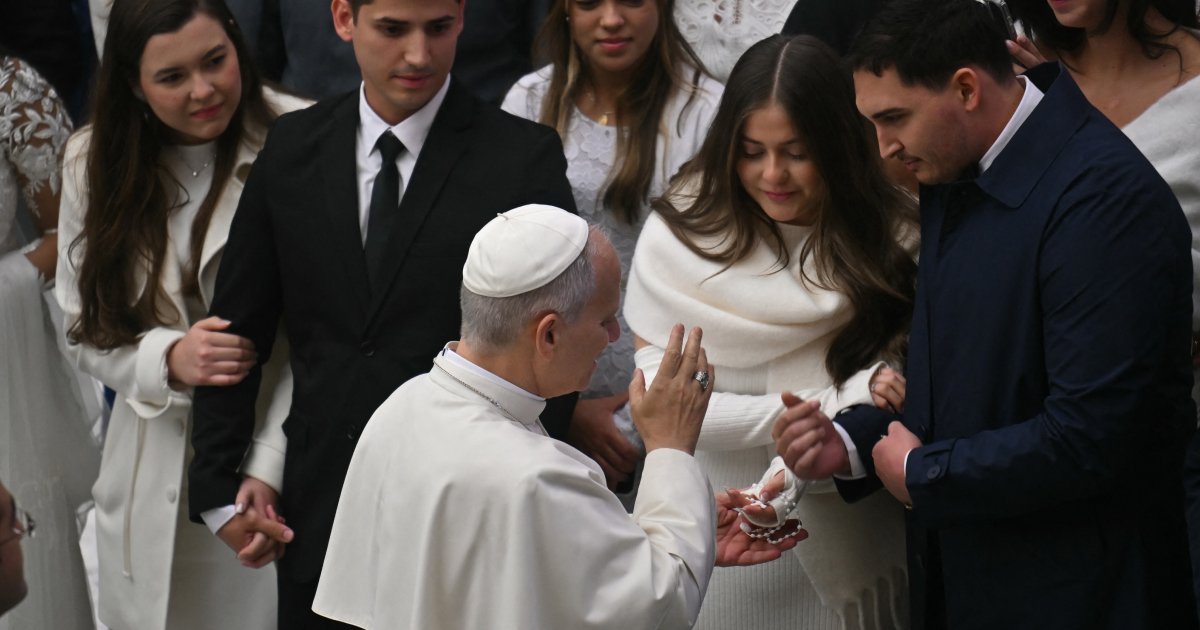


Amoris Laetitia was marked on its 10th anniversary on March 19 with a message from Pope Leo XIV reflecting on the document’s place in the life of the Church.
Writing on the Solemnity of St Joseph, the Pope described the exhortation, first issued in 2016 by Pope Francis, as “a luminous message of hope regarding conjugal love and family life” and gave thanks for what he called the “stimulus” it has provided for reflection and pastoral renewal over the past decade. He said the Church must continue to “persevere on this path”, presenting the Gospel to families in a spirit of joy.
The Pope confirmed that he has invited the presidents of the world’s episcopal conferences to gather in October 2026 for what he described as a process of “mutual listening” and “synodal discernment”. The meeting, he said, will focus on how best to proclaim the Gospel to families today in light of Amoris Laetitia and the changing circumstances faced by households across the world.
Amoris Laetitia followed a period of consultation within the Church that included two assemblies of the Synod of Bishops dedicated to marriage and family life. In his message, Pope Leo noted that the document formed part of a wider development of the Church’s pastoral and doctrinal attention to the family, alongside earlier teaching such as Familiaris Consortio, issued by Pope St John Paul II.
Quoting from the text, the Pope highlighted its emphasis on the presence of God in the daily realities of family life, including moments of difficulty and crisis. He pointed to its call to adopt “the gaze of Jesus” in supporting married couples and to encourage what it describes as the growth and deepening of conjugal love. He also referred to its teaching that love within marriage is lived in concrete and often imperfect circumstances, relating this to the mystery of the Incarnation.
The message underlined the importance of the family as a “domestic church”, echoing the teaching of Vatican II, and reaffirmed its role in the transmission of the faith. Pope Leo said that Christian spouses, through the sacrament of marriage, contribute in a particular way to the mission of the Church, especially in forming younger generations.
He also stressed the need for renewed pastoral attention to families in what he described as an era of rapid social and cultural change. Citing the exhortation, he referred to the need for “new pastoral methods” and for greater care in the education of children, as well as support for families facing hardship, poverty and violence.
Reflecting on the challenges faced by families, the Pope said that fragility is part of human life and must be recognised in the Church’s pastoral approach. He recalled his remarks to young people during the Jubilee of Hope, where he said that human life is not static but is continually renewed through self-giving love. In this context, he said, the Church must present the vocation to marriage in a way that recognises its difficulties while also making clear its beauty.
The Pope expressed gratitude to families who, despite difficulties, continue to live what he described as the “spirituality of family love”. He also thanked clergy, pastoral workers, lay associations and ecclesial movements involved in family ministry.
Looking ahead to the October meeting, Pope Leo said the aim would be to build on existing work in local Churches while responding to new challenges. He said that, in many places, the Church’s presence in society depends in a particular way on the witness of lay people, especially within family life, where the Gospel is lived and shared in everyday circumstances.
He concluded by entrusting the initiative to the intercession of St Joseph, described as the guardian of the Holy Family, and expressed the hope that the Church’s commitment to supporting marriage and family life would continue to deepen in the years ahead.
The message made no reference to the passages of Amoris Laetitia that have been the subject of debate since its publication, particularly those concerning the reception of Holy Communion by divorced and civilly remarried Catholics.
Paragraph 305 of Amoris Laetitia, together with its accompanying footnote, suggested that in certain cases those living in what the Church describes as “irregular” unions might receive sacramental help, including the Eucharist. The text spoke in general terms of pastors not being content merely to apply moral laws “as if they were stones to throw”, and of situations in which individuals, though objectively at odds with the moral law, might not be fully culpable and could still grow in grace.
In September 2016, four cardinals, Carlo Caffarra, Raymond Burke, Walter Brandmüller and Joachim Meisner, submitted five dubia to the Apostolic See seeking clarification on these questions.
The first dubium asked whether it had become permissible to grant absolution and admit to Holy Communion those who, while bound by a valid marriage, live in a new union more uxorio without fulfilling the conditions previously set out in Familiaris Consortio. That earlier teaching had allowed such access only where the couple committed to living in continence.
Other questions raised whether Amoris Laetitia altered the Church’s teaching on intrinsically evil acts as set out in Veritatis Splendor, and whether circumstances could mitigate not only culpability but also the moral evaluation of actions themselves.
At the time, no direct response was issued. Instead, interpretation developed through episcopal practice. The Buenos Aires guidelines, later affirmed by Pope Francis and given the status of authentic Magisterium, indicated that in certain cases, after discernment, access to the sacraments could be possible even where the traditional requirement of continence was not fulfilled.
In 2023, in response to questions posed by Cardinal Dominik Duka, the Dicastery for the Doctrine of the Faith issued a clarification which confirmed key elements of this interpretation. It stated that Amoris Laetitia belongs to the ordinary papal Magisterium and that the Buenos Aires criteria carry authoritative weight. It also affirmed that, in certain cases, sacramental absolution and Eucharistic reception could be permitted following a process of pastoral discernment that takes account of mitigating factors.
From one perspective, this development can be understood in continuity with the Church’s long-standing moral theology, particularly the distinction between objective sin and subjective responsibility. From another, the concerns raised by the original dubia remain, namely whether such an approach risks creating a disjunction between doctrine and sacramental discipline.
Pope Leo XIV, by avoiding direct engagement with these contested passages or the subsequent clarifications, has not reopened the debate at the level of explicit teaching. However, by convening the presidents of episcopal conferences for a new process of discernment, he signals that the current situation, stabilised but not fully resolved, may yet require further consideration.
The trajectory is therefore clear: the dubia posed questions that were never answered in their original terms; the 2023 clarification provided an authoritative interpretation without resolving all theological concerns; and Pope Leo now inherits a Church in which the issue has been managed rather than settled.
The questions that remain are whether the Church will move towards greater uniformity or continue to permit a diversity of pastoral practice, how far individual discernment should shape sacramental discipline, and how this process of “mutual listening” will develop under Pope Leo XIV’s leadership.