Michael Davies (1936–2004) was, from the 1970s until his death, the foremost lay advocate of the Traditional Latin Mass (TLM). His books, particularly the trilogy Cranmer’s Godly Order, Pope John’s Council and Pope Paul’s New Mass, were an enormous influence on a generation of Catholics attached to the TLM and set the terms of the debate. He rejected the extreme claims made by some that the reformed Mass was invalid or that recent popes were not real popes, and when he died he was praised by Cardinal Joseph Ratzinger. Nevertheless, his support for the Traditional Mass and the traditional teachings of the Church was uncompromising.
Leo Darroch’s biography starts with Davies’s early life. He was born into a Protestant family with Welsh roots and attended a grammar school. Instead of doing National Service he joined the regular Army and served in Malaya. Back in civilian life he became a Catholic, married Maria Milosh, a Yugoslav teacher who had been studying in England and became a teacher himself. The young Davies had a growing family and was devout, conscientious and intelligent, but those who met him in the 1960s would have had little reason to imagine that he would devote the second half of his life to writing, speaking and campaigning about the Church’s teaching and liturgy, with unrelenting industry and very little earthly reward. It is interesting to ask what radicalised him.
Davies’s first campaign was directly connected with his work as a teacher, collaborating with Daphne MacLeod and Hamish Fraser to oppose the ‘new catechetics’ that was being imposed on Catholic schools in the wake of the Second Vatican Council. As MacLeod testified in her book Will Your Grandchildren Be Catholic?, the process of updating teaching methods was hijacked by theological dissidents. This is not some radical conspiracy theory: Catholic teachers were called to refresher courses taught by priests who publicly dissented from Humanae Vitae, some of whom went on to leave the priesthood to marry, and were introduced to texts like the ‘Dutch Catechism’, which were condemned by the Vatican.
The next issue that Davies became involved in was the reception of Holy Communion in the hand, which began to be promoted before the promulgation of the reformed Mass in 1969. It was never discussed by the Second Vatican Council, and Pope Paul VI condemned it, but somehow it became the nearly universal practice anyway.
These experiences set Davies on a line of thought that led to his first book, Cranmer’s Godly Order. Davies saw the liturgy as a key theological battlefield and drew a parallel with the process of the English Reformation. Thomas Cranmer undermined the Faith of English Catholics by changing the liturgy, at first in ways that simply neglected to express Catholic truths. The way the Eucharist was to be handled and distributed, for example, tells us something about the attitude of the celebrant, but it also leaves a degree of ambiguity. Members of the congregation might ask: does he do this out of convenience, training, forgetfulness or with some systematic theological agenda? Reforming the liturgy, Davies argued, is an ideal way to change the people’s beliefs under cover of plausible deniability.
In this, Davies’s attitude contrasted with that of his ally Daphne MacLeod, who continued to focus on catechesis for the rest of her energetic life and regarded liturgical questions as a distraction. Davies, like other early campaigners for the Traditional Mass such as Hugh Ross Williamson, saw the two issues as inseparable. This set the tone for the traditional movement in the decades that followed.
Leo Darroch’s book maps Davies’s life through his books and articles. How he combined his prodigious output with a full-time teaching job is a mystery; how he survived financially when he did give up teaching is no less remarkable. In contrast to many of today’s social media personalities, Davies was completely unmotivated by money, often writing and speaking for free, sometimes failing to claim money that was due to him and completely unconcerned about unauthorised editions and translations of his works.
As TS Eliot said of Shakespeare, so we might say of Davies: ‘never has a man turned so little knowledge to such great account’. He did not have a degree in theology, but he read widely and took theological and canonical advice when he needed to, and the truth is that many of the issues he dealt with were not matters of great theological sophistication. Davies pointed to the lack of consultation, slapdash procedures, ignored protests from venerable theologians and prelates and the careless violation of principles set down by Vatican II itself, in the period of reform that even the most enthusiastic Catholic progressives have to agree was chaotic. Davies’s concern, however, was not procedure for procedure’s sake, but the suffering of lay Catholics and priests, who were bearing the brunt of the changes: a suffering that led not only to lapsations, but to the loss of faith, priests leaving the priesthood, alcoholism and even suicide.
In addition, he had a schoolteacher’s concern to explain complex issues, and he presents his material with refreshing candour and self-confidence. Catholics of this era (to say nothing of more recent times) were afflicted above all by confusion: things they had been told to take for granted were being questioned; things that had seemed permanent were vanishing before their eyes; the very basis of their spiritual lives was being dismantled. For the more conservatively minded of these, Davies’s writings were a blessed relief. Without overburdening his readers with off-putting and exhausting polemic, he could explain what was going on and reassure them that their reactions were not unreasonable. He was the ideal evangelist for middle-brow Catholics, bewildered and concerned about what is happening to their Church.
What Davies wanted was not to expose the failure of the hierarchical Church, but for her to take up with renewed vigour her divine munus, the gift and duty to teach with authority. He enjoyed cordial relations with Cardinal Ratzinger and would have been delighted, but not surprised, by Pope Benedict’s freeing of the Traditional Mass in 2007.
Since his death much has been added to the stock of knowledge from which scholars can draw about the history of the liturgy and the process of the reform after Vatican II. The essential arguments, however, have not really changed, and Davies remains a reliable, sane and congenial guide to them.
Cardinal Ratzinger said of Michael Davies: ‘I have been profoundly touched by the news of the death of Michael Davies. I had the good fortune to meet him several times and I found him as a man of deep faith and ready to embrace suffering. Ever since the Council he put all his energy into the service of the Faith and left us important publications especially about the Sacred Liturgy. Even though he suffered from the Church in many ways in his time, he always truly remained a man of the Church. He knew that the Lord founded His Church on the rock of St Peter and that the Faith can find its fullness and maturity only in union with the successor of St Peter. Therefore we can be confident that the Lord opened wide for him the gates of heaven. We commend his soul to the Lord’s mercy.’
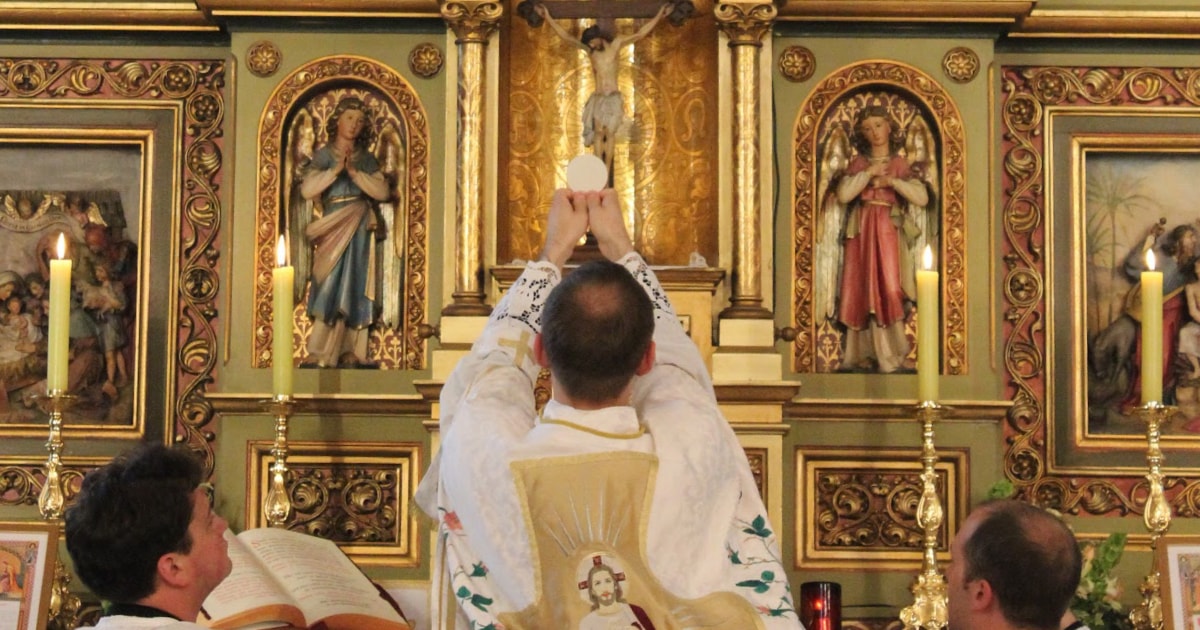
Image: Servus Tuus, CC BY-SA 3.0 <https://creativecommons.org/licenses/by-sa/3.0>, via Wikimedia Commons