

In our increasingly topsy-turvy world – which is putting it nicely: some would say our digital, technocratic-centred society is becoming ever more bleak, alienated and corrupted – Spain’s famous Camino de Santiago pilgrimage offers an oasis of human dignity and flourishing.
This was brought home to me recently when my Long Range Pilgrimage (LRP) that started in Germany’s capital city, Berlin, finally met up in northeastern Spain with the rollercoaster ride that is the Camino Francés, the most well-known and popular segment of the Camino’s myriad pilgrimage routes that thread through Europe.

Before my rendezvous with the Francés, my LRP through Germany and France often felt emblematic of the problems afflicting our digitalised modern world. I found myself alone, cut off from all I knew and struggling to engage with people. I went for months without bodily contact beyond a handshake (and even that was pretty rare). That starts to get to you after a while, trust me. We are embodied creatures who crave touch and physicality.
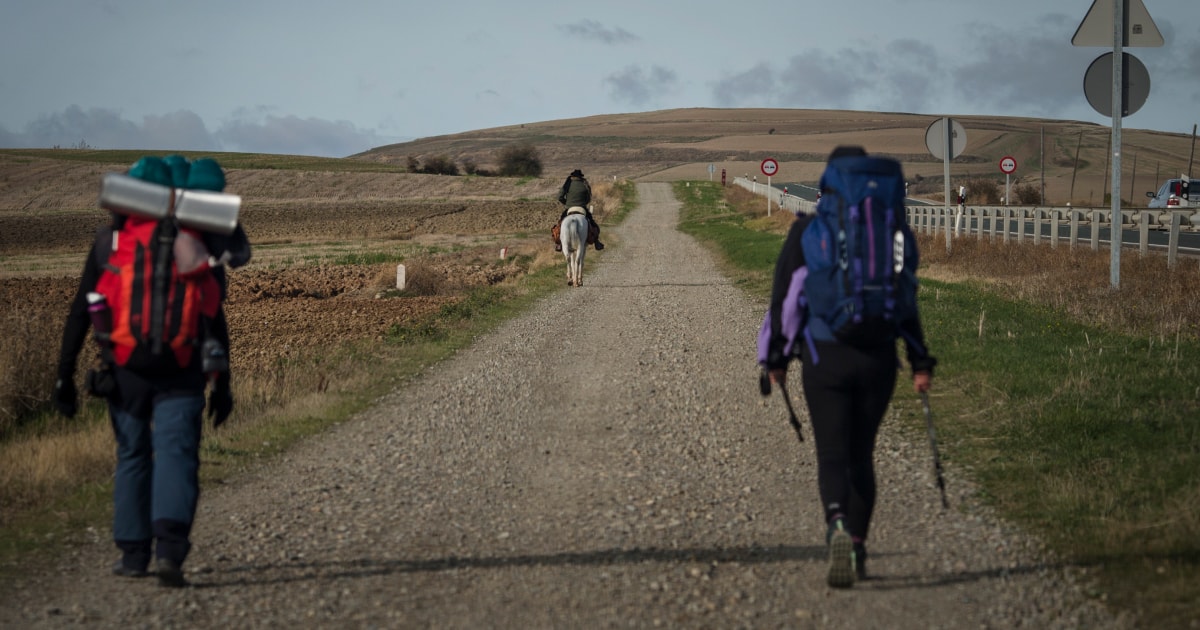
That all changed once I hit the human carnival that is the Camino Francés, which runs from St-Jean-Pied-de-Port, on the French side of the Pyrenees, all the way through the great Spanish cities of Pamplona, Burgos and Leon to Santiago de Compostela in Spain’s northwestern region of Galicia.
Despite increasing numbers of pilgrims on the Francés – along with warnings and media reports about it becoming overwhelmed by numbers and too commercialised – the pilgrimage somehow seems to remain incorruptible. It retains an ability to defy all trends – and just keeps getting better (my first Camino Francés was in 2017; I then did a 204km section with a friend in 2025, before this latest uplifting encounter that belied the tutting of the naysayers).
Based on what I have seen and experienced, the success of the Francés is largely due to how it enables people to do all the simple things that we used to take for granted and do so easily – greet strangers, ask questions of them, eat a cheap meal, become part of a community, laugh and be merry with new friends – but which are increasingly rare in the ruthless competitiveness, expensiveness and atomisation of modern Western civilisation.
I heard an American pilgrim describe the camaraderie and sense of wholesome fun that occurs on the Camino Francés as feeling like being on an Adult Summer Camp – which is no criticism. Jesus highlighted the lessons we should draw from children and how they perceive and interact with the world: “Truly I tell you, unless you change and become like little children, you will never enter the kingdom of heaven” (Matthew 18:3). Such innocence and humility is something from which the cynicism and calculating seriousness of our societies increasingly take us away, leaving many people feeling trapped in lives without meaning or dynamism.
“Our society is alienating, technical, cold and mystifying,” Sebastian Junger writes in his book Tribe, based on his journalistic experiences with troops in Afghanistan, in which he argues that regaining our tribal connection – largely lost in modern society – may be the key to our psychological survival. “Our fundamental desire, as human beings, is to be close to others, and our society does not allow for that.” Not until you break out of the societal straightjacket and get on the Camino.
“Everything becomes intense, exciting and beautiful: memories, plans, ideas,” Jean-Christophe Rufin, the diplomat, novelist and one of the founders of Médecins Sans Frontières, writes in his book about his Camino experience (he took the Camino Norte, along Spain’s northern coast). “You suddenly find yourself laughing… It is a well-known fact that when you are walking each footstep acts on your mind like a crankshaft: it sets thought in motion, galvanises it, and this in turn energises your feet.”
And the ground those energised feet cover can take you into an entirely new realm – physically, emotionally and spiritually – in which the pilgrim (as Rufin puts it) “freed from the distant world far below him, freed from his suffering and vain cravings, can at last attain Oneness, the Essence, the Origin”. At the same time, the ground covered also takes you very much into close and personal contact with your fellow pilgrims, as you share the same dormitories, showers, kitchens, wash basins and washing lines to clean and dry your hiking clothes.
In a Spectator article, Mary Wakefield discusses The Extinction of Experience, the new book by the US writer Christine Rosen that analyses “the way in which we are losing touch with the real world: the one we evolved in, as opposed to the virtual one”. Wakefield notes how “all the scrolling and texting means we’re forgetting the look and feel of life unmediated by screens”, adding that “if we get more anxious year by year, then it’s not just wars or the cost of living… but because we’re grieving for the real world, whether we know it or not”. On the Camino Francés you get to experience the “real world” and a life that is unmediated by screens. And it is wonderful, let me assure you.
Yes, admittedly, there is the chance you get a blister or two, that you will not smell your best and that if you get a bad snorer in a dormitory it can result in such exasperation that by 4.15am you have to vacate the dormitory, to be left pottering around a desolate albergue hostel until sunrise. But you also become part of a mobile village, with interlocking tribes of pilgrims emerging as you meet one group of pilgrims, but then lose sight of them – as you meet and get to know another group – before encountering the original pilgrims a few days later in a wayside café amid great exclamations of joy and hugs and copious orders of café con leche and the pilgrim’s go-to snack of choice: a wedge of tortilla de patatas (Spanish omelette).
Along the trail almost every pilgrim greets each other with Buen Camino – “Good journey” – the simplest of icebreakers, or enough on its own to mean that two people have recognised the presence of the other, after which each goes on their separate ways reassured by the acknowledgement of the other. Then there is the smiling. So many people are smiling – eventually for no obvious reason.
“Santiago pilgrims who have reached this stage in their evolution are ready to welcome their fellow humans as easily and naturally as they commune with nature,” Rufin writes. “As with everything else, they do so without desire or plan, without illusions or ulterior motives.”
How different to encounters outside the Camino, so often involving calculation, caution, assessment, cost-benefit analysis, amid the combativeness of the rat race, a competitiveness that percolates through everything, even the education of children and the choice of their schooling.
“Through our bodies and all the privations of our journey, our parched minds are refreshed and we forget the despair into which we were driven by the total domination of the material over the spiritual, science over faith and the lifespan of our mortal body over the eternity of the beyond,” Rufin writes of the Camino’s strange alchemy on an individual who undergoes it.
Seen in such a light, the Camino – which admittedly can be reduced to being described as just a long walk through Spain during which you visit a lot of Spanish cafés and the occasional church – has an increasingly important societal role to play, offering a counterbalance to the pernicious trends that appear to be tightening their hold on our communities.
“What happens to a public life, and what happens to civilisation, when we’ve sunk so deep into our separate, virtual worlds that we feel no sense of comradeship with the humans right next to us?” asks Wakefield. She answers her question by referring to Rosen’s sobering analysis: “Rosen thinks there’s a terrible price to be paid,” and then quotes Rosen as concluding: “Our use of technology has fundamentally changed not just our awareness in public spaces but our sense of duty to others. Engaged with the glowing screens in front of us rather than with the people around us, we often don’t notice what is going on.”
Or, as Wakefield adds, it’s even worse than that and “we don’t care”.
But on the Camino you care. A lot.
James Jeffrey is a former British Army officer. He is a writer, editor and a Camino guide.


x02.jpg)
.jpg)

.jpg)