September 10, 2026

After the AfD surge, Germany’s Catholic bishops face a dilemma

Jan C. Bentz
More
Related
Min read
share

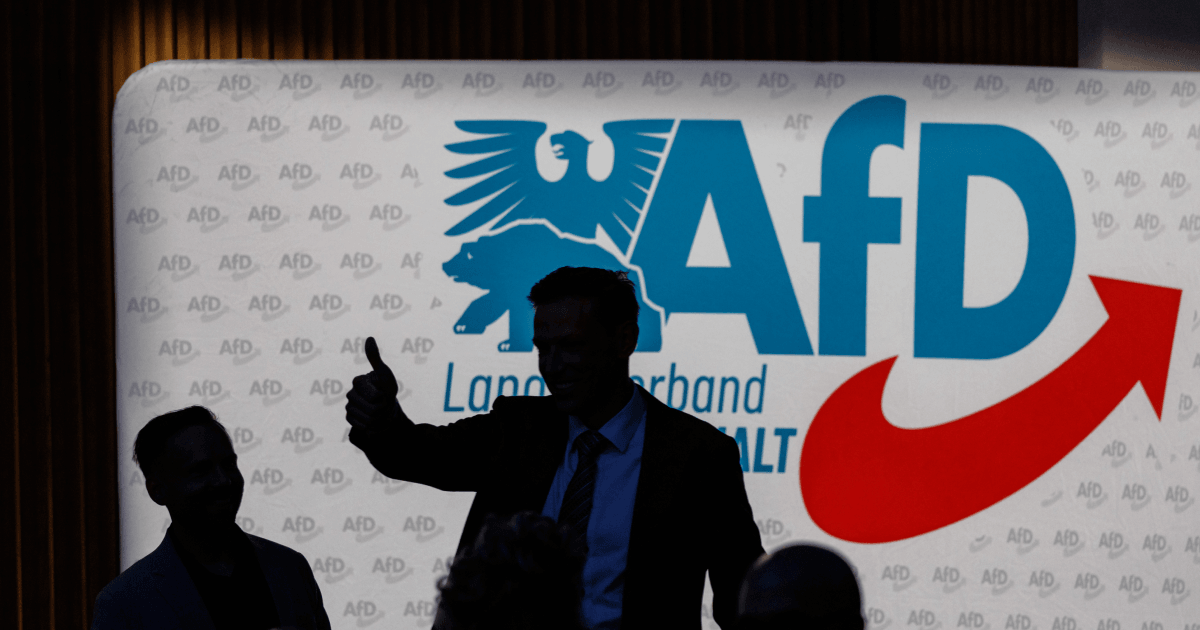
Something gave way in Saxony-Anhalt on September 6. The AfD had been advancing for years; on September 6, it ceased to look like an insurgency and began to look like the dominant political force of an entire German state. On that day, the Alternative für Deutschland won 43.8 per cent of the vote, more than doubling its result from 2021 and reducing the once-dominant Christian Democratic Union – the classic Catholic voter’s choice – to 17.2 per cent. The AfD emerged with 39 of the new Landtag’s 83 seats; the CDU with 15. Turnout reached 77.8 per cent, the highest since the state was reconstituted after German reunification. Across great stretches of this predominantly rural eastern state, blue replaced black on the electoral map.

Whatever one makes of the AfD, 43.8 per cent can no longer plausibly be described as a protest confined to the political fringes. It is here to stay. More than half a million people in the state voted for it. Among workers, according to post-election polling, support was considerably higher still.

The face of that victory was Ulrich Siegmund. At 35, the former salesman and businessman has sat in the Saxony-Anhalt parliament since 2016 and has co-led its AfD parliamentary group since 2022. He represents a somewhat different political type from the angry populist familiar from caricature. Even the regional public broadcaster MDR, hardly friendly territory for the AfD, described him before the election as a “geschliffener Kommunikator” – a polished communicator. He speaks calmly, repeats a small number of messages relentlessly and has learned to use social media with an ease still comparatively rare in German politics. This talent also produced one of the stranger episodes of the campaign: three weeks before the election, Der Spiegel placed Siegmund on its cover beneath the headline “The Most Dangerous Man in Germany”. The accompanying argument contained a paradox. Part of what supposedly made Siegmund so dangerous was precisely that he did not appear particularly dangerous. He could be charming and approachable, the magazine argued, and appeal to voters who would never think of themselves as extremists.

While the cover was intended to further the ongoing slurring of AfD politicians and voters, Siegmund treated it as an advertisement. He posted it on Instagram accompanied by Dr Dre and Snoop Dogg, called it “very good advertising” and began signing copies at campaign events. What had been intended as political stigma became campaign memorabilia, something that seemed distinctly “Trumpian”, though the comparison concerns political technique more than political convictions. President Trump discovered years ago that an accusation loses much of its force when its target refuses to observe the solemnity expected by the accuser. Instead of defending himself within the frame established by hostile journalists, he mocks the frame. The prosecutorial interview becomes part of the performance. Siegmund has learned something similar.

The danger of this strategy is that, once accusations of “extremism” have been used too freely, voters may also shrug off those that deserve serious attention. The Saxony-Anhalt AfD has, after all, been classified since 2023 as gesichert rechtsextremistisch – “confirmed right-wing extremist” – by the state’s Office for the Protection of the Constitution, or Verfassungsschutz. Its reports cite ethnically exclusionary, anti-Muslim, anti-Semitic and racist statements, evidence that cannot simply be dismissed as another hostile headline.

Yet the designation also requires some precision. The Verfassungsschutz is an intelligence agency, not a constitutional court; in Saxony-Anhalt it is part of the interior ministry, currently headed by a CDU politician. Its classification is an executive assessment, subject to judicial review, and the AfD continues to challenge it in court. This neither makes the finding false nor its officials party operatives. It does mean that an important piece of evidence should not be mistaken for an apolitical verdict that settles the political argument by itself.

For Catholics in Saxony-Anhalt, these questions acquired particular urgency because the Church entered the election campaign with unusual force.

Catholics form only a small minority in the state – roughly 66,000 people among a population of more than two million – but the Diocese of Magdeburg maintains a much larger public presence through Caritas, schools, kindergartens and other social and educational institutions. Its bishop, Gerhard Feige, has become one of the most forthright episcopal critics of the AfD.

Earlier in 2026, Feige warned his fellow German bishops about what he called the AfD’s Retro-Traum einer Familienidylle, its “retro dream of a family idyll”, and criticised its conception of remigration and its hostility towards established churches. When the party published its state election programme, Feige joined senior Protestant leaders in arguing that important parts of it contradicted the Christian understanding of the human person through Abwertung und Ausgrenzung – devaluation and exclusion.

The diocese subsequently mounted an extensive campaign under the title “BEWUSST WÄHLEN!” – “Vote Consciously!” Catholic schools, Caritas, parishes and educational institutions were involved. The message stressed human dignity, solidarity, neighbourly love and democratic participation. By August, the campaign had joined a broader alliance responsible for hundreds of large public posters across the state.

Behind this intervention stood the German Bishops’ Conference’s 2024 declaration on “völkischer Nationalismus”, which stated that ethnic nationalism and Christianity were incompatible and concluded that extreme-right parties, including an AfD increasingly dominated by such tendencies, could not be regarded as an acceptable political home for Christians.

The bishops’ central argument was anthropological, and there is nothing novel about it. Christianity cannot make ancestry the measure of human worth. The stranger at the gate does not cease to possess human dignity because he is Syrian rather than Saxon. Anti-Semitism, racial contempt and the subordination of personal dignity to an ethnically conceived collective collide directly with the Christian understanding of man. But the German Catholic debate becomes more complicated than the bishops’ declarations may suggest.

The Saxony-Anhalt AfD is explicitly pro-life. Its programme insists that abortion remain within the criminal code, rejects the establishment of abortion as a human right and calls for greater assistance to women facing crisis pregnancies. It strongly privileges marriage, children and the natural family in social policy. On these questions, whatever else may be said about the party, its programme stands substantially closer to historic Catholic moral teaching than those of several parties with which the German Church has maintained far less troubled relations.

A Catholic voter may therefore find himself in a peculiar position. One party speaks recognisably Catholic language about unborn life and the family while advancing ideas about nation and migration he may find difficult to reconcile with Catholic social doctrine. Other parties speak eloquently about human dignity and inclusion while regarding abortion as a right and traditional Christian sexual anthropology as something to be overcome.

There is no getting around the dilemma by selecting whichever half of Catholic anthropology happens to fit one’s existing politics. The election produced a remarkable indication of how Catholics themselves resolved it.

According to post-election analysis by Forschungsgruppe Wahlen reported by the Catholic press, 32 per cent of Catholic voters chose the AfD. Among Protestants the figure was 33 per cent, and among the religiously unaffiliated 47 per cent. The CDU did considerably better among Catholics than among the electorate generally, receiving 26 per cent – but even there it finished behind the AfD.

In other words, roughly one Catholic voter in three appears to have disregarded, or at least reached a different prudential judgement from, the thrust of the episcopal intervention.

Cardinal Gerhard Ludwig Müller addressed precisely this point after the election. The former prefect of the Congregation for the Doctrine of the Faith did not endorse the AfD. His concern was the proper scope of episcopal authority. Bishops, Müller argued, possess every right to teach the moral principles Catholics must bring into political life. What they must not do, in his judgement, is throw their spiritual authority into the electoral scales “in favour of or against a particular political party”. Such conduct, he warned, risks becoming a “misuse of spiritual authority for political purposes”. Müller’s distinction is worth taking seriously even by those who disagree with his conclusion.

A bishop must say that racism is wrong. He must defend the dignity of migrants and unborn children alike. He must condemn anti-Semitism, euthanasia and political violence. Catholic moral teaching would become meaningless if episcopal authority fell silent whenever its implications became politically inconvenient.

But the movement from “this proposition contradicts the Christian understanding of man” to “a Catholic cannot vote for this party” crosses from moral doctrine into prudential political judgement. Parties are bundles of policies, personalities and consequences. Few embody Catholic social teaching whole and entire. German Catholics know this as well as anyone, and the election shows it.

After the result, Bishop Feige’s language became noticeably more measured. Together with other senior church leaders in Saxony-Anhalt, he expressed “great concern” and appealed to those seeking political responsibility to respect the constitution, the Basic Law and the dignity of every person. His most important sentence may also have been his simplest: whoever seeks responsibility for government assumes responsibility “for all people in our state”. That principle will soon be tested.

The AfD’s 39 seats leave it three short of an absolute majority. The BSW, with five deputies, has rejected the absolute logic of the Brandmauer and is open to cooperation on individual measures, though not to making Siegmund minister-president. The CDU faces the harder question of what the firewall means when the party behind it has won almost 44 per cent of the vote. For now, rumours of CDU defections remain just that.

More significant than the coalition arithmetic is the apparent failure of isolation. For years, parties refused cooperation, intelligence agencies scrutinised the AfD, newspapers warned against it and churches drew moral boundaries around it. Yet 43.8 per cent of Saxony-Anhalt voted for the party. For many of these voters, further denunciations may merely confirm the suspicion that institutions which seldom listen to them become remarkably eloquent when telling them how to vote. Siegmund grasped this instinctively: the Spiegel cover intended as a millstone became a campaign trophy.

The Church therefore faces a problem of its own. Alleged “ethnic nationalism” that compromises human dignity cannot be baptised by a pro-life manifesto; neither can abortion, euthanasia or the dissolution of the family be overlooked because their advocates speak more congenially about migration. Catholic social teaching remains politically inconvenient because no party possesses it whole. The bishops, too, should take notice of this. The moral authority they wield is a precious currency indeed – and a fragile one. When episcopal interventions become difficult to distinguish from the vocabulary of one political camp, Catholics elsewhere politically may eventually stop listening, as they have already in many places in Germany.

Saxony-Anhalt has exposed the distance between a substantial part of eastern Germany and the institutions that have spent years warning them about their political choices. The Church now stands inside that distance. Her task is to defend the unborn child and the Syrian migrant within the same Christian anthropology, resisting any drift into extreme ethnic nationalism – wherever it is found – as well as progressivism in anthropological matters. Whether or not Ulrich Siegmund enters the state chancellery, the Brandmauer is cracking. And the Catholic Church needs to take heed of this.

Continue reading with a free account

Create a free account to read up to five articles each month
Create free account

You have # free articles remaining this month.

Subscribe to get unlimited access.
Sign up

subscribe to the catholic herald today

Our best content is exclusively available to our subscribers. Subscribe today and gain instant access to expert analysis, in-depth articles, and thought-provoking insights—anytime, anywhere. Don’t miss out on the conversations that matter most.
Subscribe