

A rich array awaits us this week, culminating in the Solemnity of the Assumption, though the riches are not earthly ones. On Monday 10th we remember St Lawrence, the 3rd-century deacon who is said to have sold the Church’s possessions and dispersed the proceeds among the poor, incurring the wrath of the prefect of Rome, who demanded that Lawrence return the money. Three days later, Lawrence appeared before him with destitute orphans and people who were blind, lame or impoverished: the Church’s “treasure”. For this, he was burned to death. The Mass that day gives us a reading from the Second Letter of St Paul to the Corinthians (9:6–10), which underscores what motivated the holy deacon.
Whoever sows sparingly will also reap sparingly, and whoever sows bountifully will also reap bountifully. Each one must give as he has decided in his heart, not reluctantly or under compulsion, for God loves a cheerful giver. And God is able to make all grace abound to you, so that, having all sufficiency in all things at all times, you may abound in every good work. As it is written, “He has distributed freely, he has given to the poor; his righteousness endures for ever.”
Tuesday 11th is the memorial of St Clare, who also embraced poverty in order to follow Christ alongside St Francis of Assisi. With him, she founded the Poor Clares, establishing their first house at San Damiano. It was in 1234 that Clare famously displayed the Blessed Sacrament on the convent wall as Frederick II’s army attacked. Prostrating herself, she prayed: “Good Lord, I beg you: defend those I cannot protect.” When Clare raised the ciborium, the soldiers scattered. Clare died in 1253 and was canonised only two years later. The Gospel we are given for that day is relevant to the trustful simplicity of the Franciscan charism.
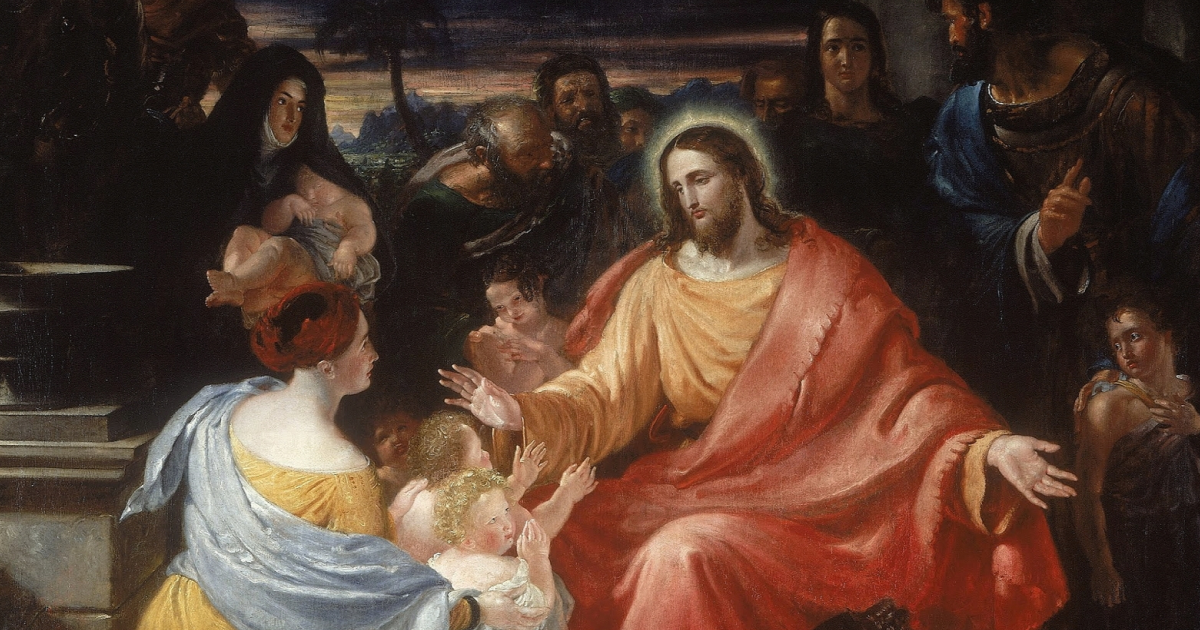
At that time the disciples came to Jesus, saying, “Who is the greatest in the Kingdom of Heaven?” And calling to him a child, he put him in the midst of them and said, “Truly, I say to you, unless you turn and become like children, you will never enter the Kingdom of Heaven. Whoever humbles himself like this child is the greatest in the Kingdom of Heaven. Whoever receives one such child in my name receives me.
“See that you do not despise one of these little ones. For I tell you that in Heaven their angels always see the face of my Father who is in Heaven.” (Matthew 18:1–5, 10)
The Meditation for that day (page 146) is by Mother Mary Francis of Our Lady PCC:
“There should be no one thing more humbling in life… than the discovery of how little we understand those with whom we associate so intimately. We ought to be humble before these mysterious beings around us… Not to respect uniqueness is already to have disqualified oneself for ever understanding a human being. It is in this way that the extrovert deplores the sensitiveness of the introvert, and the introvert is secretly scornful of the insensitiveness of the extrovert. Thus two persons fail each other… where two persons might have contributed gloriously to the fulfilment of each other. The point is not to ferret out the mysteries of another’s personality, but to wait humbly outside the portals in case one might ever be needed inside. It is a false and devouring love that seeks to pick the locks of another’s soul, but it is a humble and detached love which observes and waits at the door.”
Heather King’s Credible Witness this month (page 151) is Venerable Margaret Sinclair (1900–1925), a Scottish extern sister in the Order of the Poor Clares, who displayed heroic virtue while dying of tuberculosis at the age of 25, just months after making her first profession, echoing one of her favourite saints, St Thérèse. Her life is a fascinating story of humble origins ultimately leading to total consecration to Christ. Her cause for canonisation was introduced in 1942 and, as Pope St John Paul II observed of her:
“Margaret could well be described as one of God’s little ones, who through her very simplicity was touched by God with the strength of real holiness of life, whether as a child, a young woman, an apprentice, a factory worker, a member of a trade union, or a professed Sister of religion.”
Wednesday 12th is the memorial of another remarkable woman, St Jane Frances de Chantal, whose much longer life – she died in 1641 – took her from a high-born position as a married woman and mother to the creation of a new order for older or infirm women, the Visitation, which she founded with her spiritual director, St Francis de Sales. She herself knew how to direct women in the spiritual life, as the extract from her letters attests (page 159):
“May you all live in harmony with one heart and mind in God… Show a childlike trust and gentleness towards one another, supporting each one in mutual charity. Never be astonished at the faults of the community or of any individual Sister, for to be shocked at our Sisters’ faults, to pick them apart, examine them, to get all upset about them, is the sign of a narrow-mindedness which has no insight into human frailty, and very little charity or forbearance.”
Thursday’s optional memorial is of Ss Pontian and Hippolytus, 3rd-century theologians and martyrs who were originally rivals for the papacy. Hippolytus is the only former antipope to have died a martyr, after being reconciled with the Church. This week’s Old Testament readings from the Book of Ezekiel continue with a particularly strong depiction of how the prophets can dramatise the lessons God wants to convey to His people.
The word of the Lord came to me: “Son of man, you dwell in the midst of a rebellious house, who have eyes to see, but see not, who have ears to hear, but hear not, for they are a rebellious house. As for you, son of man, prepare for yourself an exile’s baggage, and go into exile by day in their sight. You shall go like an exile from your place to another place in their sight. Perhaps they will understand, though they are a rebellious house.” (Ezekiel 12:1–2)
The Meditation for the day is from Blessed Franz Jägerstätter (†1943), an Austrian farmer, husband and father who was executed for refusing to serve in the Nazi army.
“Pertinent here is the adage: ‘What you do not want others to do to you, do not impose on others’ (cf Matthew 7:12). We are able to give many more death blows with our tongues than with our hands. With our words, we can quickly destroy a person’s honour. What it does to us when we learn that someone has made known our mistakes or has disgraced us, so it also does to others, whether these others are poor or rich, of high or low rank. Even if others treat us unfairly many times or offend us, we should not harbour hatred against them or hold a grudge against them.”
Appropriately, the following day celebrates the great martyr of Auschwitz, St Maximilian Kolbe, who, after taking the place of another man, died in the starvation bunker on August 14, 1941. The Meditation is from his writings:
“If you are leaving Poznań to go to Kraków, you should not go northwards, but you must necessarily travel southwards. Similarly, you should not move to the west or to the east, even if you are attracted by the beauty of nature and the easiness of the journey. The same thing happens in relation to people’s ultimate purpose in life, [which is] to be reached using everything one possesses as means to that end, leaving aside all that is contrary to it. All the different purposes people have in life are useful as long as they lead them to that ultimate purpose… We should also remember that if we have a friend who has not had to undergo some hardship for our sake, we are still not sure whether this person is a true friend or not; but when he or she puts up with difficulties and sufferings for our sake, then we will be shown that this friendship is authentic. In fact, a true friend is always ready to suffer for the beloved person. Therefore, we should not be surprised to find that the saints have sought their paradise on this earth, not in its worldly pleasures, honours or riches, but in poverty, humiliations and sufferings accepted for the love of God.”
Saturday 15th – the Assumption being transferred to the Sunday – gives us a beautiful meditation from Caryll Houselander which picks up again on the theme from Tuesday’s Gospel, linking the holiness of children with that of Mary.
“Christ’s insistence on the power of children is very striking. Almost more than anything else in the Gospel it proves that in God’s eyes being something comes before doing something. He sets a little child among his Apostles as an example of what he loves. He says that Heaven is full of children. Indeed, the Architect of Love has built the door into Heaven so low that no one but a small child can pass through it, unless, to get down to a child’s little height, he goes in on his knees. How consistent it is with the incredible tenderness of God that his Christ, the Immortal Child, should be conceived by the power of the Spirit in the body of a child. That a child should bear a Child, to redeem the world. Our Lady was at most 14 when the angel came to her; perhaps she was younger. The whole world trembled on the word of a child, on a child’s consent.”
The Vigil Mass of the Solemnity of the Assumption of the Blessed Virgin Mary has a Collect that gives eloquent expression to this mystery:
“O God, who, looking on the lowliness of the Blessed Virgin Mary,
raised her to this grace, that your Only Begotten Son was born of her according to the flesh and that she was crowned this day with surpassing glory, grant through her prayers, that, saved by the mystery of your redemption, we may merit to be exalted by you on high.”
The Gospel picks up the true meaning of Mary’s discipleship, which goes far beyond her physical role.
At that time: As Jesus was speaking to the crowd, a woman in the crowd raised her voice and said to him, “Blessed is the womb that bore you, and the breasts at which you nursed!” But he said, “Blessed rather are those who hear the word of God and keep it!” (Luke 11:27–28)
After a fascinating pilgrimage with Anthony Esolen to the home of St Augustine, celebrating Our Lady of Africa (page 204), we pass to the Solemnity itself. The introduction to the Mass for this Sunday reminds us why this feast has such prominence, quoting Mgr Ronald Knox: “That transformation of our material bodies to which we look forward one day has been accomplished – we know it now for certain – in her.” The first reading is the famous vision from the Book of Revelation.
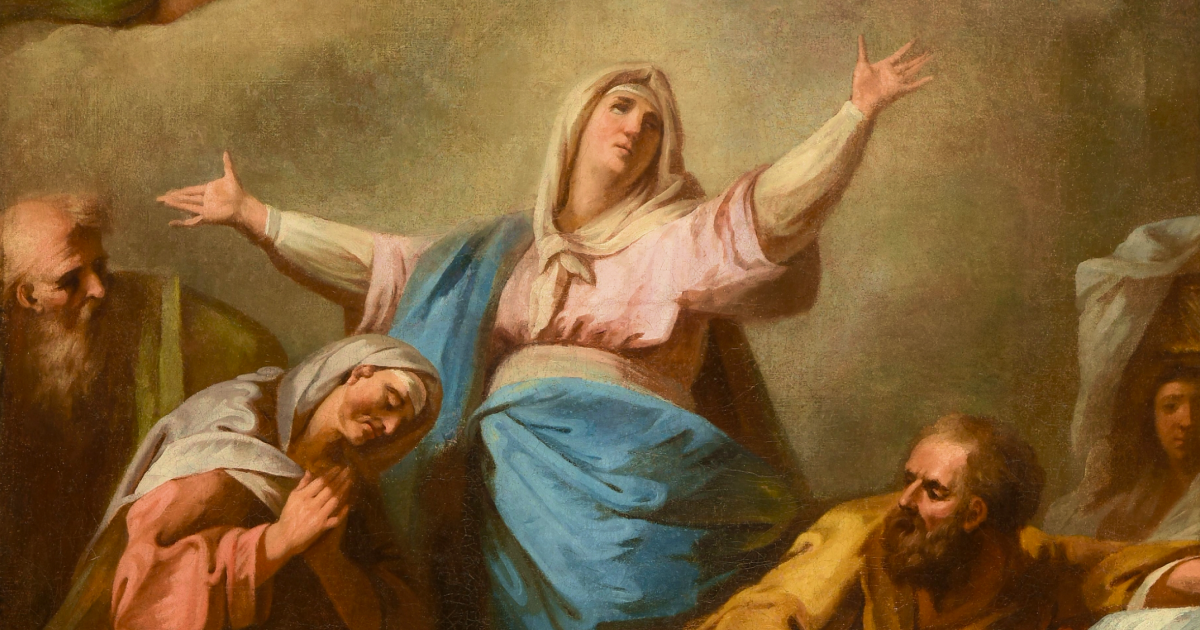
“And a great sign appeared in Heaven: a woman clothed with the sun, with the moon under her feet and, on her head, a crown of 12 stars. She was pregnant and was crying out in birth pains and the agony of giving birth.” (Revelation 12:1–2)
Finally, the Gospel for the Assumption relates the moment when Our Lady bequeathed to us the great prayer after which the book you hold in your hands is named.
“My soul magnifies the Lord, and my spirit rejoices in God my Saviour,
for He has looked on the humble estate of His servant.
For behold, from now on all generations will call me blessed;
for He who is mighty has done great things for me,
and holy is His name.
And His mercy is for those who fear Him from generation to generation.
He has shown strength with His arm;
He has scattered the proud in the thoughts of their hearts;
He has brought down the mighty from their thrones
and exalted those of humble estate;
He has filled the hungry with good things,
and the rich He has sent away empty.
He has helped His servant Israel, in remembrance of His mercy,
as He spoke to our fathers, to Abraham and to his offspring for ever.”
(Luke 1:46–55)
Magnificat is a spiritual guide to help you develop your prayer life, grow in your spiritual life, find a way to a more profound love for Christ, and participate in the holy Mass with greater fervour. If you are in the UK, you can subscribe here.