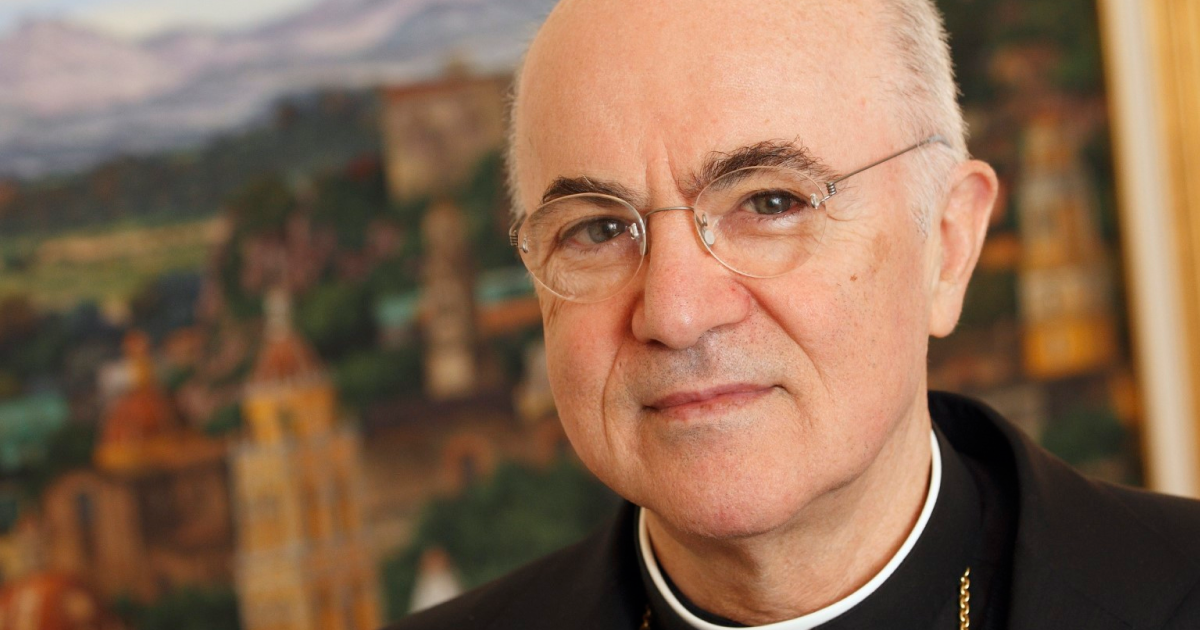


Archbishop Carlo Maria Viganò has released the full text of a private letter sent to Pope Leo XIV on January 25, 2026, in which the former apostolic nuncio to the US defends his record of service under five popes, rejects his 2024 excommunication as illegitimate and urges the new Pontiff to confront what he describes as the Church’s rupture with Tradition.
The text, published by LifeSiteNews on June 15, comes months after Viganò’s repeated attempts to secure a papal audience were reportedly accepted then cancelled. In the letter, addressed from Viterbo on the feast of the Conversion of St Paul, the 85-year-old prelate recounts his diplomatic career, his role in exposing clerical corruption and his growing conviction that the Second Vatican Council marked a deliberate break with the Church’s perennial magisterium.
Born in Varese on January 16, 1941, into a “deeply Catholic family”, Viganò was ordained in 1968. He entered the Pontifical Ecclesiastical Academy in 1971 and served in nunciatures in Baghdad, Kuwait and London before holding senior posts in the Secretariat of State. Consecrated bishop by Pope St John Paul II, he served as nuncio to Nigeria from 1992 to 1998, delegate for pontifical representations from 1998 to 2009 and secretary general of the Governorate of Vatican City State under Benedict XVI. In 2011 he was appointed nuncio to the US, a post he held until 2016.
“I was born … into a deeply Catholic family, thanks to which I was able to grow up practising my Faith daily,” he wrote. He described handling “the most confidential and delicate cases concerning bishops and cardinals, including the dossier of Theodore McCarrick”, actions that he said led to his removal from key posts despite turning around the Governorate’s finances from a €15 million deficit to a €35 million surplus in 18 months.
Viganò detailed personal restrictions imposed after 2016: expulsion from the Washington nunciature on his 75th birthday, revocation of Vatican citizenship and passport under Francis, denial of healthcare access and removal of his Vatican driver’s licence held since 1973. “He also forbade me from residing in the Roman residence for retired nuncios that was specially prepared by Pope Benedict,” he stated.
His 2018 testimony on McCarrick and alleged Curial complicity, he said, forced him into hiding on the advice of Cardinal Raymond Burke amid threats and following the suspicious death of his predecessor, Archbishop Pietro Sambi. This led him to question “the deep origins of the disastrous state of the Catholic Church”.
The letter offers a detailed critique of the Council and its aftermath. Viganò recalled seminary formation already shaped by “new theologians” such as Küng, Rahner and Congar before the Council concluded. He described a “conciliar revolution” that followed “a very precise script”, with documents designed for both orthodox and heretical interpretations. “The very architects of Vatican II defined it as ‘the 1789 of the Church’,” he wrote, citing its self-understanding as heterogeneous to prior councils.
Viganò recalled: “I witnessed the haemorrhaging of thousands of priestly and religious vocations, while those priests who did not want to support the new conciliar path nor abandon the Tridentine Liturgy were ostracised, treated as heretics, excommunicated or suspended a divinis, deprived of their salaries and left to die in solitude.”
Regarding its ultimate end point, the archbishop observed: “The Council facilitated and contributed to the de-Christianisation of the West and the establishment, in the civil sphere, of a new order conforming to the designs of Freemasonry. The plans of the lodges are well known, and we are aware that they involved infiltrating the Catholic Church and attacking her from within to achieve their predetermined goals.”
He recounted rediscovering the Traditional Latin Mass, which he celebrated at his 1968 ordination, and founding the Exsurge Domine Foundation to support persecuted clergy and seminarians, including members of the dissolved Familia Christi fraternity. “Abandoning the Montini Mass marked a new phase in my episcopal ministry,” he explained.
On his canonical status, Viganò was unequivocal: “In the face of the excommunication unjustly imposed upon me, I declare that I am not a schismatic! By the grace of God, I am and will remain a devout son of the Holy Roman Church … I firmly believe in the apostolic communion, and I recognise the Petrine primacy.” He argued that his accusers had failed to refute his arguments and acted out of ideological motive.
The archbishop contrasted his treatment with the leniency shown to others. He cited the case of Peruvian priest Eleuterio Vásquez Gonzales, known as Padre Lute, who was accused of sexual abuse and received dismissal from the clerical state without trial, while the victims’ canon lawyer was reportedly sidelined. “This case repeats the same modus operandi of Bergoglio previously adopted with McCarrick,” he wrote.
Viganò appealed directly to Leo XIV, the first American Pope, elected in May 2025 following the death of Francis. “I cannot understand how, after the disastrous experience of Jorge Bergoglio, you not only refuse to condemn his errors and scandals, but also seize every opportunity to reaffirm your complete continuity with them,” he stated, invoking Pope Leo XIII and questioning how the Church had reached a point where pre-conciliar popes would be judged schismatic by today’s standards.
He concluded by asking the Pope either to confirm him in the Faith or identify where he contradicts the Deposit of Faith: “Tell me in what way I have contradicted the Catholic Faith, and I will amend myself … I ask you to exercise your supreme authority to confirm the brethren in the Faith.”
The letter, sent by Vatican post, has received no public response from the Holy See as of June 18. Viganò’s excommunication latae sententiae, declared in July 2024 for denial of the legitimacy of Francis and rejection of Vatican II, remains in effect under the new pontificate. Traditionalist observers continue to watch closely for any signs of liturgical or doctrinal shifts under Leo XIV, whose background as an Augustinian with extensive experience in Peru has drawn mixed early assessments from conservative quarters.