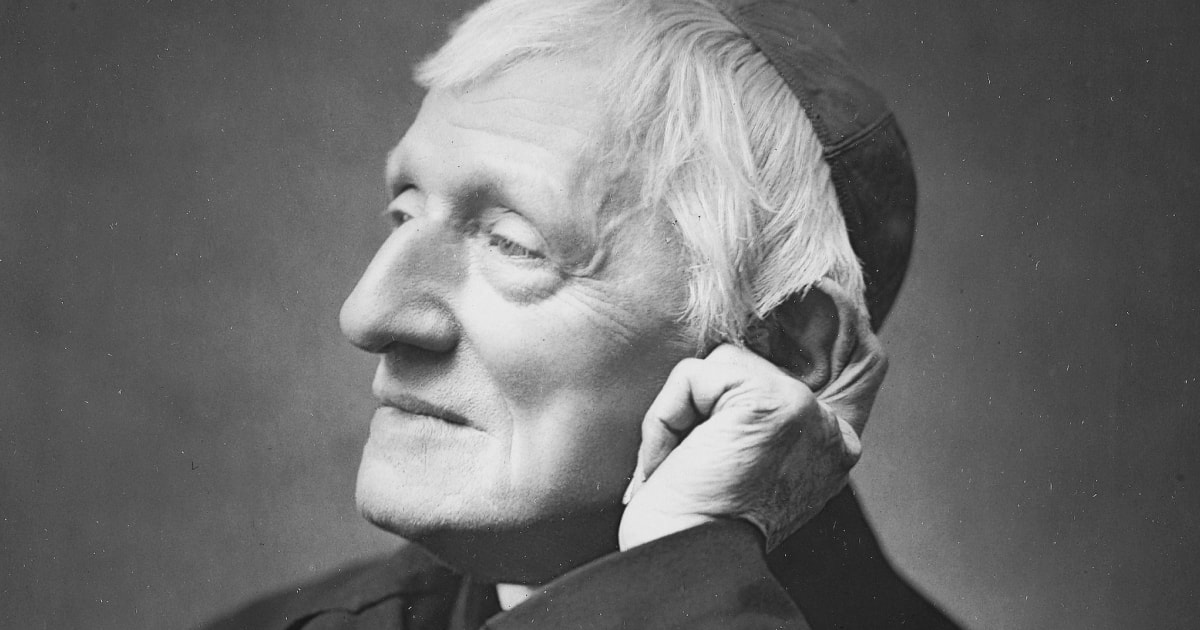


St John Henry Newman is frequently remembered as the great convert of the 19th century; far less attention has been paid to the fact that he was also among the most perceptive critics of how conversion itself is pursued, measured and – one might say, with only slight exaggeration – occasionally miscounted.
Newman resists, with characteristic sobriety, the assumption that the vitality of the Church can be gauged by the number of those entering her visible bounds. He relocates the question within a far more demanding horizon: the formation of a Catholic mind capable not only of receiving truth, but of sustaining and integrating it. He understands conversion not as a spiritual headline, or even the decisive moment in the convert’s life, but rather the threshold of a much longer and more exacting process.
It is precisely here that Newman’s well-known caution assumes its full force. Reflecting on the tendencies of ecclesial life in his own day, he observes with disarming frankness: ‘At Propaganda, conversions, and nothing else, are the proof of doing any thing. Everywhere with Catholics, to make converts, is doing something; and not to make them, is “doing nothing”.’ The remark seems to be diagnostic. It exposes a subtle but persistent temptation to reduce the life of the Church to visible outcomes, to mistake numerical increase for spiritual vitality and depth.
Against this tendency Newman sets his own principle with equal clarity: ‘To me conversions were not the first thing, but the edification of Catholics.’ The priority is unmistakable. What matters most is not the expansion of the Church in numbers, but the formation of those within her – an education in the fullest sense of the word, by which the intellect is refined, judgement is disciplined and the relation of truth to truth is gradually perceived. Quality over quantity, one could say.
This emphasis leads Newman to a further, more uncomfortable observation – one that retains its relevance with surprising force. ‘Catholics… from their very blindness, cannot see that they are blind.’ A community insufficiently formed will not easily recognise its own deficiencies; indeed, it may resist precisely those efforts that would remedy them. Hence his insistence that the true work of the Church lies in what he calls, in a deliberately expansive sense, education: ‘by giving them juster views, by enlarging and refining their minds, in one word, by education’.
What emerges from these reflections is a conception of conversion that is at once more demanding and more realistic than many contemporary accounts. Conversion, for Newman, is not merely assent to a set of propositions, nor a moment of existential decision, but the reconfiguration of one’s entire intellectual and moral horizon. It is an entry into a form of life in which truth must be learned, inhabited and, over time, understood. And this takes time.
The contemporary landscape offers no shortage of occasions to revisit this insight. In recent years, a number of public figures – media personalities, commentators and cultural critics – have turned towards the Catholic faith, often in ways that attract considerable attention. Figures such as Candace Owens, Russell Brand or even Shia LaBeouf, who speak openly about religious questions and, at times, gesture towards Catholicism, exemplify a broader cultural movement: a renewed curiosity about tradition among those previously formed by late-modern scepticism. Such developments are not without significance; indeed, they may reflect a genuine desire for order, coherence and transcendence in a disordered age. And yet, one cannot entirely suppress the suspicion that conversion, when it unfolds under the conditions of publicity, risks acquiring a certain theatrical dimension. It becomes, if not quite a performance, then at least an event.
Newman would not have dismissed such cases; but he would almost certainly have received them with patience rather than enthusiasm. His concern was never with the fact of conversion as such, but with its durability – its capacity to mature into understanding. He knew that conviction formed quickly is often tested slowly, and that the real difficulties of faith emerge not at the moment of entry, but in the long labour of assimilation. One suspects that he would have regarded the modern phenomenon of highly visible ‘intellectual conversions’ – often accompanied by podcasts, interviews and immediate commentary on complex theological matters – with a certain quiet reserve. Not because such voices are unwelcome, but because the weight of the tradition they have entered cannot be mastered at the speed of a news cycle.
By contrast, there are quieter examples – less visible, though perhaps more instructive – of conversion undertaken with precisely the seriousness Newman describes. Figures such as Abigail Favale, whose intellectual journey into the Church is marked by careful study and sustained engagement with both feminist theory and Catholic anthropology, or Scott Hahn, whose conversion unfolded through years of scriptural and theological inquiry and has continued to bear fruit in a lifetime of teaching, exemplify a different rhythm. Here conversion does not culminate in declaration, but unfolds into a sustained engagement with doctrine, tradition and the life of the Church. It is marked less by immediacy than by patience, less by assertion than by study. One might say, with only slight irony, that such conversions are almost invisible precisely because they are real. Here one finds what Newman sought: not merely converts, but minds formed in the truth they profess.
His famous desideratum for the laity follows directly from this vision. He calls not for a body of believers animated primarily by zeal, still less by controversy, but for one that is deeply instructed – men and women who know their religion, who understand where they stand and who can give an account of their faith with clarity and composure.
Newman’s own tone, it should be noted, is never triumphalist. He is acutely aware of his own limitations, remarking with disarming humility: ‘I have nothing of a Saint about me… It is enough for me to black the saints’ shoes – if St Philip uses blacking, in heaven.’ The remark is lightly humorous, but it serves a serious purpose. It situates the entire question of conversion and formation within a framework of humility: the recognition that truth is received, not possessed.
The force of Newman’s insight is, if anything, sharper today. In our social media-saturated way of seeing the world, the tendency to confuse visibility with vitality and metrics with meaning is pervasive. Newman’s call to sobriety and maturity is therefore especially welcome. The strength of the Church lies not in how many enter, but in what they become once inside. What matters is whether a Catholic mind emerges on the other side of conversion: a mind formed slowly enough to bear the weight of truth, and a soul disciplined enough not to mistake first enthusiasm for final understanding. For the real drama of conversion does not occur at the moment of entry, but in what follows – when the novelty fades, the questions deepen and the work begins. A Church attentive to this will be less impressed by arrivals, and more concerned with formation; less interested in counting converts, and more in keeping them.
.jpg)


.jpg)
.jpg)