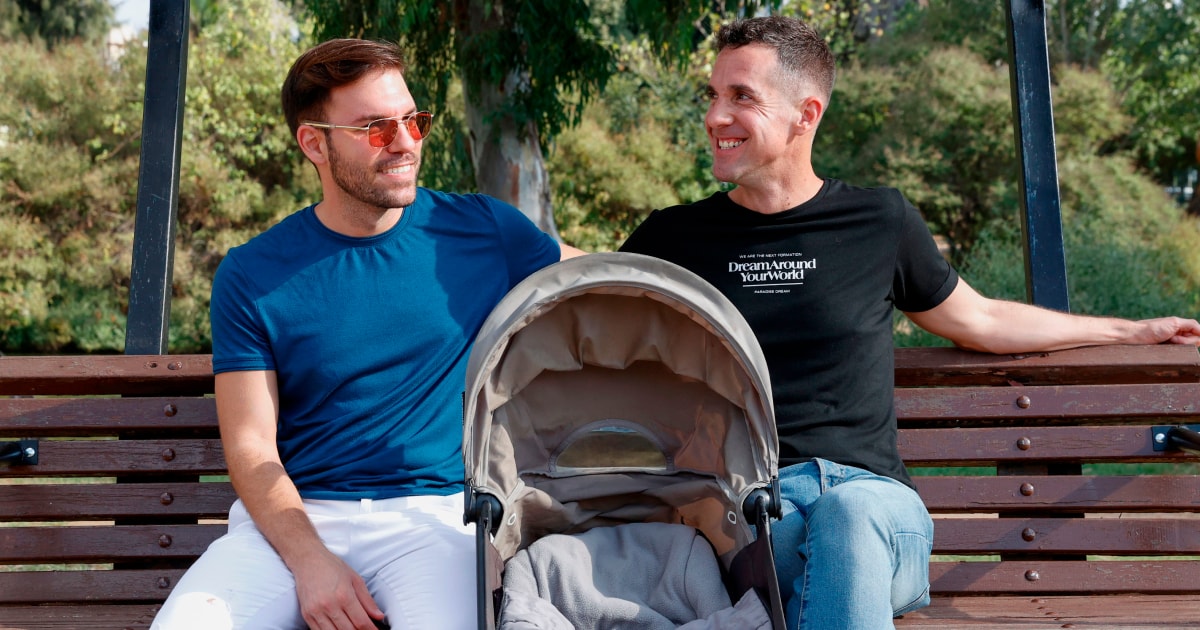

The video is brief, almost throwaway. A five-month-old baby, reaching instinctively for ‘mama’, is met not with recognition but with laughter. Behind the camera, two fathers mock the child’s cry, captioning the moment with a glib ‘who’s going to tell him’. It was posted by Shane McAnally, a Grammy award–winning country artist, and quickly circulated online as light-hearted content.
The clip is not just uncomfortable, it is disturbing: a baby separated from his mother, crying out, while the adults who arranged it laugh. What is presented as a joke reflects a culture where surrogacy, and the loss it involves, is becoming normalised.

Surrogacy today is often presented as an empowering arrangement. Celebrities openly share their journeys, whether to avoid the physical toll of pregnancy or to build families otherwise biologically unavailable to them. For many same-sex couples, it is described as a hopeful, even beautiful, path to parenthood. And in many cases, all parties involved – the surrogate, the egg donor, the commissioning parents – enter the arrangement with consent, goodwill and even love, with particular attention on the surrogate mother, who is hailed as a modern-day martyr.
This is why critiques of surrogacy rooted purely in exploitation of women can sometimes feel insufficient. While many feminists raise serious concerns about the commodification of women’s bodies, those arguments can lose traction when faced with individual stories of willing participation and mutual benefit.
Focusing exclusively on adult consent risks missing the central figure in the arrangement: the child. To understand this, we cannot begin from a place of what adults desire, but with what children are owed. Every child, as a matter of natural right, has an inherent claim not only to life but to their mother and father, to an origin that is not fragmented, contractual or commercialised. In surrogacy, what should be one relationship, ‘mother’, is divided into three distinct roles: the genetic mother (egg donor), the birth mother (surrogate) and the social mother (the one who raises the child, if there is one).
None of these roles is trivial. The genetic mother provides biological identity. The birth mother establishes the earliest bond of trust and attachment. The social mother offers the ongoing maternal presence essential for development. Children who are born from a surrogate are fortunate if they have this social mother. When these roles are separated, something is lost. Not always visibly, not always immediately, but meaningfully.
In cases of tragedy, death, abandonment or separation, we recognise this loss and respond with compassion. But surrogacy is different. It intentionally engineers that separation from the outset. The child is not losing a mother by circumstance, but by design.
This is where the concept of the ‘primal wound’, introduced by psychologist Nancy Verrier, becomes relevant. Originally developed to describe the trauma experienced by adopted children separated from their birth mothers, it points to a deep, pre-verbal rupture in attachment. Adoption, at its best, seeks to heal that wound. Surrogacy, by contrast, creates it deliberately.
Research, while ethically constrained in human contexts, offers insight through animal studies. The controversial experiments of psychologist Harry Harlow demonstrated the profound effects of maternal deprivation in infant monkeys. More recent studies have found that even when surrogate care meets all physical needs, separation from the biological mother leads to increased anxiety, impulsivity and altered stress responses. In rodents, even brief maternal separation can permanently reshape brain structure.
Humans are far more complex in their capacity for attachment than any animal model. If such separation produces measurable harm in animals, it is reasonable to be alarmed at what the consequences may be for human children, whose emotional and relational needs are deeper still.
Some longitudinal studies suggest that children raised without stable parental bonds are more likely to struggle academically, face developmental challenges and experience higher risks of mental health issues, including depression and suicidality. While outcomes vary and are influenced by many factors, the consistent thread is that early relational disruption matters.
Returning to the video, what makes it unsettling is not merely the tone of the adults, but what it represents. The baby’s call for ‘mama’ is not learned behaviour, it is instinctive. It reflects an expectation embedded at the level of human development: that there is, or should be, a mother.
This is why the moment feels so jarring. It is not just a joke at a baby’s expense. It is a glimpse into a broader reordering of relationships, where adult intention overrides child-centred norms, and where the absence of a mother is not mourned but celebrated as progress.
The conversation around surrogacy cannot remain focused solely on adult autonomy or desire. It must reckon with the rights of the child, the only party who does not choose, does not consent and cannot articulate their loss. Because when a five-month-old calls out for ‘mama’, the question is not who will “tell him” the truth. The question is whether we are willing to hear what he is already saying.


.jpg)