

Representatives of Europe’s Churches met with the Taoiseach recently, saying the crises facing the continent required a return to the founding ideals of European integration – a project shaped by Catholic statesmen in the post-war era.
Bishop Mariano Crociata of Latina, head of the Commission of the Bishops’ Conferences of the European Union, joined other Church leaders in a meeting with Taoiseach Micheál Martin on July 9. They discussed the many issues facing Europe today – migration, the war in Ukraine, the development of its defence capabilities and the erosion of multilateralism – and called for the bloc to renew its “commitment to the EU’s founding vision”.
Open, transparent and regular dialogue between the EU and the Churches are provided for under Article 17 of the Treaty on the Functioning of the European Union (TFEU). Today, the European Union is defined in the minds of many as the archetypal secular institution – not atheistic, but pluralistic. Byzantine, only in the bureaucratic sense.
Much can be said of the Catholic Church’s role in the forging of the idea, or recognition, of Europe as a polity. The name developed a new meaning in the Middle Ages as, sandwiched between the sea, the sultans, and the steppe, the idea that those under what was left of Christendom were one people began to take hold.
Yet if we look at the institution of the EU today, the symbolism remains. The flag of Europe, adopted by the Council of Europe in 1955 on the Feast of the Immaculate Conception of the Blessed Virgin Mary, draws heavily from Marian imagery. The circle of 12 stars that sit atop Our Lady’s blue echoes the Woman of the Apocalypse in Revelation 12. One such statue stands in Our Lady of Strasbourg Cathedral, where the European Parliament sits. By adding a rose to the middle of the flag, you will create the arms of the abbot and Servant of God Prosper Guéranger OSB.
It owes not just its symbols but also the foundational structure and the ethos of reconciliation to great Catholic figures of the 20th century who saw in the horrors of their time no alternative but to return to those old ideas and reform them into their new age.
In 20 years and 21 days, Europe had seen two world wars that had left it decimated, half under the grip of the Soviet Iron Curtain, half clinging to the creeping encroachment of American power. At the turn of the century, many European nations stood themselves at the heights of world power. Now, they were a theatre of competing powers at their periphery. The conquerors had become the conquered.
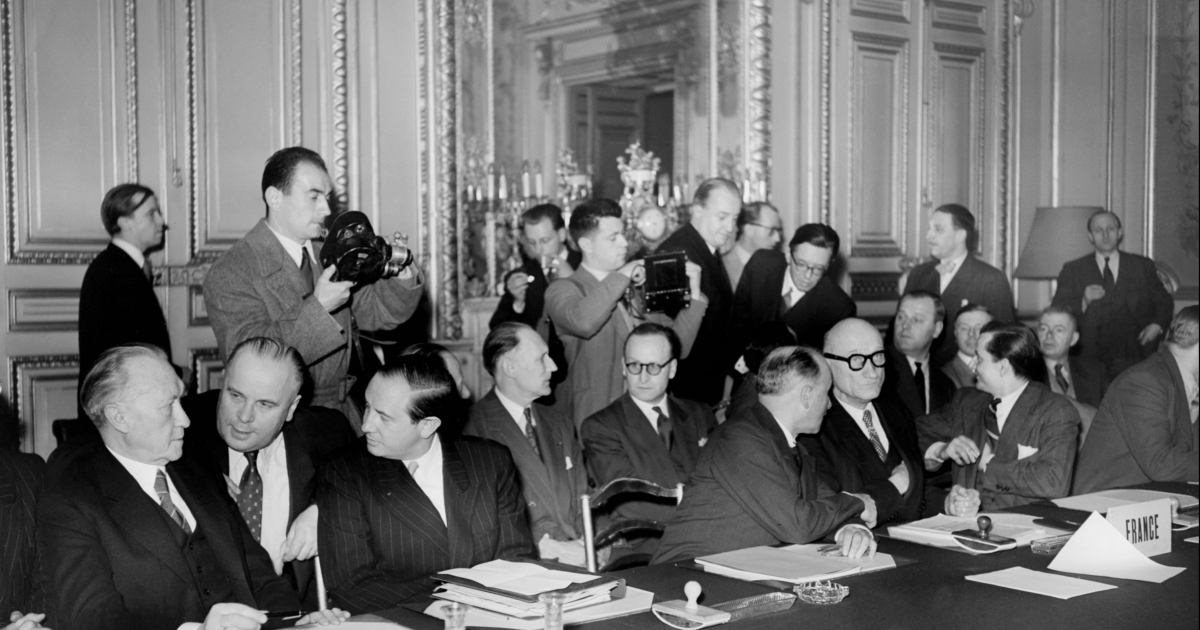
Few had a more extreme experience of the change than Konrad Adenauer (1876-1967). He was born just under five years after German Unification by Chancellor Otto von Bismarck. By the time Adenauer would accede as Chancellor, the empire would be abolished, a fledgling democracy installed, a dictatorship proclaimed, and the nation defeated in another ruinous war. Notably, Adenauer’s reign would begin at the undoing of the unification of his nation of which he was almost as old.
A devout Rhenish Catholic, he was formed by the struggle between the Catholic Church and the Prussian state, the Kulturkampf. He would join the Catholic Centre Party and serve as Mayor of Cologne before his dismissal, freezing of his bank accounts and brief imprisonment when the Nazi Party came to power.
One of his first major commitments was to Western European integration, at the price of continued German division. In this project, which had modest immediate economic goals but a grand ambition of civilisational unification, Adenauer was joined by a number of Catholics at the helm.
Frenchman Jacques Maritain, a convert to the Faith, philosopher and theologian had pushed from the beginning of the Second World War his vision of a united Europe as a reforged Christendom.
Robert Schuman served as Prime Minister of France and President of the European Parliament. A devout Catholic like Adenauer, he laid the groundwork for the Council of Europe, the European Economic Community, and the European Coal and Steel Community (ECSC). In 2021, he was declared Venerable by Pope Francis.
Italian Prime Minister and Servant of God Alcide De Gasperi led his country into the ECSC and is considered one of the so-called “Founding Fathers of Europe”. Both he and Adenauer were profoundly influenced by Pope Leo XIII’s teachings.
Two of these men are on the path to sainthood, but all of them were committed to the establishment of Catholic social teaching through the instrument of European democracy and integration. That, perhaps, is what today’s bishops were harking back to in their calls for a return to Europe’s “founding values”.
It would be remiss not to mention one last figure. A man, like Adenauer, who lived the transition from the old empires to the infant democracies – and who sought to inject the social project of the old into the new. Otto Von Habsburg was born in the last years of the Austro-Hungarian Empire. He would be the first in his line to become heir to the nation and throne which no longer existed.
The son of Blessed Charles of Austria, he lived in exile following the abolition of the Dual Monarchy. He would support its restoration but also become one of the early voices for a united Europe.
He held as conviction that as the old Europe would not have arisen without God, neither must the new one. In his vision of Europe, it could provide an alternative to the communism in the East and the consumer economy of the West.
On the day the Bundestag ratified the European Coal and Steel Community, January 11, 1952, von Habsburg gave a stirring lecture in Paris: “What separates us Europeans is much less important than what unites us. We are bound together by our history, our religious beliefs, our culture, our economic structure and the constant realities of well-defined politics – in short, everything that matters in the lives of nations."
The European Union of tomorrow will not look like the European Union of today, just as it bears less and less resemblance to the vision proposed by its “Founding Fathers”. In the years preceding Adenauer’s birth, external military threats in Germany led to its unification into one nation. The conflict in Ukraine, at the Union’s periphery, appears to be leading the continent down the often-coupled need for firepower and federalisation.
But on the European Right, we are also seeing a new consensus emerge, one which faced its founders: that perhaps a Europe of individual states will inevitably become the playground of the empires to its left and right. The question of Euroscepticism is far from settled, but it may be time to consider that if unification is Europe’s best hope, it had better arise with God, rather than without Him.