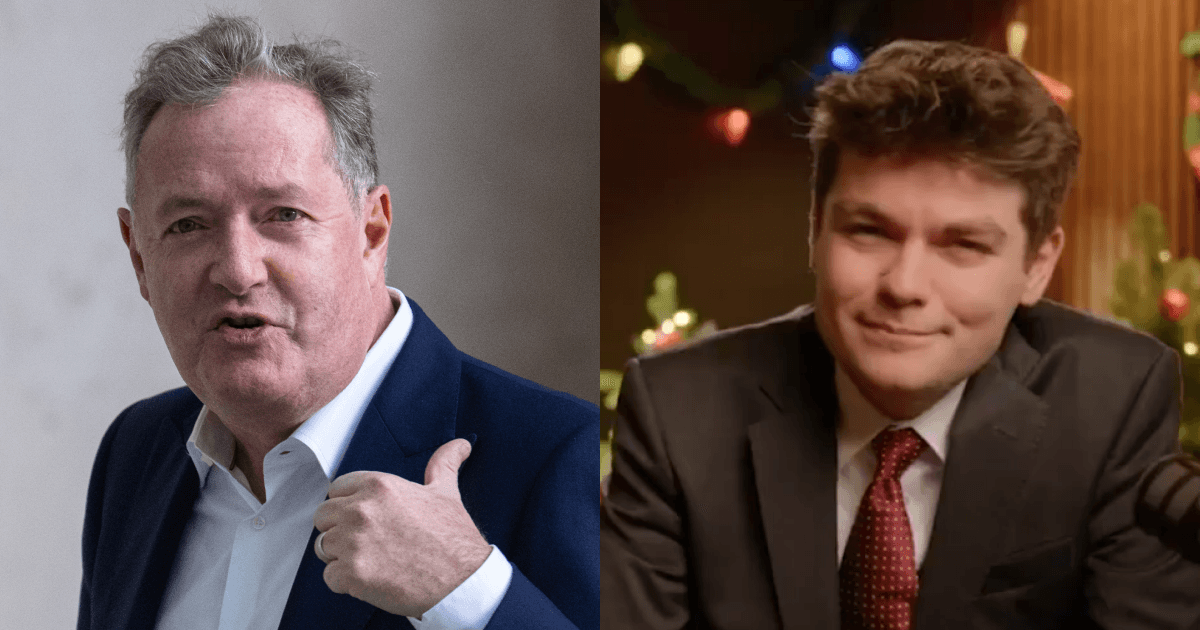
Last week Piers Morgan hosted the controversial American political commentator Nick Fuentes on his YouTube programme Piers Morgan Uncensored.
The wide-ranging interview, broadcast on Monday 8 December, ran for almost two hours and marked one of Fuentes’s most prominent mainstream appearances to date, following his recent interview with Tucker Carlson.
Piers Morgan told viewers that his purpose was to address Fuentes directly rather than speak about him at a distance. “It doesn’t make a lot of sense to spend all this time talking about Nick Fuentes, but not actually to Nick Fuentes,” he said at the start of the programme, adding that his guest was now being discussed “in a more mainstream environment than you may be used to”.
During the conversation, Morgan repeatedly questioned Fuentes about his past statements on Jews, Adolf Hitler and the Holocaust. Challenging his tone and language, Morgan said, “It’s your lack of humanity and compassion for people about things like the Holocaust, about slavery, it’s that that people find so contemptible. And I don’t understand why you need to do that.”
In one of the most watched segments of the interview, Fuentes acknowledged that six million Jews were killed in the Holocaust, a historical fact he has previously questioned. “I’m open to believing the official narrative,” he said. He went on to argue that his principal concern was opposition to Holocaust denial laws in some European countries.
“In many countries, it’s not even legal to talk about it. And that’s really where my interest in the Holocaust begins and sort of ends, to tell you the truth,” he said. He later added, “Can you imagine if in the United States they said, ‘The number of Palestinians killed in Gaza is 100,000, and if you don’t say that, you’re going to jail.’”
Fuentes also stated, “I don’t hate any Jews,” and said, “I really think that every death is a tragedy.” However, the interview later returned to earlier remarks in which he had spoken admiringly of Hitler. When asked directly by Morgan, “You think Hitler was really f—king cool?”, Fuentes replied, “Yes, and I’m tired of pretending he’s not.” Fuentes went on to dismiss Morgan as “a boomer” and suggested that younger generations felt detached from the historical memory of the Holocaust.
During the interview, Morgan pressed Fuentes on his personal life, a moment that quickly drew attention online. When Morgan asked bluntly whether he had ever had sex, Fuentes replied, “No, absolutely not,” prompting the broadcaster to quip, “Wow, says the guy who’s never got laid.”
Pope Leo XIV was raised near the end of the conversation as one of Morgan’s final questions. Morgan noted that the Jerusalem Post had called on Pope Leo to condemn Fuentes and asked whether such a rebuke would matter to him. Fuentes replied that it would. “It would be very disheartening,” he said, explaining that, “Because he is our spiritual leader, he is head of the Church… if he condemned me it would be very disheartening.”
The question naturally arises as to whether Pope Leo XIV would publicly condemn Nick Fuentes as an individual or the America First movement as a whole. Historically, popes have condemned political leaders and political movements. However, since the Second Vatican Council, such condemnations have tended to be issued primarily against theological movements rather than as direct personal or political censures.
During the Protestant Reformation, papal condemnation was both explicit and personal. In 1521 Pope Leo X formally condemned the teachings of Martin Luther and excommunicated him, signalling the Church’s rejection of the emerging Protestant movement. This stance was reinforced by subsequent pontiffs through the Council of Trent, convened between 1545 and 1563, which condemned Protestant theological and political doctrines.
Throughout the nineteenth century, popes continued to denounce movements they regarded as hostile to Catholic doctrine. Political groups such as the Carbonari were repeatedly condemned, with Catholics forbidden from joining organisations perceived as anti-clerical or subversive. Liberal Catholic movements also came under scrutiny. In 1832 Pope Gregory XVI issued the encyclical Mirari Vos, condemning the ideas promoted by Hugues Félicité de Lamennais and his journal L’Avenir, which advocated religious liberty, democracy and the separation of Church and state. Lamennais’s refusal to submit to papal authority ultimately led to his excommunication.
In the early twentieth century, Saint Pope Pius X condemned the French lay movement Le Sillon, criticising its democratic and egalitarian vision as theologically unsound. In an apostolic letter to the French bishops in 1910, he warned that its understanding of authority and liberty risked undermining both the Church’s structure and its doctrine.
The case most closely resembling the America First movement was the Church’s confrontation with Action Française. This ultra-monarchist group, led by Charles Maurras, defended Catholic cultural influence but was condemned by Pope Pius XI in 1926. The Pope was alarmed that Maurras, an agnostic, treated religion primarily as a tool of nationalism. He condemned the attempt to restore the French monarchy through Catholicism framed in utilitarian and nationalist terms.
Pius XI approved a decree of the Holy Office placing Action Française’s key writings on the Index of Forbidden Books. The papal ban was lifted only in 1939 by Pius XII, by which time the movement had been gravely weakened.
As with the historical case of Action Française, there are parallels with the America First movement and its leader Nick Fuentes. However, at the present stage of the Church’s life, it appears unlikely that Pope Leo XIV would meet the expectations voiced by the Jerusalem Post for a public, political condemnation of Fuentes or America First by name.
What appears more likely is that Pope Leo XIV would condemn the underlying principles associated with the movement rather than issue a direct personal or organisational rebuke. While it remains within papal authority to name and denounce a specific individual or group, the contemporary pattern of papal intervention suggests a preference for addressing ideas and moral errors rather than engaging in overt political naming.


.png)


.jpg)