
March 27, 2026

Europe’s crypts still have lessons for the living

Georgia L. Gilholy
More
Related
Min read
share

Visiting dead bodies is higher on more people’s city-break bucket lists than you would expect. Particularly at the height of summer, crypts designed to preserve decaying remains tend to function as a cool respite from the sweaty Plätze and piazze teeming with handbag hawkers and bulging crowds of tourists.

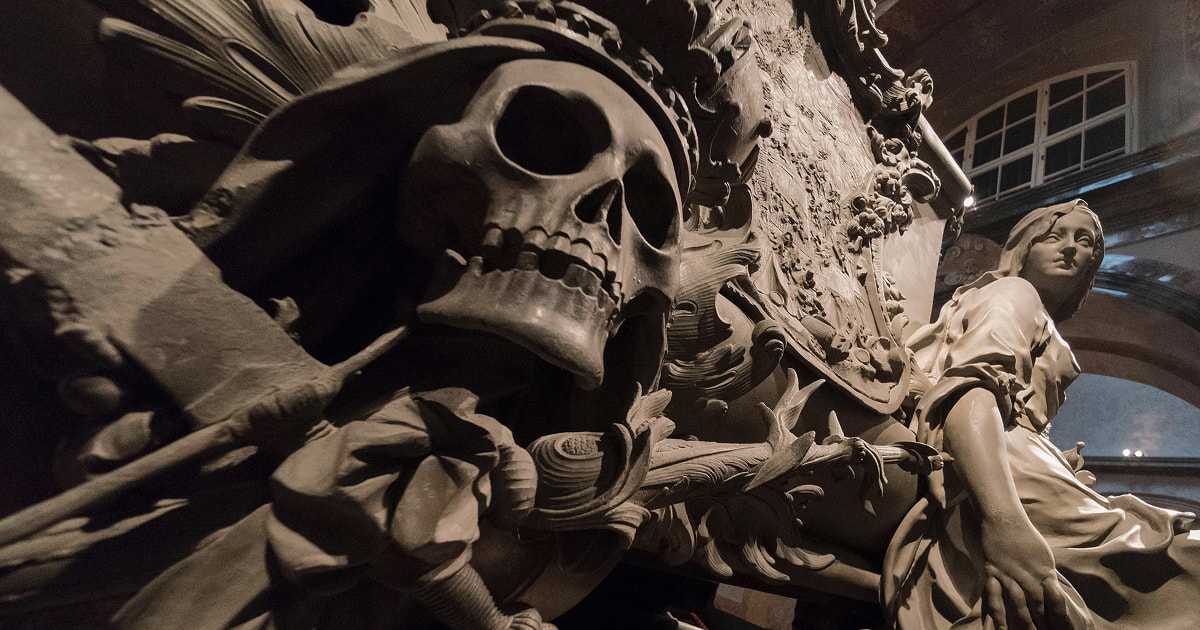
Tucked under the Capuchin church, Vienna’s Imperial Crypt is one such haunt. It was here that I found myself last year, imagining I was superior to the other visitors and, in some respects, confirming that assumption. Like a hair-netted Ena Sharples shaking her head at the raucous youth of 1960s Salford, my eyes twitched at the antics of my fellow travellers.
For centuries, the crypt has been home to the remains of high-ranking members of the Habsburg line. The tombs, which received their most recent resident in 2023, preserve a long-running ritual that certainly puts the corpses of these once-powerful figures in their place. As Eduard Habsburg detailed in his 2024 book The Habsburg Way:

“When the master of protocol knocks at the door that leads down to the crypt, a monk from inside asks three times, ‘Who is there?’ And then they read all the titles, saying, ‘Zita, empress of Austria, queen of Hungary, queen of Bohemia, queen of Croatia,’ and all the titles. And the voice says, ‘We don’t know her.’ And then he will knock again, and he will say, ‘Who goes there?’ And then they would read all the achievements of that ruler, everything he or she has done, all the wars fought, all the marriages, all the children. And again, the voice would say, ‘We don’t know him.’ And then, the third time he knocks, he says, ‘Who goes there?’ He would say, ‘Zita, a poor, sinful woman.’ And then the door opens.”

This is not a gimmick but a profound recognition of Christian truth. As we are reminded yearly on Ash Wednesday, “For dust we are and to dust we shall return.” As much as we are all capable of redemption, we are all born sinners, regardless of our station or lack thereof here on Earth.

To me, the crypt felt like a serious place in which to reflect on these facts. Indeed, that is partly why I chose to pass through it. Sadly, where one might have expected silence but for whispered prayer, the shadowy halls were instead chock-full of people chuckling and posing for smiley selfies. Tourists barked in various languages on loud video calls, which for some reason they thought urgent enough to take while gawking at these graves, some of which belonged to children and babies. Was I witnessing an episode of mass hysteria provoked by proximity to death, or further proof that any sense of decorum is in free fall?

So why does this place exist at all, if not to be shared on an Instagram story? The Kapuzinergruft’s ornate sculptures, tombstones and opulent artwork certainly reflect the tastes of their times and the Habsburgs’ prestige, but putting on a show was surely not their only concern. After all, many of their members had more than enough chances to do so in life.

This crypt, and so many others, are not merely intended to provide a fitting tribute to the dead and hopefully encourage prayers for them, but to educate the soul. Horace’s quip, Eram quod es; eris quod sum (“I was what you are; you will become what I am”), is inscribed above the crypt’s entrance, before one is offered a view of various bones. The presence of such grisly remains, which once functioned as part of a living body, is shocking. This kind of shock is instructive because it reminds us of our physical frailty, and how we ought to direct our energies towards the eternal – regardless of how tough that may be.

We often find ourselves far too shocked by any idea that our immediate wants, whether they involve causing audible chaos in a crypt or something far more sinister, must be curbed. This instinct is currently being witnessed across our politics and culture.

Kim Leadbeater MP, sponsor of the assisted suicide bill now being scrutinised by the House of Lords, claims her campaign is motivated by a wish that people have a right to avoid “harrowing deaths” – ignoring the supernatural dimension of mortality entirely, not to mention the fact that assisted suicide itself may be extremely physically and psychologically harrowing for its victims and those left to handle its aftermath. Mankind simply cannot legislate away all unpleasant things.

Leadbeater and her fellow cultural vandalists crave the ability to neatly file away the inconvenience and grisliness of mortality, but as Christians we must realise that this is impossible. In the words of the 17th-century Capuchin monk Jean François de Reims, “The source of all our suffering is estrangement from God. Our cure consists of our union with Him.” It is that possibility with which we should be most concerned, and the more we are reminded, the better.

Visiting dead bodies is higher on more people’s city-break bucket lists than you would expect. Particularly at the height of summer, crypts designed to preserve decaying remains tend to function as a cool respite from the sweaty Plätze and piazze teeming with handbag hawkers and bulging crowds of tourists.

Tucked under the Capuchin church, Vienna’s Imperial Crypt is one such haunt. It was here that I found myself last year, imagining I was superior to the other visitors and, in some respects, confirming that assumption. Like a hair-netted Ena Sharples shaking her head at the raucous youth of 1960s Salford, my eyes twitched at the antics of my fellow travellers.
For centuries, the crypt has been home to the remains of high-ranking members of the Habsburg line. The tombs, which received their most recent resident in 2023, preserve a long-running ritual that certainly puts the corpses of these once-powerful figures in their place. As Eduard Habsburg detailed in his 2024 book The Habsburg Way:

“When the master of protocol knocks at the door that leads down to the crypt, a monk from inside asks three times, ‘Who is there?’ And then they read all the titles, saying, ‘Zita, empress of Austria, queen of Hungary, queen of Bohemia, queen of Croatia,’ and all the titles. And the voice says, ‘We don’t know her.’ And then he will knock again, and he will say, ‘Who goes there?’ And then they would read all the achievements of that ruler, everything he or she has done, all the wars fought, all the marriages, all the children. And again, the voice would say, ‘We don’t know him.’ And then, the third time he knocks, he says, ‘Who goes there?’ He would say, ‘Zita, a poor, sinful woman.’ And then the door opens.”

This is not a gimmick but a profound recognition of Christian truth. As we are reminded yearly on Ash Wednesday, “For dust we are and to dust we shall return.” As much as we are all capable of redemption, we are all born sinners, regardless of our station or lack thereof here on Earth.

To me, the crypt felt like a serious place in which to reflect on these facts. Indeed, that is partly why I chose to pass through it. Sadly, where one might have expected silence but for whispered prayer, the shadowy halls were instead chock-full of people chuckling and posing for smiley selfies. Tourists barked in various languages on loud video calls, which for some reason they thought urgent enough to take while gawking at these graves, some of which belonged to children and babies. Was I witnessing an episode of mass hysteria provoked by proximity to death, or further proof that any sense of decorum is in free fall?

So why does this place exist at all, if not to be shared on an Instagram story? The Kapuzinergruft’s ornate sculptures, tombstones and opulent artwork certainly reflect the tastes of their times and the Habsburgs’ prestige, but putting on a show was surely not their only concern. After all, many of their members had more than enough chances to do so in life.

This crypt, and so many others, are not merely intended to provide a fitting tribute to the dead and hopefully encourage prayers for them, but to educate the soul. Horace’s quip, Eram quod es; eris quod sum (“I was what you are; you will become what I am”), is inscribed above the crypt’s entrance, before one is offered a view of various bones. The presence of such grisly remains, which once functioned as part of a living body, is shocking. This kind of shock is instructive because it reminds us of our physical frailty, and how we ought to direct our energies towards the eternal – regardless of how tough that may be.

We often find ourselves far too shocked by any idea that our immediate wants, whether they involve causing audible chaos in a crypt or something far more sinister, must be curbed. This instinct is currently being witnessed across our politics and culture.

Kim Leadbeater MP, sponsor of the assisted suicide bill now being scrutinised by the House of Lords, claims her campaign is motivated by a wish that people have a right to avoid “harrowing deaths” – ignoring the supernatural dimension of mortality entirely, not to mention the fact that assisted suicide itself may be extremely physically and psychologically harrowing for its victims and those left to handle its aftermath. Mankind simply cannot legislate away all unpleasant things.

Leadbeater and her fellow cultural vandalists crave the ability to neatly file away the inconvenience and grisliness of mortality, but as Christians we must realise that this is impossible. In the words of the 17th-century Capuchin monk Jean François de Reims, “The source of all our suffering is estrangement from God. Our cure consists of our union with Him.” It is that possibility with which we should be most concerned, and the more we are reminded, the better.

subscribe to
the catholic herald

Continue reading your article with a subscription.
Read 5 articles with our free plan.
Subscribe

subscribe to the catholic herald today

Our best content is exclusively available to our subscribers. Subscribe today and gain instant access to expert analysis, in-depth articles, and thought-provoking insights—anytime, anywhere. Don’t miss out on the conversations that matter most.
Subscribe