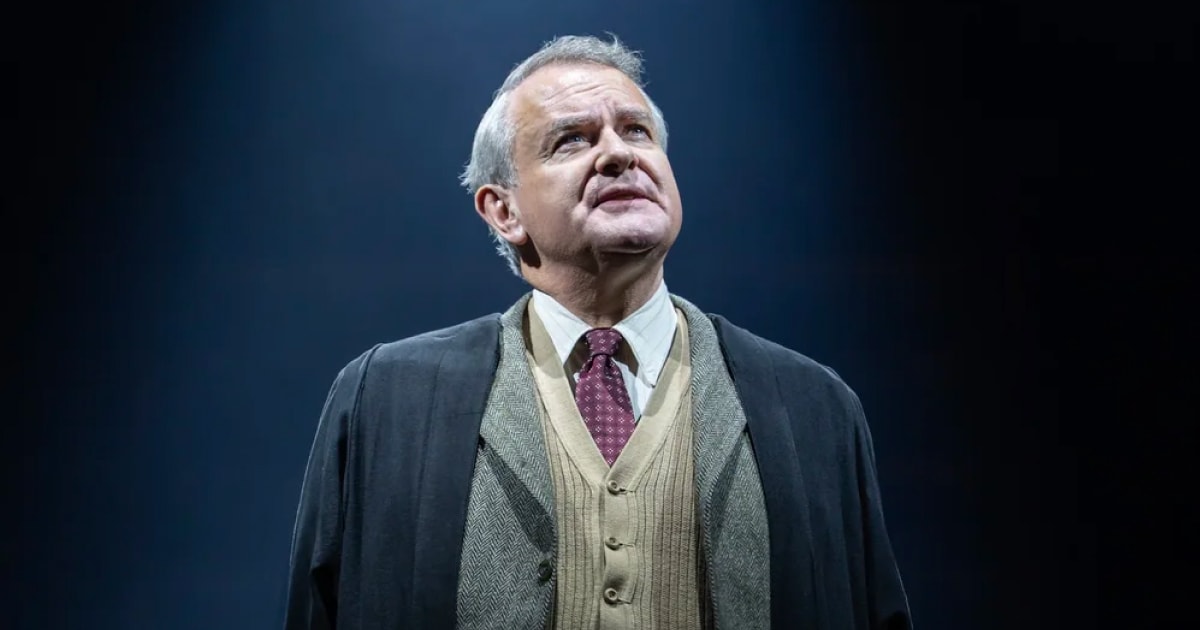


‘Shadowlands’ (written by William Nicholson, directed by Rachel Kavanaugh), Aldwych Theatre, London
In 1955 CS Lewis followed in the footsteps of many a Christian before him, publishing an outline of his youthful waywardness and subsequent conversion. While the bestseller Surprised by Joy was not dedicated to the woman who would soon disrupt his settled life, friends would later chuckle about its prescience.
Helen ‘Joy’ Davidman was born to Jewish parents in New York City. Aged 12, she announced her newfound atheism to them after reading HG Wells’s Whiggish Outline of History. The precocious girl graduated from high school aged 14, and by 20 she was a published poet with a Master’s degree from Columbia University. Is it any wonder that she garnered a reputation for arrogance and wound up married to a man 17 years her senior?
Her first marriage, however, was to the communist novelist William Gresham in 1942, a philandering alcoholic who routinely threatened to abandon his family – as he had his first wife. As the grim decade drew to a close, Davidman explored her native Judaism and dabbled with early Scientology, before a profound Christian conversion. Disillusioned with both her husband and their once-shared radical obsessions, she turned to Lewis’s writings, and the two struck up an intellectual correspondence. But how did this unlikely pair end up husband and wife? Rachel Kavanaugh’s production of William Nicholson’s 1989 play Shadowlands, currently showing at London’s Aldwych Theatre, is keen to explain.
In 1952 the fashionable Davidman (here played by Maggie Siff) arrived for a European sojourn, seemingly hoping for a chance encounter with her esteemed pen pal (Hugh Bonneville). Instead, he formally invited her to meet for tea, and the pair grew closer. From this first slightly awkward meeting it is easy to see why many of Lewis’s stuffy chums found the no-nonsense Bronxite obnoxious, as it is to appreciate why a celebrity theologian would be intrigued by a woman willing to match his wit and curiosity.
We soon hear that, across the pond, Gresham has stepped out with his wife’s cousin and has demanded a divorce. Davidman consequently relocated abroad for good, and Lewis agreed to a civil marriage to prevent her deportation. Her erstwhile affection for the Soviets seemed to have put her on shaky ground with the Home Office. While this initial union was surely motivated by Lewis’s desire to keep her close, it was a strictly private, practical and celibate arrangement. This hardly kept tongues from wagging at a time when friendships across the sexes were much rarer. Lewis was already paying for Davidman’s sons’ schooling, visiting her daily, and celebrating Easter, Christmas and other great occasions with them. Nicholson’s script has the pair joke about them ‘technically’ being married but ‘up to nothing at all’, and there is no doubt that the relationship was a celibate one at this point.
Only the year following their civil marriage did they enter one ‘before God’, on what they imagined was Davidman’s deathbed due to a terminal bone cancer diagnosis. It is not possible, especially for a cautious character like Lewis, to fall in love overnight, but Nicholson’s subtle script conveys how this episode prompted his romantic feelings to be fully realised and expressed. The pair’s humour permeates even amidst crises, and Siff’s ailing Davidman pokes fun at Lewis’s sincere but pig-eared proposal. That Bonneville’s Lewis, and the real-life man, were completely clueless – or in denial – about Davidman’s emerging eros for much time prior to this is part of his charm. It is only after Lewis prays for her recovery, and a crutch-laden Davidman joins him at their now shared home, that they share a kiss.
The play conveys how their steadfast friendship, first rooted in their joint pursuit of truth, was fortified, not displaced, by the romance which eventually erupted. In Lewis’s A Grief Observed, penned in order to cope with his wife’s death, he asks: ‘Could a woman be a complete wife unless, for a moment, in one particular mood, a man felt almost inclined to call her Brother?’ Lewis’s answer, as regards his by then late beloved, is that no: a marriage in which one has no regard for the other beyond fleeting passions is not as sturdy as the reverse. The play gradually reveals how he would grow to possess both instincts with Davidman.
While Davidman is in hospital, a devastated Lewis concludes that although it would be wrong to flout Christian custom simply because he ‘wishes to marry Joy’, she was ‘never really married to him [Gresham] in the first place’, given that she was not his first wife. Fr Bide, who was reprimanded by the Bishop of Oxford for conducting the ceremony, later complained about various portrayals of the real-life matter, stating that his thought process had been: ‘“What would He [Jesus] have done?” and then there wasn’t any further answer at all.’ Nicholson, however, seems to have had little time for what he blatantly regards as ecclesiastical technicalities. Faithful Catholics will certainly wonder if Davidman was truly free to marry Lewis, but their partnership surely has some lessons for us regardless.
Many Catholics will be familiar with our co-religionist JRR Tolkien’s deep bond with Lewis, whom he helped warm towards Christianity. Their friendship cooled as Tolkien grew exhausted by what he perceived to be Lewis’s anti-Catholicism and unconventional marriage – although Tolkien did later offer to take in Davidman’s youngest son. Tolkien is absent from Nicholson’s play, but Lewis’s priggish academic ensemble stands in for many of Davidman’s detractors, who evidently thought she was taking the old Oxonian bachelor for a proverbial ride. Still, Tolkien visited Lewis the week of his death, and afterwards told his daughter: ‘So far I have felt… like an old tree that is losing all its leaves one by one: this feels like an axe-blow near the roots.’
Lewis certainly became intimate with such loss, but not before much happiness. In the play’s second act we are treated to Davidman’s seemingly miraculous remission and the pair’s domestic pleasantries. Lewis finds himself ‘almost blushing’ at booking a hotel room with his own wife, and they embark upon a sun-kissed wander in rural Herefordshire. Amid this idyllic setting, Davidman delicately reminds him that the pain he will feel when her illness returns is intrinsically linked to the pleasure of the ‘now’. Bonneville’s convincing take on the disorientated Lewis after Davidman’s death is the precise opposite of the self-assured don we met earlier, although his faith eventually endures.
The play is bookended with snippets from Lewis’s lectures on the murkiness and transcendence of the post-lapsarian universe, for which the play is named. All the better for our faith, and Lewis’s, that we find companions who help bring us closer to what is solid and enduring along the way. Kavanaugh’s production will not merely leave you with a hankering for the cups of tea and tobacco Bonneville’s Lewis is rarely without, but a thirst for what is true, beautiful and good. We cannot entirely grasp these things in the ‘shadows’ of this world, but the people we love will certainly offer us real glimpses of it, even if by knowing them we open ourselves up to the trauma of their mortality.
Photograph: Johan Persson


.jpg)

.jpg)