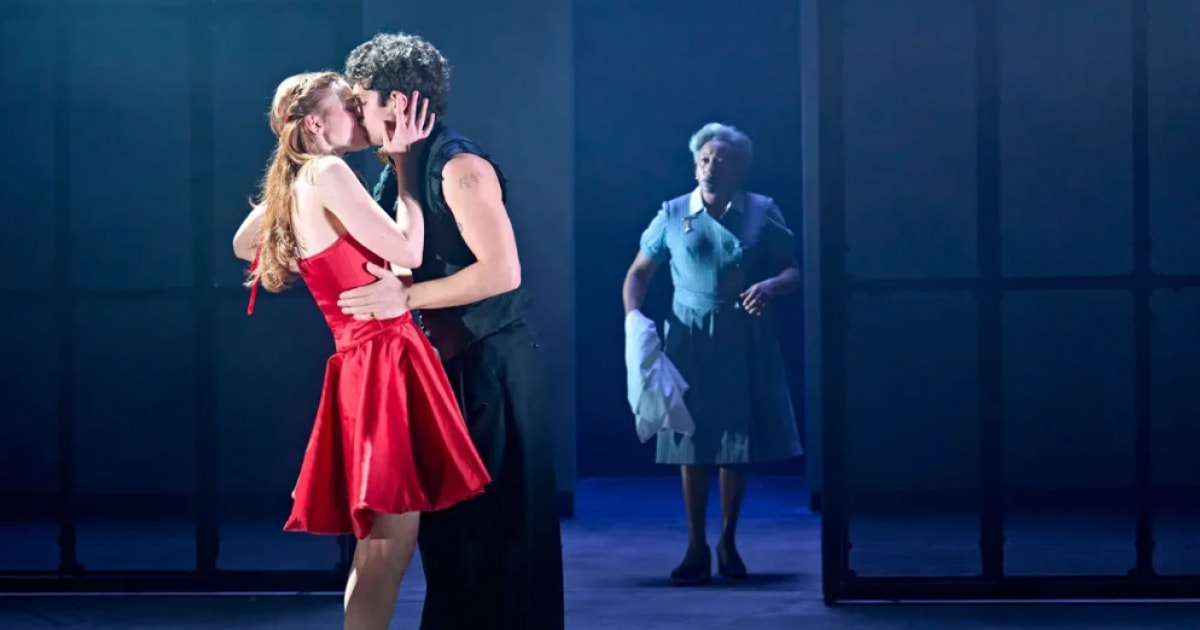



Ignore the buzz: Robert Icke’s new production of Romeo and Juliet is actually as good as people say it is. To a reviewer who glories in pointing out errors and condemning monstrous innovations, here we have an old classic presented afresh, lovingly handled rather than treated with the kid gloves of an archivist.
There are twenty million ways of doing Shakespeare wrongly – some modes of which have become so commonplace as to have reached the age of being unvenerable traditions in their own right. Most prominent among these is the Romantic interpretation that sees this play as the apex of tragic beauty. I have never been one for the beauty of failure. Failure sucks. Shakespeare agrees with me, as this play is not a glorification of teenage love but a very clear and blatant condemnation of passions untempered, unchallenged and unmastered. Romeo and Juliet is not a celebration of emotions but the shining of a bright light upon their dangers. It is not that physical desire is inherently bad – we must never give in to puritanism – but that here is a supreme example of when teenage lust should have been channelled into a more ordered love.
The false conception of the Romantics is easier to comprehend when, as in this production, the actors are in their early-to-mid 20s. Here the characters feel like adults to us when Shakespeare is very clear in conveying through his text that they are not. Juliet’s age of not yet 14 is repeatedly referenced, and Romeo’s skilled swordsmanship would suggest that he is at least 16, perhaps even 18. As Joseph Pearce has pointed out – somewhat contrary to the popular imagination of today – 13-year-olds were not marriageable in the England of Shakespeare’s day. Sadie Sink (Juliet) and Noah Jupe (Romeo) are 24 and 21 respectively; ages that, if you reverse the sexes, were broadly normal for the Tudor era. No matter what his age or skill with a blade, Romeo is no man but a pitiable weathervane guided by the whims of his wandering lust. Rosaline today, Juliet tomorrow. Who knows what next, had the tragic permanence of death been avoided.
The role of the Church in society is channelled through the character of poor Friar Lawrence. Poor Friar Lawrence. He represents the bounteous charity of the Church: full of good intentions, loving care and genuine paternal concern, like so many of our clergy across the centuries. But through his missteps – agreeing to conduct the somewhat illicit marriage of the two ‘star-crossed’ lovers – he becomes a facilitator of tragedy rather than one who prevents it.
Alas, as has so often been the case in the history of the Church, the option Friar Lawrence thinks is the charitable one is – in both fact and effect – extremely unwise and injudicious. Counselling the tempering of passions may have been less popular, and perhaps would have gone unheeded, but it would have been better than facilitating everything by a semi-illicit marriage. In fact, Friar Lawrence attempts just this, but it feels like a box-ticking exercise compared to his willingness to marry the duo. How often, in the moral dramas of our own lives, are we the same?
How did it come to this? Perhaps I’ve spent too much time in politics, attempting – and mostly failing – to deduce how exactly things went wrong and what would be needed to put them right. But how can you wake up in Verona one morning to learn the tragic demise of Romeo and Juliet and not think: how did this come to be?
Dropped throughout Icke’s version are quick, brief moments of a few seconds where time is stopped and rewound to give us a sense of choice and chance. These slight, gentle counterfactuals remind us that we are the product of decisions rather than fate. Our sins are of our own choosing and all the possibilities of life, peace, family, children, love and joy are achieved or thwarted by our own actions. Joseph de Maistre reminds us early on in his Considerations that one of the most admirable things in the universal order of things is ‘the actions of free beings under the divine hand’. Shakespeare shows us the – not inevitable – result of the actions of free beings under their own hands instead.
Part of the tragedy – viewed through a politico’s eye – is that a match which, had it been tried by the test of time, may have facilitated the ending of Verona’s civil strife between Montague and Capulet instead results in more bodies in the dynastic sepulchres. Handled well, the amorous stirrings between Romeo and Juliet could have sparked peace. Instead, they bring death and desolation.
A full production of Shakespeare’s text normally runs to just over three hours, but Icke reduces this to a very manageable two and a half. A more sensitive traditionalist than myself might take umbrage that we are deprived of the familiar opening lines of ‘Two houses, both alike in dignity’, but Icke’s reinterpretation is nonetheless faithful to Shakespeare’s purpose and intent. His elisions are gentle – they are executed not out of iconoclasm but to give a fresh appreciation of an unquestionable classic.
Icke’s directions are a regular feature on the stages of London, but what has made this production so buzzworthy is the appearance of Sadie Sink of ‘Stranger Things’ fame in one of the title roles. There is no way around it: Sink is superb. I promise you, it’s not just her physical beauty but her skill as an actress. With her, it is difficult not to fall into the same trap as Romeo on that night in Verona. She is well matched with Noah Jupe as Romeo. Sitting in the second row from the stage, I had the chance to observe them up close and it was incredibly difficult to believe they were actually acting.
If any of their colleagues on stage could be charged with attempting to steal the show, it is Clare Perkins in the role of Nurse. Perkins is truly sublime. Kasper Hilton-Hille deserves mention for a ribald and convincing Mercutio – one of the trickier roles in this drama. Much though it would give me joy to criticise and condemn, the performances in this production were truly delightful. That so many of the actors are towards the younger end of the spectrum gives one a hopeful confidence in the future of the British stage. Icke, Sink, Jupe and Perkins are all deserving of our praise.
In the end, however, the play’s the thing. Shakespeare brings out the best in good actors and the worst in mediocre actors. The trill of his words plucks strings in the common memory of Angledom. Long may they continue to do so.


.jpg)


.jpg)