May 6, 2026

Catholic weddings in Ireland down by half in 10 years

Ruadhan Jones
More
Related
Min read
share

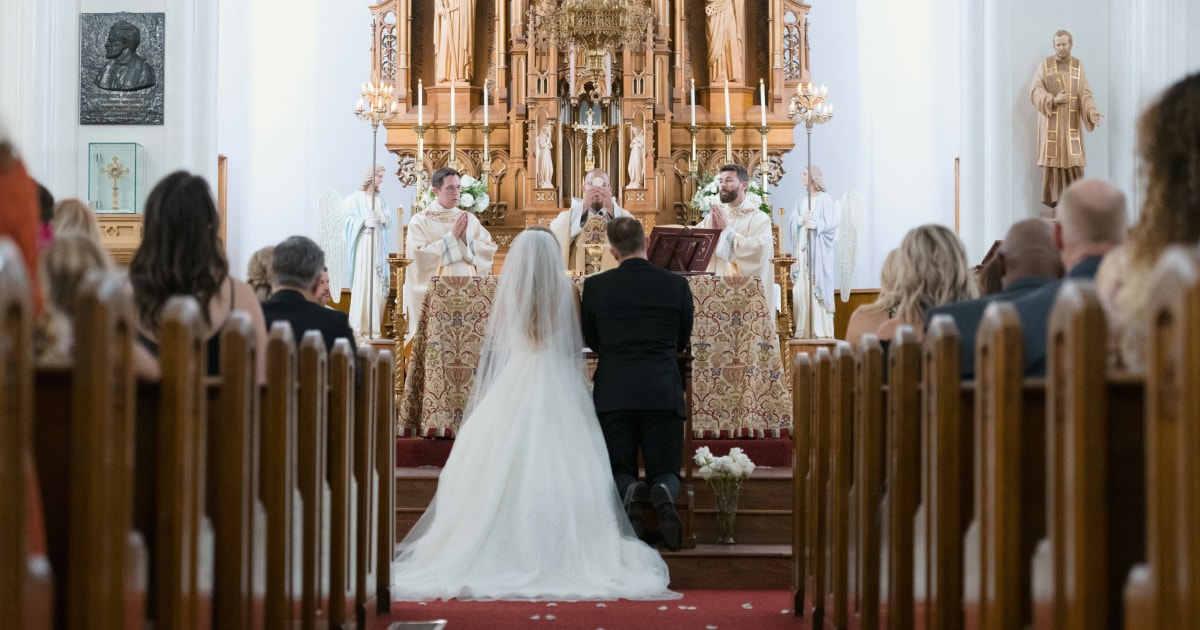
The number of Catholic marriages in Ireland has halved in just 10 years according to a new study, marking the latest milestone in the decline of Catholicism on the one-time island of saints and scholars. Catholic marriages fell 51 per cent from over 13,000 to 6,425 between 2014 and 2024, according to the study from the Central Statistics Office (CSO), the chief statistical agency of the Irish state. Civil ceremonies now outnumber Catholic weddings, with a sharp rise in secular humanist and ‘New Age’ weddings, the study also highlights. Despite the fact that the Irish population grew substantially in the 10-year period, marriages declined by 7.7 per cent overall, with Ireland now having one of the lowest marriage rates in Europe at 3.8 per 1,000 people.

Marriage in Ireland has been reshaped over the past 30 years by two referendums – national votes to change the country’s constitution – that legalised first divorce (1995) and later same-sex marriage (2015). Both of these practices have significantly undermined the understanding of marriage as a lifelong bond between a man and a woman, and mean the figures require some caveats.

The first is that the statistics include same-sex and opposite-sex marriages; when you exclude same-sex marriages, the Catholic option remains the most frequently chosen, if only just. The second reality is the presence of second marriages, which because of Church teaching on divorce must take place outside the Catholic sphere. Among first marriages, again Catholic weddings are still the most popular choice, accounting for 40 per cent of marriages in 2024, according to a study by Christian think tank the Iona Institute.

One of the most notable revelations of the study is the degree to which ‘New Age’ ceremonies, what the CSO calls ‘other religious denominations’, have rapidly increased their hold of the wedding landscape, making up a quarter of all opposite-sex marriages. A study of these ceremonies by the Iona Institute showed that, in 2024, the largest such groups providing these ceremonies were OneSpirit Ireland, Entheos Ireland, the Earth Spiritualist Tradition, One World Ministers and Our Spiritual Earth.

‘Many of these bodies present themselves as “spiritual” and deliberately use a non-denominational and highly inclusive language,’ said Dr Angelo Bottone of the Iona Institute. ‘Some of these groups are hard to classify. They are not denominations in the ordinary sense.’

‘Some are spiritualist, some interfaith, some pagan or nature-based,’ he continued. ‘The new figures even include 11 marriages under the rites and ceremonies of the “Temple of Plants”, a group of priestesses which describes itself as non-religious, multi-racial, multi-cultural and multi-dimensional. “We are united in our love for the Earth and all Her realms. Plants are central to our work and seen as an expression of the Divine Feminine,” they say on their webpage.’

But even allowing for these caveats, the figures still mark another grim milestone in the decline of Catholicism in Ireland, and Christianity more generally; the Church of Ireland and Presbyterian churches, traditionally two of the larger Christian denominations in Ireland, have both fallen away precipitously. It is not hard to fathom the reasons, given that Ireland is on a well-documented flight from organised religion.

One prominent Irish Catholic commentator, Breda O’Brien, suggests that the decline could be halted to some degree if the Church allowed Catholic weddings to take place outside a church setting. In a 2024 study on marriage in Ireland conducted by the Iona Institute, Ms O’Brien argued that for many a secular wedding was chosen as much for convenience as anything else, with hotels offering complete ceremony and reception packages.

If the Church were to allow weddings to be celebrated outside of a church, it would mark a new era in the Church’s approach to marriage in Ireland. The limiting of weddings to church settings is a practice with an interesting history in the country, the culmination of a centuries-long battle by the Church to regularise Irish marital practices. From the early days of the Church in Ireland, Church teaching on marriage struggled to gain a foothold, with practices of divorce and concubinage remaining strong into the 12th century.

After the penal era, although divorce was long gone, a new battlefront opened in the 19th century, when Cardinal Paul Cullen of Dublin led a mission to Romanise Irish religious practices. Chief among these was moving the sacraments of baptism and marriage from houses, where they typically took place, and into churches. There were a variety of reasons for this, among them the discipline of the clergy and the licentiousness of some of the celebrations. It could be argued then that what we are seeing is more than the decline of the Church; we are seeing the age-old battle rearing its head again.

Looking at the global picture, however, it is clear this is not a problem isolated to Ireland. Cardinal Kevin Farrell, prefect of the Dicastery for the Laity, Family and Life, said on April 28 that the decline in Catholic marriages is a global crisis affecting the Church. He cited figures from the Annuarium Statisticum Ecclesiae 2021 showing that baptisms of children under seven fell by 31.1 per cent between 1991 and 2021, while Catholic marriages dropped by 48 per cent over the same period.

Continue reading with a free account

Create a free account to read up to five articles each month
Create free account

You have # free articles remaining this month.

Subscribe to get unlimited access.
Sign up

subscribe to the catholic herald today

Our best content is exclusively available to our subscribers. Subscribe today and gain instant access to expert analysis, in-depth articles, and thought-provoking insights—anytime, anywhere. Don’t miss out on the conversations that matter most.
Subscribe