May 11, 2026

Beyond therapy: the soul’s need for God

Jan C. Bentz
More
Related
Min read
share

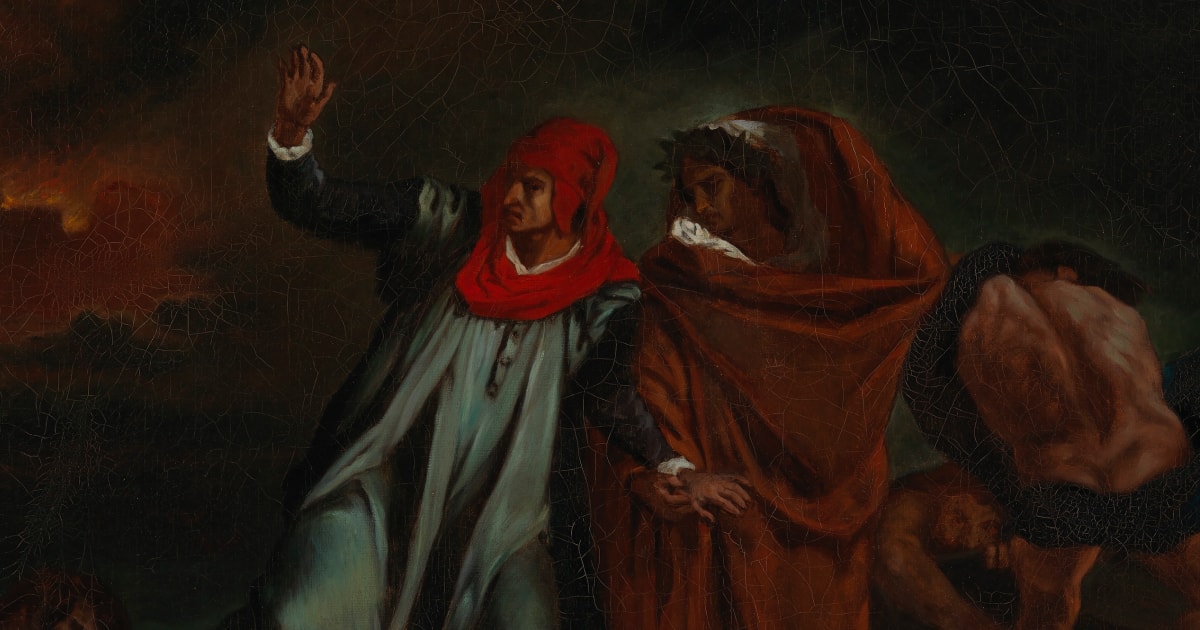
In the closing cantos of Dante’s Divine Comedy, Dante the pilgrim finally beholds the vision for which his entire journey has prepared him: the beatific vision of God. The whole Comedy unfolds as a path towards that vision, a preparation. Dante does not begin in paradise, nor even in clarity. He begins “in a dark wood”, lost, disorientated, unable to find the straight way. His journey in search of himself and his love, Beatrice, leads him not just to a discovery of his true self but also to a discovery of the origin of his being, God Himself. His personal narrative leads him to a fuller understanding of his own soul, the world in which this soul has been placed, and the author of his soul Himself; the culminating end sees Dante diving into the endless sea of Love and Light that “moves all the stars”. But the path is long and arduous: the path is a process of purification, confession, forgiveness and finally transformation in grace.

If one were to read this journey in purely modern psychological terms, much of it would seem intelligible. Dante is confused, burdened and disordered at first; he must come to understand himself, confront his past, his exile, his emotional distress and learn to live rightly. In this sense, there is something recognisably therapeutic about the movement from the Inferno through the Purgatorio into the Paradiso. And yet, the deepest claim of the poem lies elsewhere. Dante is not healed merely by understanding himself; he is healed by being reconciled to God. This distinction illustrates with particular clarity the difference – and the proper relationship – between psychotherapy and faith.

Therapy, in its modern form, is a remarkable achievement. It offers the tools to articulate distress, to manage anxiety, to reframe destructive patterns of thought and to restore a measure of functional stability. Its goal, as contemporary definitions suggest, is the cultivation of wellbeing: the ability to cope, to relate and to live with a certain degree of coherence within the conditions of ordinary life. In this sense, therapy touches on something essential. It takes seriously the woundedness of the human psyche and seeks, through disciplined method and trained attention, to alleviate suffering.

Yet from a Catholic perspective, this is not the whole story of the human person. Man is a psychological being, but not merely that. The Greek psyche – derived from psychein, “to breathe” or “to blow” – does not originally denote a clinical object or a measurable system, but the very principle of life: the breath that animates, the presence that makes a body living rather than dead. It names not merely “mind”, still less a set of functions, but the soul as the seat of personality, thought, desire and existence itself. In classical and biblical usage, psyche can even stand for the whole person – “three thousand souls” – suggesting that what we call the “psyche” is not a part within us, but in some sense the living self as such. Thus the term itself resists scientific reduction.

Man is not merely a psychological being; he is a creature ordered to God. His deepest wounds are not exhausted by anxiety, trauma or maladaptive behaviour, but include estrangement from the divine source of his being. And it is precisely here that therapy, by its very nature, reaches its limit.

The first difference is therefore one of reconciliation. Therapy can help a person come to terms with guilt, to understand its origins and to integrate it into a narrative of self-acceptance. Catholicism claims something more radical: not merely the management of guilt, but the forgiveness of sin. In the sacrament of Reconciliation, the penitent does not simply reinterpret his past; he is absolved, restored and reconciled – not only psychologically, but ontologically – to God and to the Church. The peace that follows is not merely a state of mind, but the fruit of grace.

This leads to a second distinction: grace rather than technique. Therapy operates through method – through conversation, interpretation, behavioural practice and evidence-based intervention. Catholicism does not deny the value of such means, but it introduces a different order of causality. In the sacraments, God Himself acts. The Eucharist, Confession and the Anointing of the Sick are not symbolic gestures or therapeutic rituals; they are channels of divine life. What is offered is not simply insight, but participation in a reality that transcends the human subject.

Third, faith in God – the One true God above all – offers a horizon of ultimate meaning that extends beyond the therapeutic framework. Modern psychology increasingly recognises the importance of meaning for human flourishing. Yet meaning, in this context, often remains a human construction – a way of organising experience so that it becomes bearable. Catholicism, by contrast, proposes that meaning is not merely made but given. Suffering, in particular, is not only something to be alleviated, but something that can be united to the suffering of Christ and thereby transformed. As John Paul II insists, suffering “belongs to the transcendence of man”: it opens the person to a dimension that no technique can fully encompass.

This point finds a striking, if partial, analogue in the work of Viktor Frankl and his development of logotherapy. Against reductionist models of the human person, Frankl insisted that man is fundamentally orientated towards meaning, and that even in the most extreme conditions – such as the concentration camps in which he himself suffered – life retains a significance that is not exhausted by psychological states or external circumstances. Meaning, for Frankl, is discovered; it presents itself as something to which the person must respond. Yet even here the horizon remains ultimately anthropological rather than theological. Logotherapy can affirm that suffering may bear meaning, but it cannot finally ground that meaning in a transcendent source. Catholic anthropology, by contrast, receives this intuition and situates it within a fuller metaphysical order: meaning is not merely discovered but given, and suffering can be taken up into a redemptive reality that surpasses the merely human.

A more explicitly theological attempt to integrate psychology and faith can be found in the approach of G C Dilsaver’s Imago Dei Psychotherapy. Here the human person is not approached as a merely psychological system – still less as a bundle of functions to be regulated – but as a being whose very structure is intrinsically ordered towards truth, towards the good and ultimately towards God as his final end. Drawing explicitly on the philosophia perennis, this approach proceeds from the conviction, long established within the Thomistic tradition, that no psychology can be adequate which does not rest upon a true anthropology; that is to say, upon an account of man as a unity of body and soul, endowed with intellect and will, capable of knowing truth and choosing the good, and therefore intelligible only in light of the end towards which he is ordered. The attempt does not want to subordinate theology to psychology, nor to collapse one into the other, but to allow theology to exercise its proper illuminating function, clarifying what psychology observes without being able, on its own terms, to explain in full.

Closely related to all this is the question of hope. Therapy aims, rightly, at improving life within this world. It seeks greater stability, healthier relationships and reduced distress. Catholicism does not negate these aims, but it situates them within a larger eschatological horizon. The ultimate good of man is not simply a well-adjusted life, but communion with God. Hope, in this sense, is not merely optimism or resilience; it is orientated towards eternal life. It allows even suffering and death to be understood within a narrative that does not end in dissolution.

The contrast between these two becomes almost audible in the language each permits. Therapy is wary of words like sin or vice; it prefers the safer vocabulary of distress and coping. Catholicism, by contrast, speaks more bluntly. “I have done wrong” is not a feeling but a reality to be faced – one that can be understood but calls mostly for repentance and forgiveness. Therapy may help you process it; it does not pretend to remove it.

Finally, religion offers something that therapy, by definition, cannot: a sacramental and worshipping community. The therapeutic relationship is professional, structured, time-limited – and, by its very nature, an economic exchange. The Church, by contrast, is not a service provider but a form of life: a community ordered to worship, sustained by sacrament and bound together not by contract but by charity. Where therapy offers care within defined limits, religion offers belonging within an order that claims to be enduring, objective and ultimately given rather than negotiated. The Church is a mystical body – a communion that endures across time, rooted in shared worship, doctrine and life. Even contemporary health research increasingly acknowledges that such forms of spiritual belonging contribute to resilience and wellbeing, though their deepest significance cannot be reduced to these effects.

None of this implies that therapy and religion stand in opposition. On the contrary, the Catholic tradition has consistently affirmed the legitimacy of medical and psychological care. There are wounds that require clinical expertise, disorders that demand professional treatment and situations in which therapy is indispensable. The Church herself often encourages collaboration between pastoral care and psychological science.

Yet it remains essential to see that the two operate on different planes. Therapy can heal aspects of the psyche; it can restore balance, clarity and functional health. Religion addresses the soul in its relation to God. It offers forgiveness where therapy offers interpretation, grace where therapy offers method, redemption where therapy offers coping.

To return, then, to Dante: the pilgrim does not find his way out of the dark wood by sitting down and analysing it. He must be led, corrected, washed clean, forgiven – indeed, remade. The journey does not end in tidy self-possession, as though he had finally “figured himself out”, but in vision: in the astonished recognition of a reality greater than himself, and yet, somehow, the very thing for which he was made all along.

Continue reading with a free account

Create a free account to read up to five articles each month
Create free account

You have # free articles remaining this month.

Subscribe to get unlimited access.
Sign up

subscribe to the catholic herald today

Our best content is exclusively available to our subscribers. Subscribe today and gain instant access to expert analysis, in-depth articles, and thought-provoking insights—anytime, anywhere. Don’t miss out on the conversations that matter most.
Subscribe