

A German-born former bishop and Augustinian has mounted a defence of Pope Leo XIV amid accusations that the Pope once participated in acts of indigenous worship.
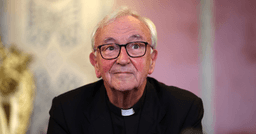
Bishop Reinaldo Nann, who served as a bishop in Peru between 2017 and 2024 before entering into a civil marriage but not being formally laicised, wrote for Religion Digital on March 22 that the then missionary Fr Robert Prevost “is not an idolater, nor did he worship Pachamama”. The allegation centres on an image said to show Prevost kneeling during a ceremony linked to Andean spirituality while attending a theology and ecology congress in Brazil in 1995.
Nann does not dispute the authenticity of the image or the circumstances in which it was taken. “To put it bluntly: the young missionary Robert Prevost did indeed participate in this congress on ecology and theology in 1995 and, as part of a ceremony to Mother Earth, he knelt down,” he wrote. However, he rejects the conclusions drawn from it.
“But I don’t see any statue of Pachamama in the photo, only men kneeling and one raising his right hand. I can’t see any worship of Pachamama as a goddess, neither on the part of Prevost nor on the part of any of the attendees,” he added.
The controversy has been amplified by several online outlets, which have presented the image as evidence of idolatry and suggested that such an act would call into question the legitimacy of Leo XIV’s pontificate. Nann directly addresses this line of argument, describing it as a serious misreading of both the event and Catholic teaching.
“Their articles suggest the following: there was an act of idol worship, a false god,” he wrote. “Since an idolater is an apostate who has betrayed his Catholic faith, Pope Leo XIV would be an apostate, no longer a legitimate Pope.” He rejects that conclusion, arguing that it rests on a misunderstanding of what is actually depicted.
Instead, Nann offers a different interpretation rooted in his experience of missionary work and familiarity with Andean culture. “We witness an interfaith ceremony where a representative of Andean culture makes a payment to the earth, an offering and a dialogue with it,” he said. “Other people, including Augustinian priests, attend this ceremony, which is part of Andean culture.”
Central to his argument is the distinction between gesture and intention. “Intention is what matters. The gesture of prayer is not automatically worship, nor is the gesture of kneeling,” he wrote, insisting that outward actions cannot be judged in isolation from their meaning and context.
He develops this point by drawing a parallel with Catholic devotional life. “We can speak to her as we speak to the saints. We can kneel before her as we do before the saints, as long as we see her as a creature and not as a goddess.” For Nann, the key issue is whether the earth is regarded as divine or as part of creation.
“In pre-Christian times, Pachamama was a goddess, but today she is seen more as a creature of God with a distinct personality,” he wrote. “Respecting the earth as a ‘being with a soul’ still recognises it as a creature of God.
“This is not syncretism; it is inculturation,” he wrote. “Different philosophies or cultures can be evangelised without rejecting their cultural and philosophical language, as long as they accept that Jesus Christ is the only saviour.”
The intervention has been reinforced by voices within the Augustinian order, to which Leo XIV belongs. A Brazilian friar, Luiz Augusto de Mattos, defended the Pope’s record, writing for Religion Digital and arguing that his missionary and pastoral work in Latin America was consistent with the Church’s directives and shaped by fidelity to its teaching.
“When photos or comments about Friar Robert Prevost… are published… in order to criticise, slander or discredit the work he did… it is simply inadmissible,” he wrote. “It is to ignore and manipulate what Friar Prevost truly lived and practised as a religious, priest and bishop.”
Friar Mattos suggests that criticism of such work often reflects deeper disagreements about the direction of the Church since the Second Vatican Council, stressing that its pastoral activity has long been carried out “in communion with the Church of the continent” and in line with the guidance of episcopal conferences and synods. He points to the structures that coordinate this work, including continental initiatives designed to support evangelisation, formation and engagement with social issues.
“This evangelising work has always been a reality in the various areas of evangelisation that the Order undertakes,” he wrote, citing its presence in schools, parishes, formation houses and missionary territories, as well as its involvement in universities and in commissions dedicated to justice and peace. Such activity, he argues, reflects a consistent effort to apply the Church’s teaching in concrete pastoral settings.
He also underlines the extent to which that work has been shaped by the major ecclesial gatherings in the region. “The evangelising process considers the documents of Medellín, Puebla, Santo Domingo and Aparecida,” he said, alongside wider Church teaching, including encyclicals, exhortations and synodal conclusions. This, he suggests, ensures that the order’s mission remains aligned with the broader direction of the Church.
The claims were first advanced by LifeSiteNews in a report published on March 18, 2026 by its editor-in-chief John-Henry Westen, which presented a series of photographs said to show the future Pope Leo XIV, then the Augustinian Robert Francis Prevost, kneeling during a Pachamama-related ceremony at a symposium in São Paulo in January 1995.
The report stated that the images were drawn from the official proceedings of the meeting, published in 1996 under the title Ecotheology: A Perspective from St Augustine, and relied in part on research by Fr Charles Murr, who claimed to have gathered documentation over several months and to have obtained identification of Prevost in the main photograph from three Augustinian priests.
According to the published material, the caption accompanying the image describes the scene as a “Celebration of the Pachamama (Mother Earth) Rite”, depicting participants kneeling around an altar, while additional photographs from the same source were cited as further evidence of Prevost’s presence at the event, including a group image of attendees and another taken during a Eucharistic celebration.