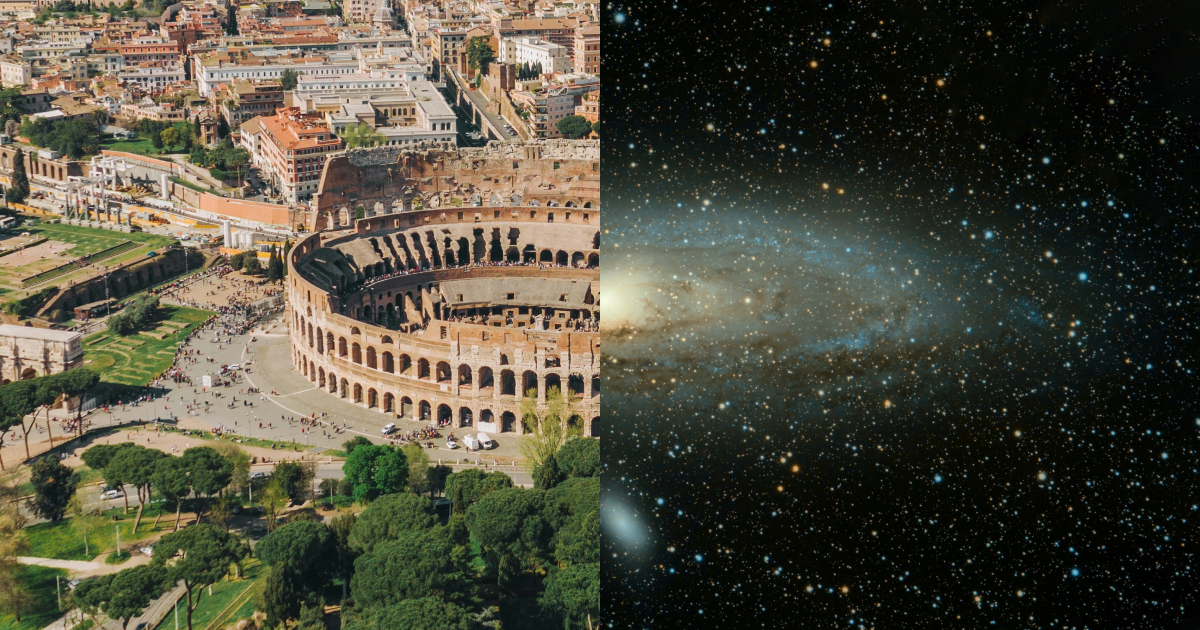


There is something about Rome that has always stirred my soul, ever since my first visit there as a nine-year-old on a parish pilgrimage. Indeed, I am of the view that if Rome does not stir something deep in a person, then they are probably not firing on all cylinders.
Last summer I sat in the courtyard of an historic Italian villa overlooking Rome, built centuries before the advent of air conditioning and elevated enough to avoid the sultry heat of the Eternal City’s streets and squares at that time of year. I was alone at the table because I had a two-thirds-smoked cigar in hand and was carefully conducting a relight so as to extract maximum enjoyment from this great gift of God’s creation. I once read that GK Chesterton had a habit of saying a kind of grace before smoking a cigar, and I have long been inspired by his habit of making the sign of the Cross with his smouldering matchstick as, the top of the cigar aflame, he was poised to enjoy the first puffs of a well-rolled stogie.
As I sat there, matchstick blessing completed, a fairly senior man of the Church saw me and came over for a chat and, as he explained it, to have an excuse to light up a cigarette of his own. The fact that he was not repelled by the cloud enveloping my small seating area immediately marked him out as a man to be taken seriously and, as can happen in these situations, amidst the tobacco fog a conversation ensued. I will not identify him, but suffice to say that one of his many duties is to consider the position of the Catholic Church on matters of space policy. Yes, space, as in “Godspeed, John Glenn”, rockets, “One small step for man”, planetary exploration, Starship, that sort of thing.
Being in the satellite communications sector myself, this is something I think about in my day job. Suffice to say I am impressed, but not at all surprised, that the Catholic Church is doing some serious thinking about how to address our interaction with the vast intergalactic and interdimensional space of God’s magnificent multiverse. So it was with real curiosity and eagerness that I commenced what was probably my most enjoyable brainstorming session of 2025: thoughts on what the Church might be called to do in the context of outer space. I thought it well to share them in these pages because if this is a mission that the Catholic Church should consider, then people like you, who read these pages, will have a voice in encouraging it as a new mission to add to the many great missions of our first two millennia since St Peter came to Rome.
The exploration, development and, dare I say it, “conquest” of space is going to be the work of many generations, centuries and eventually the labour of millions of souls. It is too giant a task to be tackled and funded by any one country’s taxpayers, or even by private capital markets in the conventional sense of the modern corporation. There is a role for these things, for sure – an essential one – but the conquest of space is a mission territory on a scale far greater than almost anything ever imagined by previous generations.
To travel to and from Mars, the moons of Saturn, beyond the bounds of the solar system and on into, and eventually beyond, our home galaxy, we will need to harness vast resources. The most important of all will be human ingenuity: to develop the technologies that will make this possible, to raise the resources necessary to fund and enable it, and to provide that other utterly vital resource – time.
Look at how we built the great cathedrals. The men who laid the foundation stone almost never got to see the capping stone placed, but each played his vital role. Think of a mix between the crusading orders – Templars and Hospitallers – and the preaching and monastic orders: Dominicans, Jesuits, Augustinians and Cistercians. A new order, or a repurposed existing one, to lead a crusade to explore the stars. Think about what motivated the great explorations of old. Of course modern history tells us it was only about gold or the extraction of other material benefits, but anyone marinated in the Catholic faith knows there was more to the motivation than that. St Brendan did not set sail in his tiny animal-skin boat for North America because he was looking for gold. He went because he felt it was his duty to God. Similarly, Cortés, when landing, fell to his knees to thank God, and his first act upon landing was to plant the crucifix on the shore of the New World.
A new Catholic order could be formed specifically to serve God in the exploration of space. It could be modelled on tried and tested methods of rallying to such missions: a first dedicated monastery where young men could discern and enter into vows and, in some cases, the priesthood, while studying and practising at the cutting edge of the sciences applicable to the development and exploration of space. Similarly, for young women, a religious order that would allow people to work as laity and, in some cases, take vows, dedicating their lives to this gargantuan task of embracing God’s creation. I suspect that dedicating one’s life to the service of God in the expansion into his wider creation is a vocation that could appeal to powerful talents.
I have no doubt that with prayer and work, and the grace of God, we would see a blossoming of innovation and purpose in such a new missionary order. It could invent and pioneer new technologies, embark on near- and deep-space missions, establish colonies beyond our own planet, embark on terraforming, harness the resources of space for the benefit of mankind and expand the wealth of human knowledge. It would be open to the laity to participate in, similar to the Sovereign Military Order of Malta, the Carmelites or Opus Dei. It would have its own religious and lay communities, scientific schools and universities and, given the Church’s magnificent history of inventing and bringing into being the idea of a university, they would likely end up being the best in the world in time. Such an order, as long as it remained spiritually healthy, would be capable of carrying the torch beyond the existence of any individual state or country, adapting to the inevitable winds of time and history and staying on mission: the exploration of space enabled by submission to God’s service, trust in his providence, hope in his grace and faith to take the risk.
In the words of Psalm 8:
“When I look at your heavens, the work of your fingers,
the moon and the stars, which you have set in place,
what is man that you are mindful of him,
and the son of man that you care for him?
Yet you have made him a little lower than the heavenly beings
and crowned him with glory and honour.
You have given him dominion over the works of your hands;”
With that commission, perhaps it is time to say: “Ad astra, ad maiorem Dei gloriam.”