

Peter Stanford – author of the fascinating, insightful and scholarly new biography Gaudí: God’s Architect – observes that there is a vacancy for a patron saint of architects, “with the 3rd-century martyr St Barbara currently holding the fort on the slightly dubious grounds that she was imprisoned in a tower by her father but managed to make a window in the wall so as to escape”.
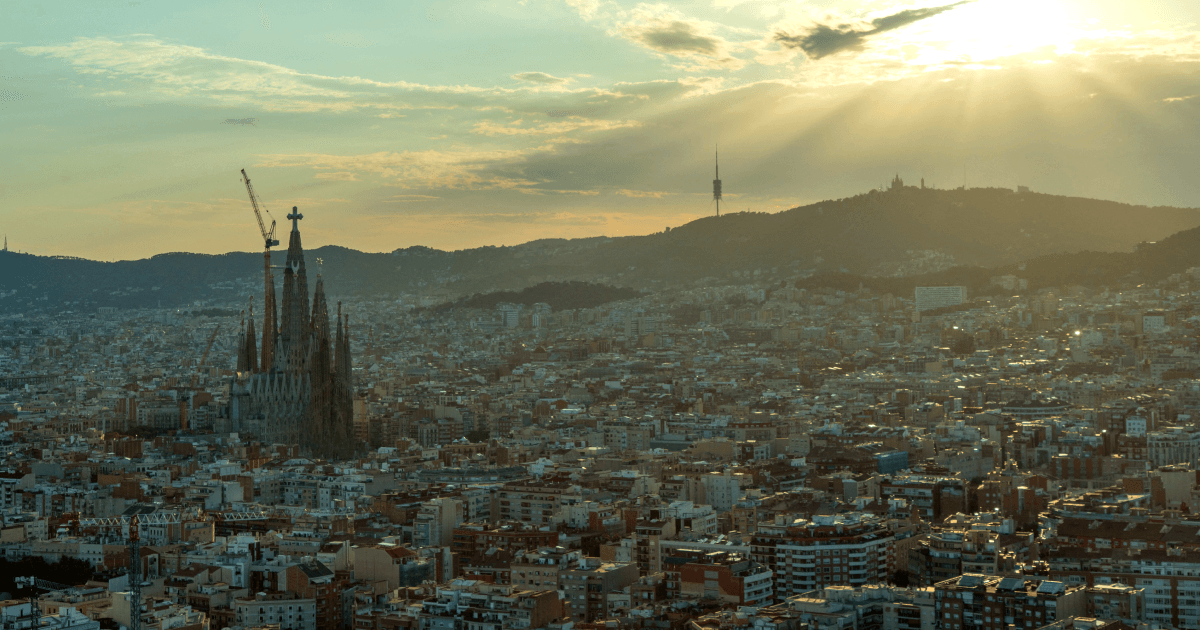
Today, June 10, on the centenary of Antoni Gaudí’s death, Pope Leo XIV celebrated Solemn Mass and consecrated the newly completed Tower of Jesus Christ, the last and highest of the basilica’s 18 honeycomb towers. At 172.5 metres, it makes La Sagrada Família the tallest church on earth.
The single largest remaining detail is the Glory Façade, which will tell the story of the Resurrection in 100 sculpted figures. This might take until 2035 to complete.
Attending Mass one Sunday in 2023, Peter Stanford writes of “the whole scene bathed in colour, flooding in from all sides… From the east side, where the Nativity Façade stands, there are greens for fertility and blues for morning light. From the west, around the Passion Façade, come oranges and golds, shot through with the red of the blood Jesus spilt… And from the still unfinished Glory Façade, behind us at the south end of the nave, a brilliant white is added to the mix.”
He had resisted all efforts to enlist him in the political process – although there may have been much provocation. He did manage to get himself arrested – once – in September 1924. On his way to Mass in memory of those Catalans killed in the Siege of Barcelona (1713–14), he was stopped by the Guardia Civil. When questioned in Spanish, he replied in Catalan. Told he would go free if he spoke Spanish, he declined. And so the 72-year-old was arrested. By noon he was free after the church’s Mgr Gil Parés paid the fine. As Stanford says, he did not emerge triumphant. He was shattered.
The church had been left alone by protesters and rioters over the previous troubled decades, but in June 1936 the mob invaded, “wrecking Gaudí’s models and burning every scrap of paper they could lay their hands on”. Turning their attention to the crypt, they opened and scattered the remains of the original spirit behind the future basilica, José María Bocabella. Then they rolled back Gaudí’s tombstone. But mercifully, his coffin was left intact.
Who was the man today dubbed a starchitect? Born on June 25, 1852, in Reus or Riudoms in the Baix Camp district, he was the youngest of five children of Francesc Gaudí i Serra, a coppersmith, and his wife, Antònia Cornet i Bertran. The next day he was christened Antoni Plàcid Guillem Gaudí i Cornet.
Through illness he had a lost childhood and, even after school, most of his military service was spent on sick leave. This did allow him to continue his studies. He graduated in architecture in 1878. At the Paris World’s Fair that year he produced a showcase for the glove manufacturer Comella, which so impressed the Catalan entrepreneur Eusebi Güell that he commissioned some of Gaudí’s most outstanding work – wine cellars, a pavilion, the Güell Palace and Park Güell, and the crypt of the church of Colònia Güell.
In 1883 he was given charge of a Barcelona church – Temple Expiatori de la Sagrada Família (“Expiatory Temple of the Holy Family”). All he inherited when he assumed the project was a half-finished crypt and Francisco de Paula del Villar’s plans for a large but unremarkable neo-Gothic church. By 1887, the crypt was completed and open for daily Mass. In 1914, the papal nuncio Francesco Ragonesi came to visit Gaudí and his church and pronounced it “a beautiful poem sculpted in stone”. Gaudí replied lyrically: “What man would not feel a poet with the church at his side?”
His work on the Nativity Façade appears to call on not just Modernisme – the Catalan version of art nouveau – but classical, Gothic and baroque elements too. And the attention to detail was extraordinary: the site’s night watchman, Josep, modelled Judas Iscariot; Pontius Pilate was a local goatherd; the Virgin Mary was the sister of one of the masons. The same attention was given to the animal figures. Gaudí told his early biographer, Joan Bergós: “Everybody will find something in the church. Farmers see cocks and hens, scientists see signs of the Zodiac, theologians see the genealogy of Jesus, but the explanation, the reason behind it all, only the erudite will know it, and it must not be divulged.”
In the years after the end of the Great War, Gaudí’s chief contribution – beyond the Nativity Façade – was to produce intricate models indicating what the basilica would look like on completion. At scales of 1:10 and 1:25, two plaster models were finally finished to his satisfaction in 1923. Funds always trickled in too slowly for his ambition – until the 1980s, when money began pouring in from around the world, especially Japan. By 1926 construction was beset by financial problems.
When asked for a completion date, Gaudí would say: “God is my client and He is in no hurry.” Yet, as Stanford puts it, Gaudí “believed he was doomed to fail God’s standard of perfection in the same way that Job… was doomed to suffer throughout his life, whatever his efforts as he was tested by his Lord, only knowing divine love when he met his maker”.
And he knew suffering. The young man who had lost his mother and surviving siblings in his twenties; the adult who never married or had any sort of intimate relationship (his one love, Pepeta Moreu, rejected young Gaudí after he finally sought to declare his feelings through an intermediary). As Stanford adds: “He regularly fell out with patrons; he was obsessive and uncompromising in the world of his wild imagination as he sought to satisfy a demanding God.”
Stanford paints a vivid picture of Gaudí’s last days. He would set off in the evening from his workshop (latterly also his home) at the basilica. Once something of a dandy, now “his tatty clothes were both careless and deliberate”. He threw on old jackets, often patched or torn, his pockets full of rosary beads and raisins; his shoes often held together with glue or string.
He was heading to the Oratory of St Philip Neri, close to Barcelona’s Gothic Cathedral. He would attend a service, then spend time with his confessor, Fr Lluís Maria de Valls i Riera, before returning to his workshop and to bed. The Number 30 tram rumbled and clanged its way from Arc de Triomf to Plaça de Catalunya. It was said Gaudí believed trams should give way to pedestrians. He stepped into its path and was knocked unconscious.
The tram driver thought he had hit a tramp and drove off. So did the first three taxis flagged down. Finally, a fourth took him to hospital, passing two of his creations, Casa Milà and Casa Batlló. The unknown patient was given Extreme Unction. Over the next few days, with his cousin Josep, his friend Dr Alfonso Trias, and a few of his Sagrada Família colleagues around his bed, he could hardly speak but would occasionally call out: “Jesus, Déu meu.”
He died at 8.05pm on June 10, 1926, and was buried in the crypt of his magnificent, unfinished masterpiece, the Beggars’ Cathedral.
A century on, his cathedral is almost complete. It is almost miraculous.

.png)