

July 22, 2026

Genesis, Einstein and the Light of the World

Gavin Ashenden
More
Related
Min read
share

When viewed through the combined lens of Genesis and Einstein, Jesus’s claim to be “the light of the world”, rather than the space or time of the world, takes on an unexpected depth.

Oddly enough, it was the recent excitement about extraterrestrial life that sent me back to the opening chapter of Genesis. I greatly enjoyed Prof Hannah Fry’s explanation of why contact with alien civilisations is so unlikely. Even if intelligent life exists elsewhere, the speed of light and the vast timescales over which civilisations emerge and disappear make meaningful contact extraordinarily improbable.

What strikes anyone who takes the physics seriously is how punishing interstellar travel really is. It is not merely difficult; it is effectively unaffordable. The speed of light is not an engineering problem waiting to be solved but a limit woven into the fabric of the universe itself.

That offers one plausible explanation for why we have never been visited. It is not necessarily that no one is out there. Rather, light itself determines the terms on which any journey across genuine cosmic distances can be made.

That thought carried me back to the opening page of Genesis and to a sequence I had read countless times without noticing its structure.

On the first day, God says: “Let there be light.”

On the second day, God separates the waters by creating the firmament – the expanse that makes ordered space possible.

On the fourth day, He creates the sun and moon “for signs, and for seasons, and for days and years”. The heavenly bodies are appointed to mark time.

Light first. Then space. Then time.

Perhaps this is not merely chronology but architecture. Perhaps Genesis is not simply telling us what happened first but describing the logical order in which reality becomes intelligible.

The first element God introduces into creation is light. Everything measurable follows.

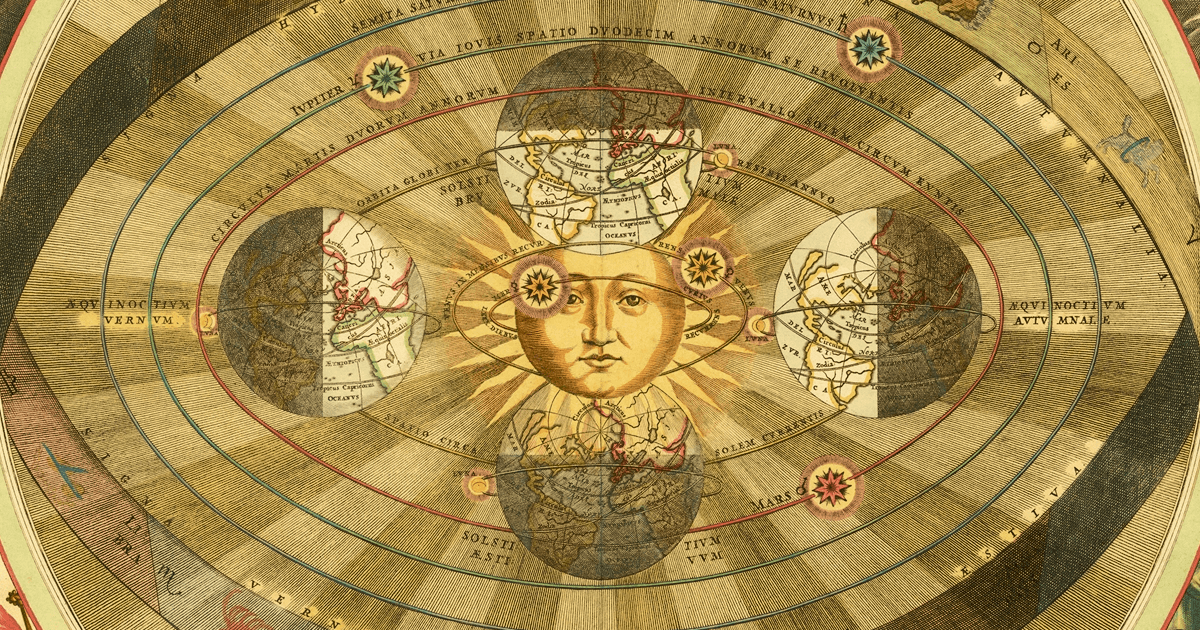
That is where the comparison with Einstein becomes intriguing. In 1905, Einstein’s special theory of relativity overturned the assumption that space and time were fixed and absolute. Time slows as objects move at very high speeds. Distances contract. Space and time are not immutable backdrops but relative quantities.

The reason is that the speed of light remains constant. Every observer measures light travelling at exactly the same speed in a vacuum. If light cannot change, something else must. Space and time themselves become relative.

As the physicist John Archibald Wheeler memorably summarised the later implications of relativity: “Matter tells spacetime how to curve, and spacetime tells matter how to move.”

Space is not simply a stage upon which events occur. It is part of the drama.

The implications run deeper still. If space and time depend upon the observer, then even the familiar distinction between past, present and future begins to dissolve.

Writing to the family of his friend Michele Besso, Einstein described that distinction as “only a stubbornly persistent illusion”.

St Augustine had wrestled with the same mystery some 1,500 years earlier in Confessions, approaching it not through mathematics but through introspection:

“What, then, is time? If no one asks me, I know what it is. If I wish to explain it to him who asks me, I do not know.”

Between them, the philosopher and the physicist illuminate the same puzzle. Time is the reality in which we live, yet the closer we examine it, the less straightforward it becomes.

None of this suggests that Moses taught Einstein’s physics or anticipated Lorentz transformations. That would ask far too much of the text. The claim is both narrower and, I think, more interesting.

Genesis places light at the foundation of creation. Physics places light at the foundation of the measurable universe. Those are not identical claims. Scripture is not offering physics, and physics is not interpreting Scripture. Yet both distinguish light from the space and time that depend upon it.

Genesis does not describe light as fast. It simply presents it as first. Einstein, in an entirely different vocabulary, identifies light as invariant. Space changes. Time changes. Light alone remains constant for every observer. Perhaps that is the real point of contact.

Not that Genesis predicted relativity, but that both recognise light as categorically different from the realities it makes possible. Scripture calls it first. Physics calls it invariant. Different vocabularies, perhaps expressing the same underlying intuition. Light first. Then space. Then time.

Einstein did not discover something Genesis had somehow concealed. Rather, he provided the mathematical language to describe a universe in which light occupies an utterly singular place.

Reading it in that light, Jesus’s words acquire an even deeper resonance:

“I am the light of the world.”

Continue reading with a free account

Create a free account to read up to five articles each month
Create free account

You have # free articles remaining this month.

Subscribe to get unlimited access.
Sign up

subscribe to the catholic herald today

Our best content is exclusively available to our subscribers. Subscribe today and gain instant access to expert analysis, in-depth articles, and thought-provoking insights—anytime, anywhere. Don’t miss out on the conversations that matter most.
Subscribe