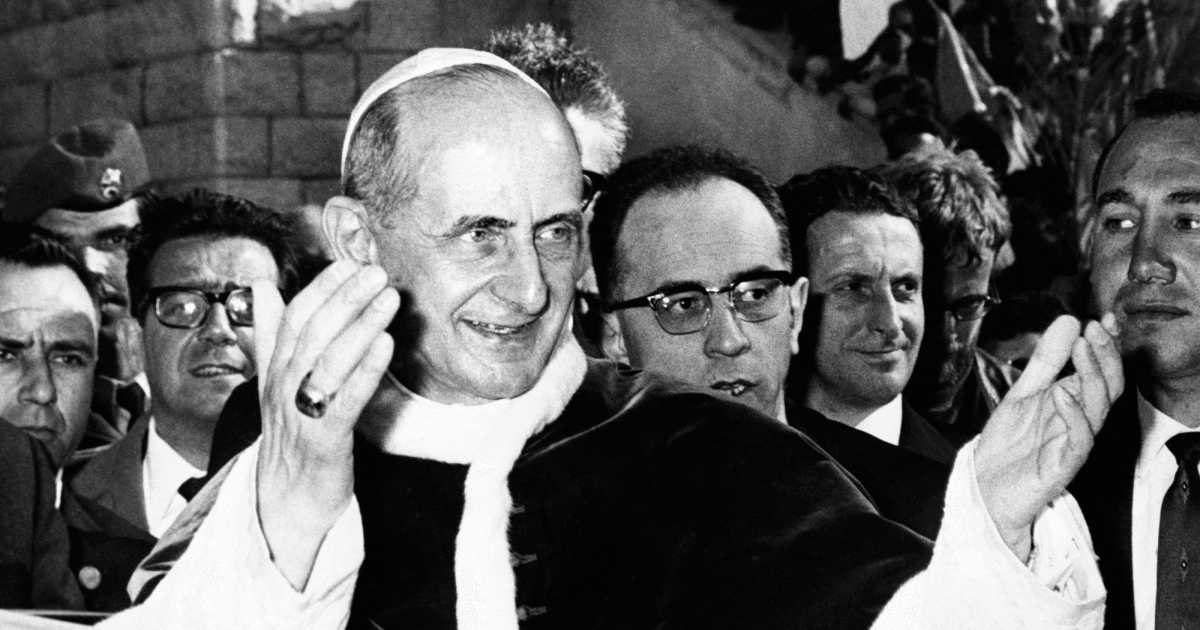



Few papal documents have been mocked as thoroughly as Humanae Vitae. When Pope Paul VI reaffirmed the Catholic Church’s opposition to artificial contraception in 1968, many assumed he had profoundly misread the modern world. The sexual revolution was under way, the contraceptive pill promised unprecedented freedom and history seemed to be moving in only one direction.
This month being the 58th anniversary of Humanae Vitae, it is a fitting moment to ask whether Pope Paul VI really misread the modern world – or whether the modern world misunderstood him.

When Humanae Vitae was published, much of the western world reacted with disbelief. Even within the Church there was dissent, confusion and disappointment. The prevailing assumption was that history had simply passed Catholic teaching by. Today, however, the encyclical deserves to be revisited, not merely as a document about contraception, but as a remarkably perceptive diagnosis of human nature and modern society.
Paul VI warned that widespread contraceptive use could contribute to four broad developments: increased marital infidelity, a lowering of moral standards, men treating women more as instruments of pleasure than persons deserving reverence and governments imposing coercive policies relating to reproduction. Whatever one’s view of the Church’s teaching on contraception itself, it is difficult to deny that these warnings now appear strikingly relevant.
The sexual revolution was presented as a revolution of freedom. But revolutions rarely deliver only what they promise. They also reshape cultures in ways their architects neither expect nor intend.
What changed was not simply attitudes towards contraception. Western societies gradually separated sex from its intrinsic relationship to new life. Once that connection was weakened, sex became increasingly detached not only from procreation but from permanence, responsibility and sacrifice. What emerged was not simply greater personal autonomy, but often greater fragmentation.
Today we live amid record levels of loneliness, collapsing birth rates, declining marriage, widespread pornography consumption and deep confusion about relationships and identity. Despite unprecedented sexual permissiveness, many western societies are experiencing unprecedented loneliness. Intimacy is increasingly commodified. The language of commitment and vocation has steadily given way to the language of personal fulfilment and lifestyle optimisation.
Paul VI’s warning about men treating women as instruments now feels less like an old religious anxiety and more like an uncomfortable description of modern culture. The promise was liberation. Too often, the result has been commercialisation, commodification and profound loneliness.
One need only look at the pornography industry, the explosion of platforms such as OnlyFans or the growing normalisation of commercial surrogacy to see how easily human intimacy becomes commercialised once sex is severed from its deeper moral and relational meaning. The body becomes content. Fertility becomes a service. Children become products of contractual arrangements rather than gifts received through love.
Nor was the encyclical wrong about state power. The 20th and 21st centuries have repeatedly shown how governments become tempted to intervene in reproduction once fertility is viewed primarily as something technological and manageable. China’s one-child policy remains the starkest example, but coercive sterilisation programmes, population-control policies and increasing state involvement in reproductive technologies all reveal the same underlying impulse: the belief that human fertility exists chiefly as a problem to be administered.
Yet perhaps the most profound warning of Humanae Vitae was not about contraception itself, but about what happens to a civilisation once sex, love and new life are no longer understood as belonging together. Across Europe, birth rates have collapsed well below replacement level. Britain is ageing rapidly. Entire societies are beginning to confront the economic and cultural consequences of demographic decline: shrinking workforces, mounting pressure on healthcare systems, fewer children, fewer families and a growing sense of social exhaustion.
This crisis is not merely economic. It is spiritual. People do not stop having children simply because housing is expensive or careers are demanding. Previous generations often endured war, rationing and genuine material hardship while continuing to welcome children. Birth rates ultimately reflect something deeper: whether societies believe the future is worth investing in.
It is no coincidence that societies which increasingly regard children as optional lifestyle accessories also struggle to defend unborn life. Once fertility becomes something to be managed rather than welcomed, the unborn child is more easily seen as an obstacle than a gift. Abortion, contraception, IVF, surrogacy and assisted suicide are often debated as separate ethical questions, yet they all arise from the same deeper assumption: that human life should be subject to individual choice and technological control rather than received with gratitude and protected in love.
Children are, in a profound sense, acts of hope. Christianity has always understood children not as projects to be undertaken once every other ambition has been fulfilled, but as gifts to be received. Modern culture increasingly reverses that order. Parenthood becomes another lifestyle option, weighed alongside travel, career progression or financial goals, rather than a vocation through which love matures and self-giving finds its fullest expression.
That is why the Church’s teaching on openness to life was never simply a prohibition. It was part of a larger vision of the human person. In the Catholic understanding, love is not primarily self-expression but self-gift. Sex is not merely recreational or therapeutic. It is bound up with responsibility, sacrifice, permanence and the creation of future generations.
Modern society increasingly understands freedom as the removal of limits rather than the capacity to give oneself meaningfully to others. But a civilisation organised entirely around autonomy eventually finds itself unable to sustain dependency, even though every society ultimately depends on people willing to care for children, the elderly, the sick and one another.
Humanae Vitae did not predict every feature of modern life. Nor does every social problem stem directly from contraception. The world is more complicated than that.
But Paul VI grasped something fundamental: Once sex was detached from openness to life, it would not remain confined to private morality. It would reshape how societies understand relationships, commitment, family, parenthood and even the purpose of human freedom itself.
For decades, Humanae Vitae was dismissed as a relic of a bygone age. Increasingly, it reads less like a relic than a diagnosis. Paul VI did not oppose modernity because he feared freedom. He feared what freedom would become once detached from truth, responsibility and openness to life. Looking around the western world in 2026, it is increasingly difficult to say he was wrong.
Michael J Robinson is the executive director of SPUC, the world’s oldest pro-life NGO and the UK’s largest.