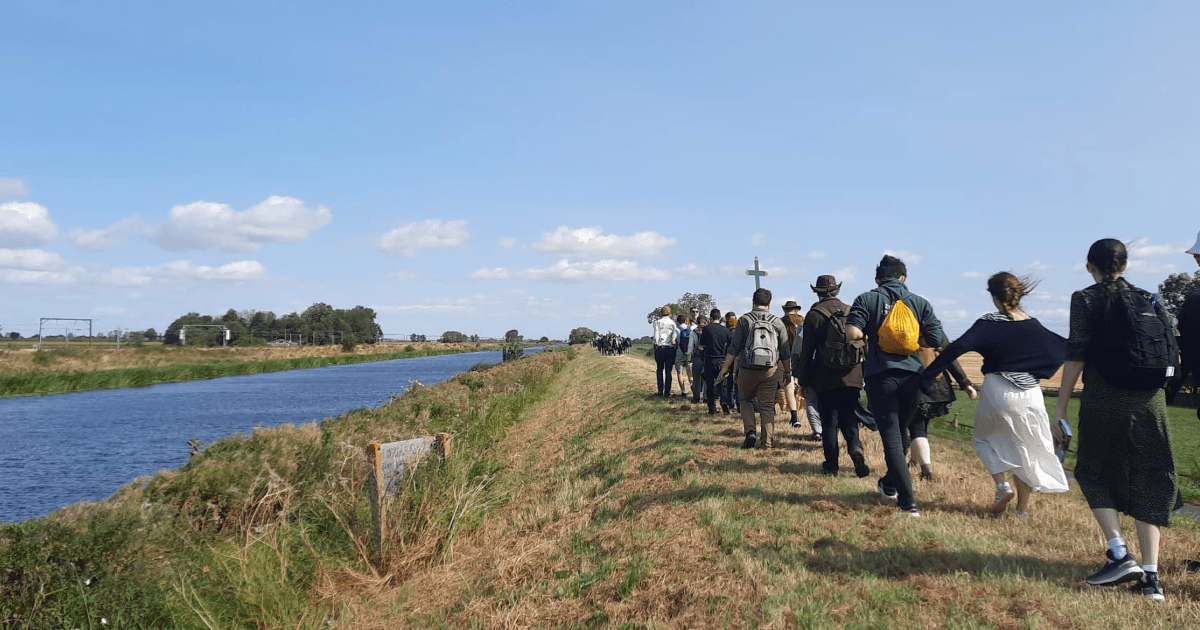

There’s a moment on the Latin Mass Society’s annual pilgrimage to Walsingham when the comparison with Chartres breaks down completely. You’ve spent the day walking the English countryside, chanting the rosary, singing hymns, gradually acquiring blisters, until somebody announces there’s a pub coming up in 10 minutes.
Chartres is magnificent – tens of thousands of Catholics marching across France to one of the great cathedrals of Christendom is hard to beat. But Walsingham has its own unmistakably English character. Medieval ruins, Norfolk villages, a bit more rain than Chartres perhaps and, yes, the occasional pub stop. I’ve done both pilgrimages several times, and I wouldn’t want Walsingham to become an English Chartres. Its charm is that it isn’t one. It feels like English Catholicism recovering its own landscape in miniature, exactly what the Latin Mass Society has spent 60 years doing.
The Society was founded in 1965, just as the liturgical changes following Vatican II were getting under way. Its first president was Sir Arnold Lunn; Evelyn Waugh and Hugh Ross Williamson were closely involved in its founding. At first the question was mostly about keeping Latin in Catholic worship, but as the changes went further, it became a question of whether the old rite would survive at all. It’s easy now to forget how uncertain that once looked.
In 1971 the Society organised an appeal to Pope Paul VI signed by an extraordinary set of names: Graham Greene, Kenneth Clark, Iris Murdoch, Yehudi Menuhin, Robert Graves, Joan Sutherland and, famously, Agatha Christie. The appeal didn’t depend on its signatories being Catholic, still less “traditionalist” – its argument was that the old Mass belonged to Europe’s cultural inheritance, that the churches had been built for it and the music written for it, and that civilisation shouldn’t casually throw it away.
Cardinal Heenan carried the appeal to Rome, and Paul VI granted a concession letting English and Welsh bishops permit the older rites on certain occasions. It became known as the “Agatha Christie indult”, after the probably apocryphal story that the pope spotted her name and exclaimed, “Ah, Agatha Christie!” The concession wasn’t quite what people now assume – it specified the transitional liturgical books incorporating the 1965 and 1967 changes, not simply the 1962 missal – but it gave the old rite public, episcopally sanctioned continuity years before the rest of the Catholic world got anything similar. A worldwide indult didn’t arrive until 1984.
Appeals, petitions and famous signatures aren’t really the point, though. What the LMS has actually spent 60 years doing is much less exciting: finding priests, organising Masses, keeping a network of local representatives going and, since 2007, training priests to say the old rite at all.
Which is where Walsingham comes in. The walking pilgrimage began in 2010 with a handful of people, loosely modelled on the Paris–Chartres walk. It now brings more than 200 pilgrims from Ely to Walsingham over three days and 56 miles, with sung Mass each morning and priests walking alongside everyone else.
Walsingham, one of medieval England’s great shrines, was destroyed at the Reformation, its pilgrimage extinguished for centuries. Until it wasn’t: the Slipper Chapel, rescued from secular use in the 19th century, became a place of Catholic devotion again. The old Mass has followed roughly the same arc – nearly lost, kept alive by a small number of people who simply refused to let it go, and now handed on to people who weren’t even born when it was supposedly finished.
This year’s pilgrimage leaves Ely over the August bank holiday, from August 27 to 30. Bookings are closing as I write this. If you’ve ever looked enviously across the Channel at Chartres, come to Walsingham instead. It’s smaller, but it’s ours.
And there are pubs.
(Photo: Joseph Shaw)