

June is a holy month. One way to know this is by the many wonderful feasts that fill its weeks. Another is to look at the way the world treats it. As we are so loudly reminded at the beginning of every summer, June has been hijacked by worldly forces who march under the banner of Pride, the chief of the deadly sins. Their emblem is the six-colour rainbow – a cynical parody of the seven-coloured sacrament of love that God set in the sky when He made His covenant with Noah and his descendants. We can be confident that June is a holy month because it is the month that the evil one targets more than any other.
But let us focus on the positive case for June’s sanctity. The month boasts up to five solemnities – more than any other month in the Church’s year – and it begins with the memorial of St Justin Martyr, the great 2nd-century convert and defender of the Faith. Whereas today lust often masquerades as love, Justin in his First Apology makes clear the moral difference Christ brings: “And thus do we also, since our persuasion by the Word, stand aloof from them [i.e., demons], and follow the only unbegotten God through His Son – we who formerly delighted in fornication, but now embrace chastity alone.”
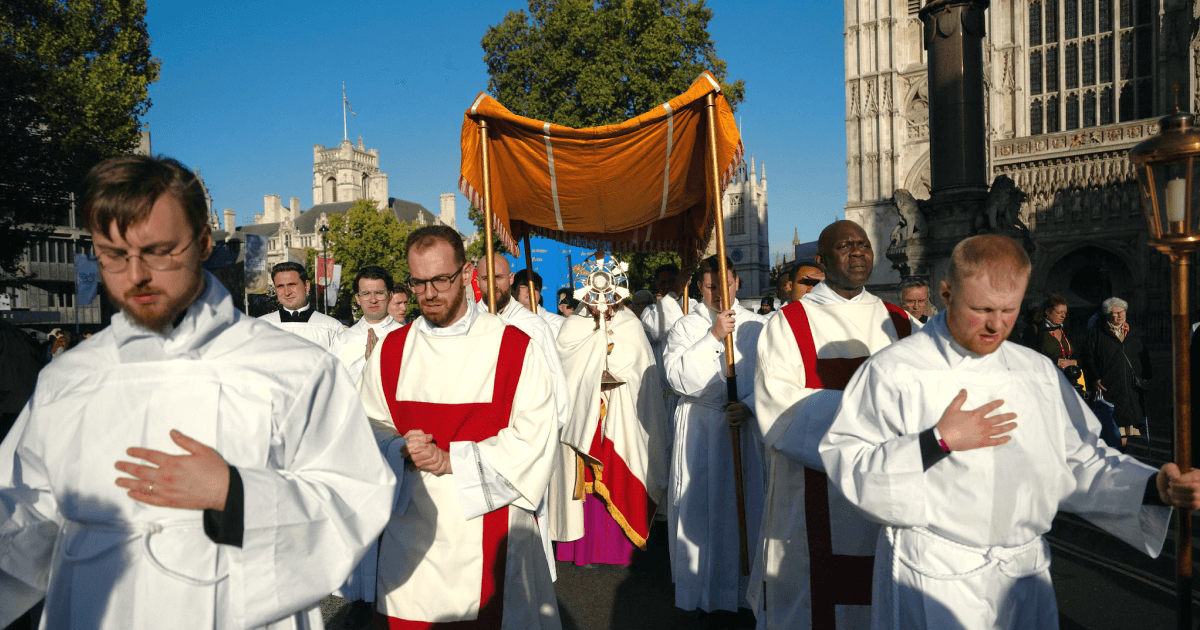
Near the beginning of June we also have the great celebration of Corpus Christi. This moveable solemnity takes place on the Thursday after Trinity Sunday (another solemnity that frequently falls in June), although in many countries it is moved to a Sunday. Corpus Christi was instituted in 1264 by Pope Urban IV, and it invites us to renew our sense of wonder at the God-man’s everlasting sacrifice of love: “This is my Body, given up for you.”
On June 3, we remember St Charles Lwanga and his companions. These Christian heroes refused to engage in homosexual acts with the local king of Buganda. Outraged, the monarch ordered the men to be burned alive. Two days later, on June 5, we have St Boniface, the great English saint who became known as the Apostle to the Germans. In his most famous escapade, he publicly challenged the region’s pagan deities by cutting down an oak tree dedicated to Thor. When the tree fell and no divine retribution followed, many of the locals became convinced of the truth of the Christian faith. Boniface later used the wood from the tree in the building of a church, and in this respect he offers us a model for how to confront and baptise the new paganism that feels so ascendant in our culture today.
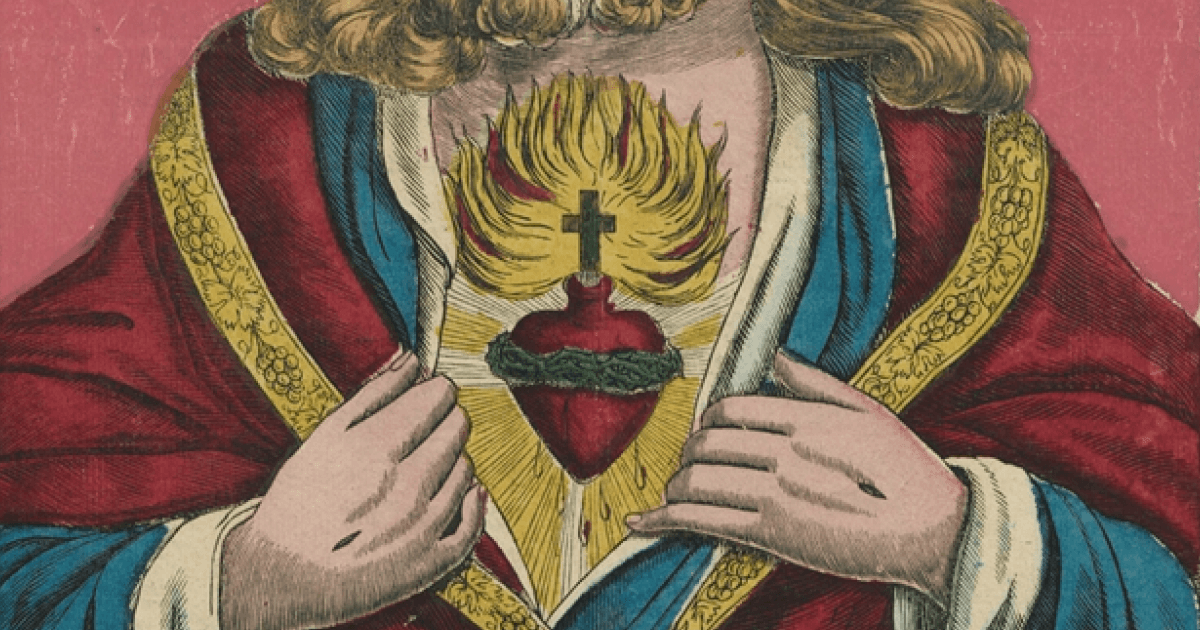
June 6 gives us St Norbert, known as the Defender of the Eucharist, and then on the Friday after Corpus Christi we celebrate the great Solemnity of the Most Sacred Heart of Jesus. When Pope Leo XIII established this feast in his 1899 encyclical Annum Sacrum, he recalled how in the early days of the Church the Emperor Constantine saw a sign of the Cross in the sky, which led him to victory over his enemies and paved the way for the legalisation of the Christian religion across the empire. Leo avows:
“And now, today, behold another blessed and heavenly token is offered to our sight – the most Sacred Heart of Jesus, with a cross rising from it and shining forth with dazzling splendour amidst flames of love. In that Sacred Heart all our hopes should be placed, and from it the salvation of men is to be confidently besought.”
Today the entire month of June is dedicated to the Sacred Heart, and this beautiful devotion is needed now more than ever. In Christ’s pierced heart, which burns with divine charity, we discover all the virtues of purity, humility, nobility and self-sacrifice. On the day that follows, we observe the memorial of Our Lady’s own Immaculate Heart. She who treasured all the mysteries of her Son’s life and pondered them in her heart teaches us what it means to conform our own hearts to His Sacred Heart.
On June 9 we commemorate St Ephrem the Syrian, whose famous prayer continues to be used by Byzantine Catholics in their Lenten liturgy. The prayer rejects a spirit of sloth and vain ambition, asking instead for “the spirit of purity and of humility, the spirit of patience and neighbourly love”. It concludes by requesting the grace to become more aware of one’s own sin, and to avoid thinking evil of one’s neighbour.
Fast forward to June 21, and we mark the memorial of St Aloysius Gonzaga. Known to the Italians as San Luigi, Gonzaga received his First Holy Communion from St Charles Borromeo, and he would later have St Robert Bellarmine as his spiritual director. He died aged just 23 after caring for the sick during a pandemic, and he is remembered for being a paragon of holy purity.
Two more great defenders of God’s plan for marriage and sexuality are Ss Thomas More and John Fisher, who share a feast on June 22. These great English martyrs preferred to lay down their lives rather than compromise the Faith of their fathers. One of those fathers is St John the Baptist, another champion of marriage, whose birthday we celebrate (in the form of a solemnity) on June 24. Two days later, on June 26, we remember St Josemaría Escrivá, the Spanish priest and founder of Opus Dei, whose luminous writings on chastity provide a timely antidote to our modern infatuation with sin.
Finally, the Church rounds out June with the Solemnity of Ss Peter and Paul. In this holy month, so disparaged by our sick world, we might call to mind Paul’s exhortation to the Philippians to set their minds on things that are pure, as well as his urgent instruction to the church in Thessalonica: “For this is the will of God, your sanctification: that you abstain from immorality; that each one of you know how to control his own body in holiness and honour, not in the passion of lust like heathen who do not know God” (1 Thess 4:3–5).

.png)