March 20, 2026

Le Puy-en-Velay: France’s little Jerusalem

James Jeffrey
More
Related
Min read
share

One of the great advantages of arriving on foot into a city of repute, like the pilgrims of old, is that you have a far greater chance of experiencing ‘the reveal’ than if speeding in along the motorway. You can walk around a corner or get to the top of a piece of ground, previously obscuring your vision, and then – baam! – right before your eyes, there it is: what you have been searching for.

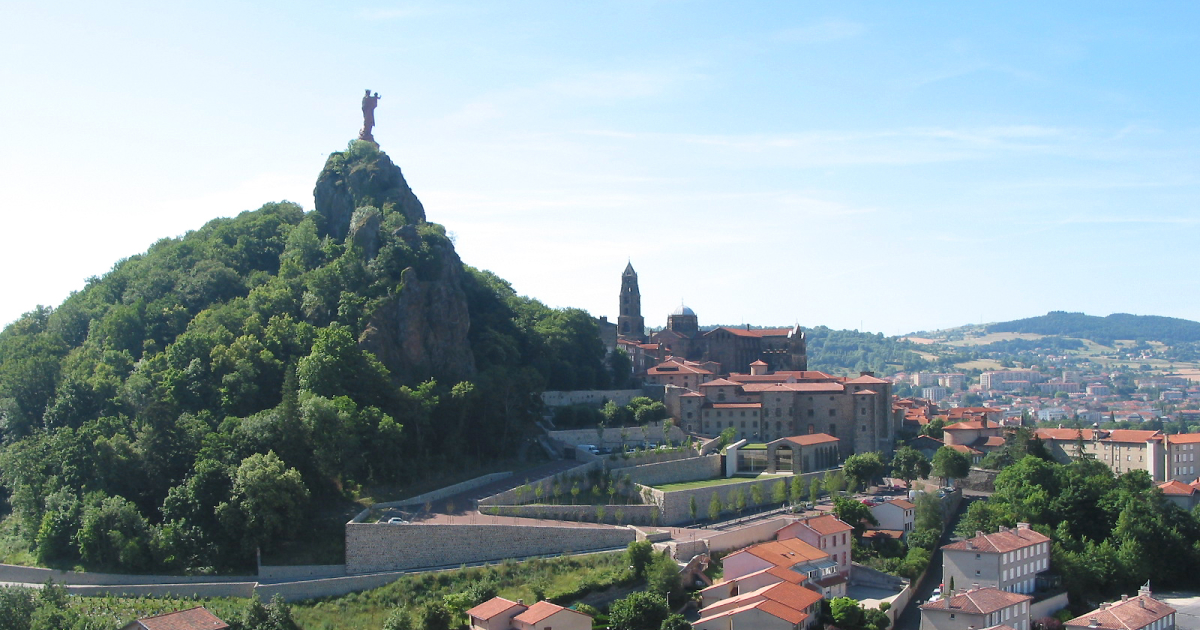
So it was that, after taking a few steps around the corner of a brick wall, suddenly laid out before me was the city of Le Puy-en-Velay with, due to the angle of my approach, its three most noteworthy landmarks seemingly bunched together. On the left was the giant statue of the Virgin Mary holding the Christ Child, precociously raising his right hand to bless the city – and the world. To the right, the Cathédrale Notre-Dame-de-l’Annonciation du Puy. Between them, the arresting Chapel of St Michel precariously perched atop the steep remains of a volcanic chimney.

Adding to my good fortune, the February weather was particularly kind that day – I was able to don hiking shorts and the city was bathed in sunshine, prompting my exuberant reaction on being hit with the reveal: ‘Wow! This is France’s little Jerusalem!’

Le Puy-en-Velay, nestled in the volcanic landscape of the Auvergne-Rhône-Alpes region in south-central France, is renowned as one of Catholic France’s most important religious sites, as well as the starting point for pilgrims on their long way to Santiago de Compostela, about 1,500km westwards in Spain.

Before setting off, pilgrims are welcomed to attend the 7am Mass in one of the cathedral’s side chapels, after which they can gather in the cathedral’s nave for a pilgrim’s blessing from the priest. But what follows is the real treat: a giant set of metal plates in the cathedral’s stone floor is lowered, revealing a secret stone staircase. It takes pilgrims from the centre of the nave to the cathedral’s central portal and arched entrance that, due to the cathedral’s elevated position, beautifully frames the surrounding countryside into which pilgrims are about to set forth. It makes for a dramatic departure.

Whereas Santiago de Compostela gains much of its vitality from being the endpoint of so many arduous quests, Le Puy-en-Velay gains its significance as the launchpad of those endeavours. As such, its more muted atmosphere befits the starting point of such an awesome undertaking. A degree of apprehension is hard to avoid: there is a long way to go and a lot to go through, physically, emotionally and spiritually.

That more muted atmosphere became more apparent to me once the sun had retreated behind the clouds and I was up close with the city – I realised my earlier comparison with Jerusalem was probably pushing it a bit. But, as with any city steeped in history, if you explore its winding alleys with attention, there is much to learn and admire. It reminds one that the game of comparisons is ultimately a flawed and unfair one – especially when it comes to where humans have chosen to put down roots – and that each place, shaped over the centuries by so much human endeavour, ingenuity, heartbreak and loss, deserves to be taken on its own merits.

The statue of the Virgin Mary atop the city’s Corneille rock dates from the middle of the 19th century, when Marian devotion underwent a revival. A local aristocrat decided to use the rocky outcrop as the pedestal for a monumental statue of the Virgin. On 8 September 1855, the feast of the Nativity of the Blessed Virgin Mary, France was victorious at the siege of Sebastopol during the Crimean War, and part of the statue was made by melting down 213 Russian cannons seized during the battle. The work of the French sculptor Jean-Marie Bonnassieux, it was unveiled on 12 September 1860 in front of 120,000 pilgrims.

The Chapel of Saint-Michel d’Aiguilhe – St Michael of the Needle – sits atop an 82-metre-high volcanic chimney shaped by millions of years of volcanic activity and erosion. Reached by 268 steps, the chapel and accompanying buildings are squeezed onto an area that is just 187 feet in diameter. Dedicated to St Michael the Archangel, the chapel was originally built in 969 by Bishop Godescalc, after he returned from his journey to the shrine of St James in Santiago de Compostela. The chapel was expanded in the 12th century with a nave, ambulatory, side chapels, a narthex and a bell tower. The influence of Spain marks its architecture and stonework – especially the ornately detailed entrance – which exhibits Moorish stylistic touches.

Even the holiest of sites are not immune to the effect of lots of tourists milling around. But if you are fortunate enough to find yourself alone inside the chapel, then, surrounded by its ancient capitals and faded remains of once-colourful frescoes on the ceiling, you quickly get that sense of being in a ‘thin place’ – those liminal locations where the gap between our terrestrial world and the metaphysical realm is reduced.

A similar sensation occurs when confronted with the cathedral’s celebrated Vierge Noire (Black Madonna). She hovers above the altar, encircled by a ring of sanctuary lamps and clad in a perfectly triangular cloak, from the centre of which the black head of the Christ Child startlingly pops out to confront you. Nearby, in the north transept, haunting Romanesque frescoes radiate the great weight of centuries past. Looking at them, you can feel as if you are time-travelling, while also being reminded of the longevity and depth of the Christian faith, as well as of the fervour and fortitude of the faithful who came before.

Le Puy-en-Velay’s prominence in France is inversely mirrored by its lack of recognition in places such as the United Kingdom and the United States, even among those countries’ Catholics. The Reformation, it cannot be denied, did a good job in terms of its goals. So if you want to engage in your own mini Counter-Reformation, a trip to Le Puy-en-Velay is a good option and a way to begin to discover what precious treasures the Eldest Daughter of the Church still holds in her bosom. And if you then set out for Santiago de Compostela from Le Puy, you will really be making a point.

James Jeffrey is a former British Army officer. He is a writer, editor and Camino guide
One of the great advantages of arriving on foot into a city of repute, like the pilgrims of old, is that you have a far greater chance of experiencing ‘the reveal’ than if speeding in along the motorway. You can walk around a corner or get to the top of a piece of ground, previously obscuring your vision, and then – baam! – right before your eyes, there it is: what you have been searching for.

So it was that, after taking a few steps around the corner of a brick wall, suddenly laid out before me was the city of Le Puy-en-Velay with, due to the angle of my approach, its three most noteworthy landmarks seemingly bunched together. On the left was the giant statue of the Virgin Mary holding the Christ Child, precociously raising his right hand to bless the city – and the world. To the right, the Cathédrale Notre-Dame-de-l’Annonciation du Puy. Between them, the arresting Chapel of St Michel precariously perched atop the steep remains of a volcanic chimney.

Adding to my good fortune, the February weather was particularly kind that day – I was able to don hiking shorts and the city was bathed in sunshine, prompting my exuberant reaction on being hit with the reveal: ‘Wow! This is France’s little Jerusalem!’

Le Puy-en-Velay, nestled in the volcanic landscape of the Auvergne-Rhône-Alpes region in south-central France, is renowned as one of Catholic France’s most important religious sites, as well as the starting point for pilgrims on their long way to Santiago de Compostela, about 1,500km westwards in Spain.

Before setting off, pilgrims are welcomed to attend the 7am Mass in one of the cathedral’s side chapels, after which they can gather in the cathedral’s nave for a pilgrim’s blessing from the priest. But what follows is the real treat: a giant set of metal plates in the cathedral’s stone floor is lowered, revealing a secret stone staircase. It takes pilgrims from the centre of the nave to the cathedral’s central portal and arched entrance that, due to the cathedral’s elevated position, beautifully frames the surrounding countryside into which pilgrims are about to set forth. It makes for a dramatic departure.

Whereas Santiago de Compostela gains much of its vitality from being the endpoint of so many arduous quests, Le Puy-en-Velay gains its significance as the launchpad of those endeavours. As such, its more muted atmosphere befits the starting point of such an awesome undertaking. A degree of apprehension is hard to avoid: there is a long way to go and a lot to go through, physically, emotionally and spiritually.

That more muted atmosphere became more apparent to me once the sun had retreated behind the clouds and I was up close with the city – I realised my earlier comparison with Jerusalem was probably pushing it a bit. But, as with any city steeped in history, if you explore its winding alleys with attention, there is much to learn and admire. It reminds one that the game of comparisons is ultimately a flawed and unfair one – especially when it comes to where humans have chosen to put down roots – and that each place, shaped over the centuries by so much human endeavour, ingenuity, heartbreak and loss, deserves to be taken on its own merits.

The statue of the Virgin Mary atop the city’s Corneille rock dates from the middle of the 19th century, when Marian devotion underwent a revival. A local aristocrat decided to use the rocky outcrop as the pedestal for a monumental statue of the Virgin. On 8 September 1855, the feast of the Nativity of the Blessed Virgin Mary, France was victorious at the siege of Sebastopol during the Crimean War, and part of the statue was made by melting down 213 Russian cannons seized during the battle. The work of the French sculptor Jean-Marie Bonnassieux, it was unveiled on 12 September 1860 in front of 120,000 pilgrims.

The Chapel of Saint-Michel d’Aiguilhe – St Michael of the Needle – sits atop an 82-metre-high volcanic chimney shaped by millions of years of volcanic activity and erosion. Reached by 268 steps, the chapel and accompanying buildings are squeezed onto an area that is just 187 feet in diameter. Dedicated to St Michael the Archangel, the chapel was originally built in 969 by Bishop Godescalc, after he returned from his journey to the shrine of St James in Santiago de Compostela. The chapel was expanded in the 12th century with a nave, ambulatory, side chapels, a narthex and a bell tower. The influence of Spain marks its architecture and stonework – especially the ornately detailed entrance – which exhibits Moorish stylistic touches.

Even the holiest of sites are not immune to the effect of lots of tourists milling around. But if you are fortunate enough to find yourself alone inside the chapel, then, surrounded by its ancient capitals and faded remains of once-colourful frescoes on the ceiling, you quickly get that sense of being in a ‘thin place’ – those liminal locations where the gap between our terrestrial world and the metaphysical realm is reduced.

A similar sensation occurs when confronted with the cathedral’s celebrated Vierge Noire (Black Madonna). She hovers above the altar, encircled by a ring of sanctuary lamps and clad in a perfectly triangular cloak, from the centre of which the black head of the Christ Child startlingly pops out to confront you. Nearby, in the north transept, haunting Romanesque frescoes radiate the great weight of centuries past. Looking at them, you can feel as if you are time-travelling, while also being reminded of the longevity and depth of the Christian faith, as well as of the fervour and fortitude of the faithful who came before.

Le Puy-en-Velay’s prominence in France is inversely mirrored by its lack of recognition in places such as the United Kingdom and the United States, even among those countries’ Catholics. The Reformation, it cannot be denied, did a good job in terms of its goals. So if you want to engage in your own mini Counter-Reformation, a trip to Le Puy-en-Velay is a good option and a way to begin to discover what precious treasures the Eldest Daughter of the Church still holds in her bosom. And if you then set out for Santiago de Compostela from Le Puy, you will really be making a point.

James Jeffrey is a former British Army officer. He is a writer, editor and Camino guide
subscribe to
the catholic herald

Continue reading your article with a subscription.
Read 5 articles with our free plan.
Subscribe

subscribe to the catholic herald today

Our best content is exclusively available to our subscribers. Subscribe today and gain instant access to expert analysis, in-depth articles, and thought-provoking insights—anytime, anywhere. Don’t miss out on the conversations that matter most.
Subscribe