May 12, 2026

Lessons from 1964: What Catholics learned from the ‘intermediate’ Mass

Joseph Shaw
More
Related
Min read
share

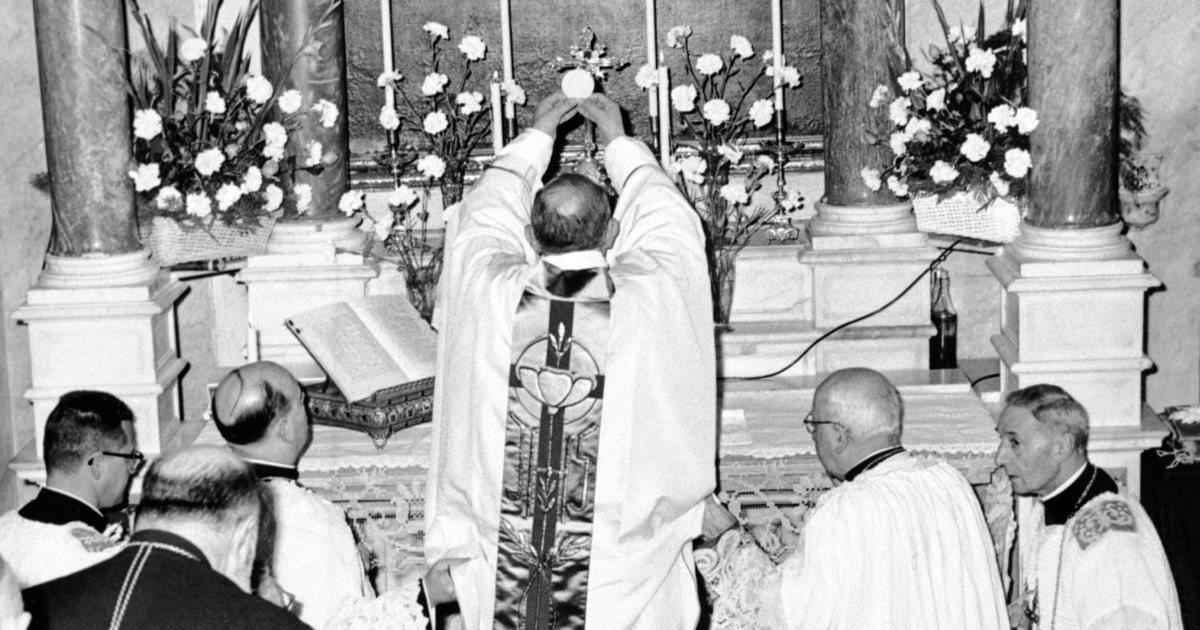
Earlier this month Nico Fassino of the Hand Missal Project published a series of articles on the revised liturgical books that were promulgated in 1964 and came into force in early 1965: that is, before the full revision of the Mass after Vatican II was complete. This may sound a niche area of research, and indeed those books were quickly overtaken by more radical revisions, but it is important for two reasons. First, Fassino’s research highlights popular reactions that surprised observers at the time and may surprise readers today; secondly, the “intermediate books” are sometimes presented today as a happy compromise between the Traditional Mass and the fully reformed Novus Ordo of 1969.

The Mass of 1964 was essentially the Traditional Latin Mass in the vernacular, but stripped of the Psalm Judica at the beginning and the Last Gospel at the end, and with other simplifications. An experimental lectionary was authorised during this time but was not compulsory. At first the Canon (Eucharistic Prayer) was supposed to be said in Latin as before, but this restriction soon disappeared.

Some people liked this “new Mass”, but what surprised proponents of the reform was the strength of feeling against it, particularly as the optional use of the vernacular displaced Latin completely. A writer for the American Catholic publication Our Sunday Visitor expressed the tone of his considerable mailbag:

“Rarely do the letters express rebellion, almost always they convey the bewilderment of Catholics who love their Church, want to do what the Church wants them to do, but somehow feel that they no longer stand on the rock of faith but on sinking sands.

“They are told that the new liturgy should bring them greater satisfaction, a new sense of closeness to Christ, and although they try, they have found no satisfaction; instead of a new sense of closeness to Christ, they have a frightening feeling that they are falling further away.”

This makes sense if we understand that the “Latin Mass” called for, and rewarded, a different form of participation from a vernacular Mass. Those Catholics who had found meaning in the old Mass – apparently the great majority – found that the new one did not work in the same way, and did not derive the same consolation from it.

One response to this reality was exemplified by a number of bishops, including Cardinal John Heenan in Westminster, who tried to insist that at least one Mass on a Sunday in each parish would be celebrated in Latin. One American bishop, Russell McVinney of Rhode Island, celebrated a Latin Mass personally in his cathedral “because”, he wrote, “of my respect for those who find it almost impossible to make the adjustments called for by the new liturgy”.

This attitude was widespread. Even in criticising the establishment of the Latin Mass Society in 1965, the Catholic Herald declared:

“If a sizable section of the English people need a Latin Mass to express themselves in, there is no reason, apart from the practical difficulties, why they should be deprived of it. […] There must be freedom for all legitimate adaptation. Unless we understand this, the whole point of Vatican II will be missed.”

A different kind of response, however, was given by Fr Gregory Murray in 1964 in The Tablet: “The plea that the laity as a body do not want liturgical change, whether in rite or in language, is, I submit, quite beside the poin … It is, therefore, not a question of what people want; it is a question of what is good for them.” This seemed to be backed up by Pope Paul VI the following year, who declared: “perhaps for some the reforms require efforts which are somewhat unpleasant at the beginning.” But, he went on:

“The religious and spiritual plan unfolded before us by the new liturgical constitution is a stupendous one for depth and authenticity of doctrine, for rationality of Christian logic, for purity and riches of culture and art. It also corresponds to the interior being and needs of modern man.”

Again, Vatican Radio declared, on the eve of the implementation of the changes in 1965: “Today’s novelty is tomorrow’s tradition. The Church asks of everyone the sacrifice of renouncing yesterday’s tradition in order that another may be established, more in keeping with the demands of the times.”

Some took things a step further and began to subject the laity to what Fassino describes as “glib, sarcastic, and even scathing public remarks”. I hardly need to reproduce his many examples, however, as the polemic against the ancient liturgical tradition, and those who appreciate its value, has been continuous from that day until the present, and readers will have their own favourites.

Fassino suggests that the bitterness of these responses to Catholics expressing pain and bewilderment about the liturgical reform was a coping mechanism to deal with a feeling among liturgical progressives that the reform was not really working. The widely read priest-sociologist Andrew Greeley expressed the pessimism of those who had been most enthusiastic about Vatican II. An American Council peritus (expert), Fr John Sheerin, declared: “We put such trust in the liturgical reforms but they seem to have made little impression on the parishioners. The wide open spaces among the pews are more wide open than ever, and one sees little evidence of any increased sense of togetherness.”

Statistics measuring the vitality of Catholic life bear out this pessimism: Mass attendance all over the developed world was beginning to fall, along with many other measures of Catholic life, such as baptisms, marriages and receptions into the Church. Lambasting the faithful for their lack of enthusiasm for a liturgical reform they had never asked for, however, was hardly likely to solve the problem.

It is useful to be reminded how many of the problems associated with the liturgical reform – conflict, confusion, liturgical abuses and lapsation – were already making themselves felt before the Novus Ordo was promulgated in 1969. It is particularly useful to bring the date before the reaffirmation of the Church’s teaching on contraception by Pope Paul VI in 1968, since the claim is often made by liturgical progressives that it was this, and not the new liturgy, that caused the Church’s problems.

In the longer term, of course, all kinds of factors influenced the Catholic Church in this period, and indeed other Churches and voluntary associations suffered similar problems. What Fassino’s research shows is not that the liturgy was the only issue, but that it is impossible to claim, as some try, that the 1964 reform was wholly positive and that things went wrong only in 1969. In point of fact, the scholars working on it took the view that if texts were going to be proclaimed week after week in the vernacular, they needed to be shorter, clearer and more varied than the texts found in the ancient Missal, and this seems quite logical. What was unfortunate, however, was the way the reform dragged on from 1964 to 1970, with more still to come, such as texts for other sacraments and the Liturgy of the Hours.

Eventually, thanks to the Latin Mass Society and other associations campaigning for the preservation of the older liturgy, a healthy liturgical pluralism such as envisaged by some back in 1965 did return to the Church, but 60 years later it still remains to be seen how this is to be integrated permanently into the life of the Church.

Continue reading with a free account

Create a free account to read up to five articles each month
Create free account

You have # free articles remaining this month.

Subscribe to get unlimited access.
Sign up

subscribe to the catholic herald today

Our best content is exclusively available to our subscribers. Subscribe today and gain instant access to expert analysis, in-depth articles, and thought-provoking insights—anytime, anywhere. Don’t miss out on the conversations that matter most.
Subscribe