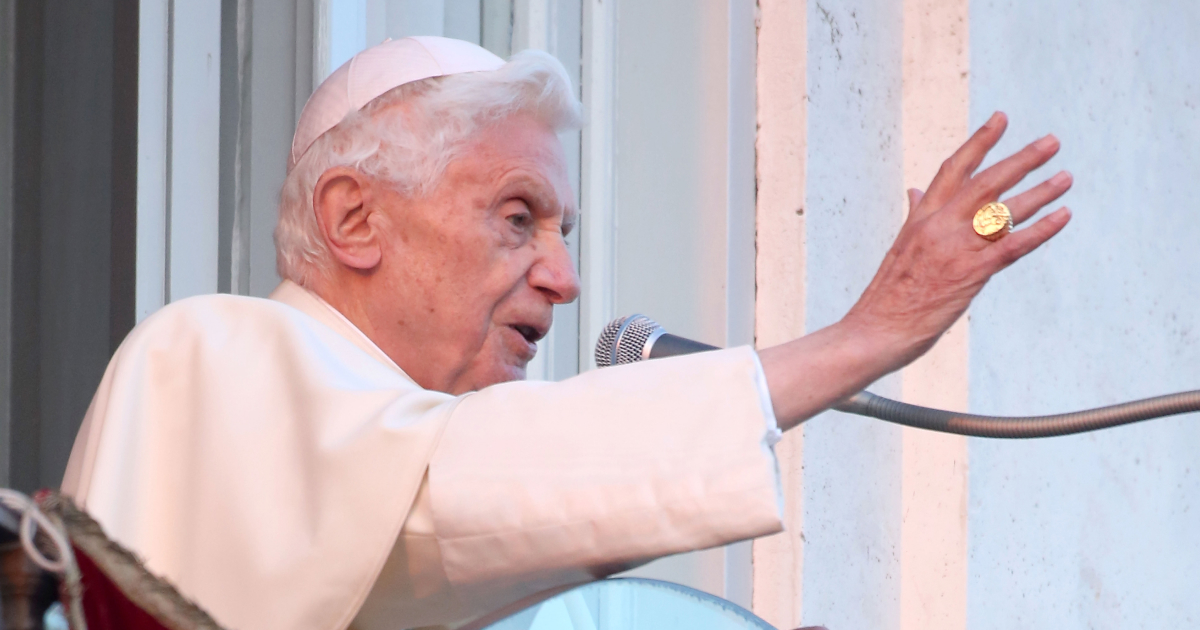


A previously unpublished letter written by Pope Leo XIV to Pope Emeritus Benedict XVI on the day of his resignation has emerged.
The letter, dated February 22, 2013 and reported by Vatican journalist Nico Spuntoni in il Giornale, was written when the future Leo XIV was serving as Prior General of the Augustinians. It followed immediately upon the announcement that Benedict XVI would resign as Pope.
Writing with what is described as personal warmth rather than formality, Fr Prevost expressed “gratitude, loyalty, admiration and support” for Benedict XVI “for everything he has done for the Church during the years of his service and for the great courage he demonstrated in taking the decision to renounce the Petrine Ministry”.
The future Pope went on to commend Benedict’s “clear teaching and the promotion of the faith right up to the search for truth”, while also highlighting what he described as his “exemplary pastoral sense”. Particular attention was given to Benedict’s handling of the sexual abuse crisis, an issue which had come to dominate much of his pontificate.
Fr Prevost acknowledged the Pope’s willingness to seek forgiveness from victims and observed that “Your action has done good to the members of the Church, not to mention what has been done for others outside the Church who always look with attention at how we are capable of responding to such a painful and complex issue”.
These remarks come in the context of continuing debate about Benedict XVI’s legacy in addressing clerical abuse. During his lifetime, the former Pope faced persistent criticism, repeated even in the final months before his death, that he had failed to act decisively in specific cases during his earlier ministry in Germany.
The letter also situates Benedict’s resignation within a broader theological and spiritual view. Fr Prevost drew a parallel with St Augustine of Hippo, noting that just as Augustine “only wanted to be a theologian but had to become a bishop”, so too Benedict “did not want to be Pope but had to be”. The comparison reflects a longstanding interpretation of Benedict’s papacy as one shaped by duty rather than personal ambition.
Further insight into the relationship between the two men has been provided by Archbishop Georg Gänswein, the long-serving personal secretary to Benedict XVI. Speaking to il Giornale, Gänswein recalled an encounter in 2007 at the tomb of St Augustine in Pavia, where Fr Prevost delivered a greeting during a papal visit. According to Archbishop Gänswein, Pope Benedict later remarked simply, “Let’s just say it was beautiful”, an observation now seen as an early indication of his favourable impression of the future Pope.
The publication of the letter coincides with renewed attention to Benedict XVI’s legacy, coming around the anniversary of his birthday. A commemorative Mass was recently celebrated in St Peter’s Basilica, presided over by Cardinal Kurt Koch, marking what would have been his 99th birthday.
During his pontificate from 2005 to 2013, Benedict XVI introduced a number of significant measures and initiatives within the life of the Church. In 2007 he issued the motu proprio Summorum Pontificum, which widened permission for the celebration of the Traditional Latin Mass, describing it as an “extraordinary form” of the Roman Rite and allowing its use without the need for episcopal approval under specified conditions.
In 2009, through the apostolic constitution Anglicanorum Coetibus, he established personal ordinariates for groups of Anglicans entering into full communion with the Catholic Church, providing a canonical structure that allowed them to retain elements of their liturgical and spiritual patrimony. This led to the creation of ordinariates in England, North America and Australia in the years that followed.
His pontificate also included a series of international apostolic journeys, major theological writings and the convocation of the Year of Faith between 2012 and 2013. Benedict XVI formally renounced the papacy on February 28, 2013, after announcing his decision earlier that month, and thereafter took the title Pope Emeritus.