July 15, 2026

Monsignor Gilbey at 125

Mark McGinness
More
Related
Min read
share

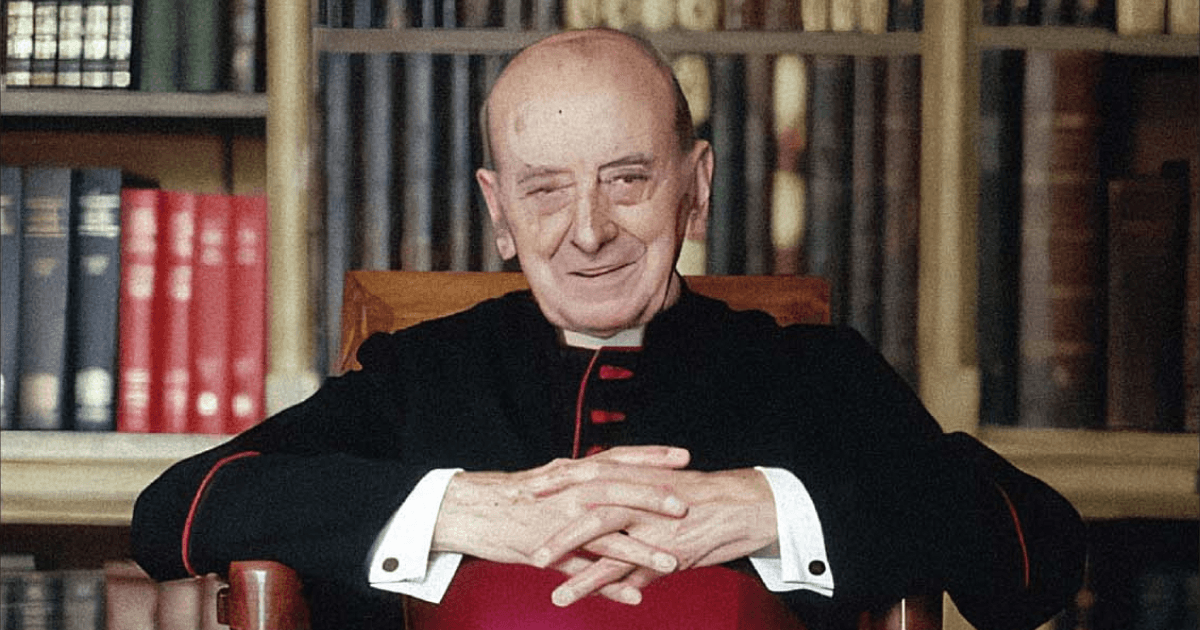
Monsignor Alfred Gilbey was born 125 years ago today in Harlow, Essex.

He was a venerable figure in the worlds of English Catholicism and London clubland, a charming Edwardian relic, known for his reactionary views, his old-world manners and appearance. Every morning for nearly 30 years, this small, bent figure – looking rather like Spy’s cartoon of Cardinal Newman (Roger Scruton interpreted him as an Anglican clergyman from Jane Austen’s day) – in frock coat, gaiters, gloves and a silk soup-plate hat, could be seen leaving his home at the top of the Travellers’ Club in Piccadilly and making his way, by No 14 bus, to the Oratory, where he said Mass in the Tridentine rite, a singular privilege conferred on him by Cardinal Heenan in the mid-1960s. When he turned 90, the Monsignor was offered a car and chauffeur by a friend to get him to the church on time.
While he was born in the early months of Edward VII’s reign, his views were abidingly Victorian. He deplored democracy, equality, ecumenism, feminism, animal rights and the French Revolution, and considered the Age of the Common Man a great mistake. Tony Blair’s Cool Britannia would have left him cold. He gloried in hunting, hierarchy and country houses, gentlemen’s clubs and the Catholic aristocracy.

These social attitudes, in isolation, would simply single him out as a historical curiosity, another example of the English eccentric whose life that country delights in celebrating. But what justifies his eminence was an unswerving devotion to his faith and his ability to convey and explain with clarity, charm and conviction the beliefs of his Church: “I always describe myself as being socially ecumenical,” Gilbey said, “but theologically intransigent”.

During his 33 years as Catholic chaplain to Cambridge University, he had spectacular success instructing undergraduates in the faith. It was said he found the 87-minute train ride from Liverpool Street station in London to Cambridge an ideal opportunity for conversion. Although he gave all credit to the Holy Spirit, The Times estimated he was instrumental in converting some 170 souls to Catholicism.

This quintessential Englishman was in fact half-Spanish. He told the writer John Mortimer in an interview: “I’ve always kept a Spanish shape, like Don Quixote, but I don’t tilt at windmills. I’m much more realistic.” His father, a Protestant and wealthy wine merchant, converted to marry his mother, a devout Spanish beauty from Jerez, where the family also bought its sherry. The Gilbeys were a vast tribe – Alfred had 75 first cousins, and a great-uncle was created a baronet, a title that is still extant.

The Gilbeys had a chapel built at home in Essex and otherwise lived a comfortable country-house existence – an elegant blend of the temporal and the spiritual, a trait their son was to inherit. Alfred, the youngest of their seven children, was educated by the Jesuits and it was at school that he knew he had a religious calling. However, he deferred to his father and had four years of fun at Trinity College, Cambridge, before training for the priesthood in Rome. In 1929, he was ordained in the family chapel as a secular priest, independent of a bishop or diocese and financially self-supporting.

After a few years at Brentwood Cathedral, he was appointed Catholic chaplain to Cambridge University in 1932. He was persuaded to give up fox hunting but took up beagling instead, which he continued to follow with enthusiasm into his eighties. For 100 terms he kept, often at his own expense, an open house and a good table at Fisher House for the undergraduates of Cambridge, providing spiritual consolation and the sacraments. “There is always time for the Sacraments,” was a favourite adage.

The certainty and sincerity of his message and methods are evident in his seminal work, We Believe (1983), a transcription of his catechism recorded by one of his converts. He was a reluctant writer. A Dominican friend suggested a title for his biography: “The Life and Letter of Alfred Gilbey.” In 1994 he was persuaded by a group of friends to collect his favourite literary passages. This was published, with the help of an editor, as The Commonplace Book of Monsignor A N Gilbey.

Women were sometimes his guests at Cambridge (they could not be undergraduates until 1948), but at one stage he admitted to not having spoken to a woman for four years. This tradition-bound male preserve was inevitably challenged in 1965, when the Board of Fisher House voted to admit women as undergraduates. Monsignor Gilbey resigned. He maintained, like Cardinal Manning, that “God created women quite differently from men” and that women were “not equal but complementary”. To seek to equate the two, Gilbey thought, was “not to elevate woman, but to degrade her”.

In 1995, when the Monsignor was 94, Valerie Grove asked him: “[W]hat if the Roman Catholic Church starts ordaining women?” His response? “If the Catholic Church ordains women, then it is all right by me… One’s own personal reactions have no authority or importance.”

The Monsignor also held a singular view on the equality of men:

“The egalitarian believes that if people are not born equal then they must be made so. That’s to fly completely in the face of Nature and the facts… Equality doesn’t exist. Each of us comes into the world with a box of tools containing advantages and disadvantages in our character, and that’s the equipment, not anyone else’s, with which we have to hammer out our sanctification.”

As to fox hunting, he thought it preposterous that animals could possibly have rights when they had no will. Hunting was “the nearest to nature of all forms of field sport… one which perfects what nature is doing all the time”, but he saw torturing or killing animals purely for pleasure as sinful.

Unless he detected moral harm, his stance on social issues did not figure in his religious instruction, where the authority of the Church was paramount and accepted and imparted without question. Although he regretted the changes wrought by Vatican II, particularly those in the liturgy, he believed they were questions of policy and administration. What really mattered, he would say, was doctrine; and absolute commitment to dogma and morals was essential.

After leaving Cambridge he was offered rooms at the Travellers’ Club, where he lived (the club’s only resident) until shortly before his death, effortlessly blending the temporal and spiritual aspects of his life – inviting friends to drink and dine at the club and attending his own private chapel, which he had built at the top of the stairs. When the club porter tired of taking calls for the popular eminence, a telephone was concealed under the altar, so occasionally worshippers would see him dive behind the altar frontal to answer the bell.

Reviewing David Watkin’s Alfred Gilbey: A Memoir by Some Friends (2002), The Telegraph’s Hugh Massingberd described, with some incredulity, the Monsignor’s daily ritual at the Travellers’: “His toilet – a ‘second levee’ – took up most of the monsignorial morning. His retiring at night was, we learn, considerably prolonged by the process in which he washed the eight half-crowns that, in pre-decimal days, he always carried with him. He would apparently go through his small change selecting images of Kings George V and VI in preference to those of Elizabeth II, whose face on the coinage he described, with affection not disdain, as that of ‘a pert girl’.”

Yet Massingberd was at pains to suggest that accounts of the Monsignor’s eccentricities could mislead. He quoted Eamon Duffy: “Alfred Gilbey was a man of disarming simplicity in whom social decorum blended indistinguishably into the life of grace.”

He was a member of at least three other London clubs and his circle of admirers and friends was enormous. Like most priests, he attended hundreds of christenings, weddings, funerals and memorial services, except that his attendance was invariably noted in The Times Court page with the phrase: “…and Monsignor Gilbey was robed and present in the sanctuary”.

When the entire Gilbey clan gathered at the Travellers’ for his 90th birthday, Basil Cardinal Hume observed that Monsignor Gilbey had been a model for his own priesthood.

Some press attention in 1993 proved unwelcome, however, when a tape of an intimate telephone call was released revealing that his great-nephew James, a confidant of the Princess of Wales, called her “Squidgy”. The Monsignor dismissed as “the most frightful piffle” subsequent talk that the Princess was receiving instruction from him with a view to conversion.

He died on the morning of March 26, 1998, aged 96. The last Mass he celebrated had been the previous day, the Feast of the Annunciation.

When asked if he looked forward to the next life, he confessed to temptations of indolence and vanity and felt uncertain but hopeful. He once said that he had the sort of mind that turned the Last Supper into a Pontifical High Mass. Those who knew him, especially those whom he converted, would imagine that he was hearing an even higher one.

Continue reading with a free account

Create a free account to read up to five articles each month
Create free account

You have # free articles remaining this month.

Subscribe to get unlimited access.
Sign up

subscribe to the catholic herald today

Our best content is exclusively available to our subscribers. Subscribe today and gain instant access to expert analysis, in-depth articles, and thought-provoking insights—anytime, anywhere. Don’t miss out on the conversations that matter most.
Subscribe