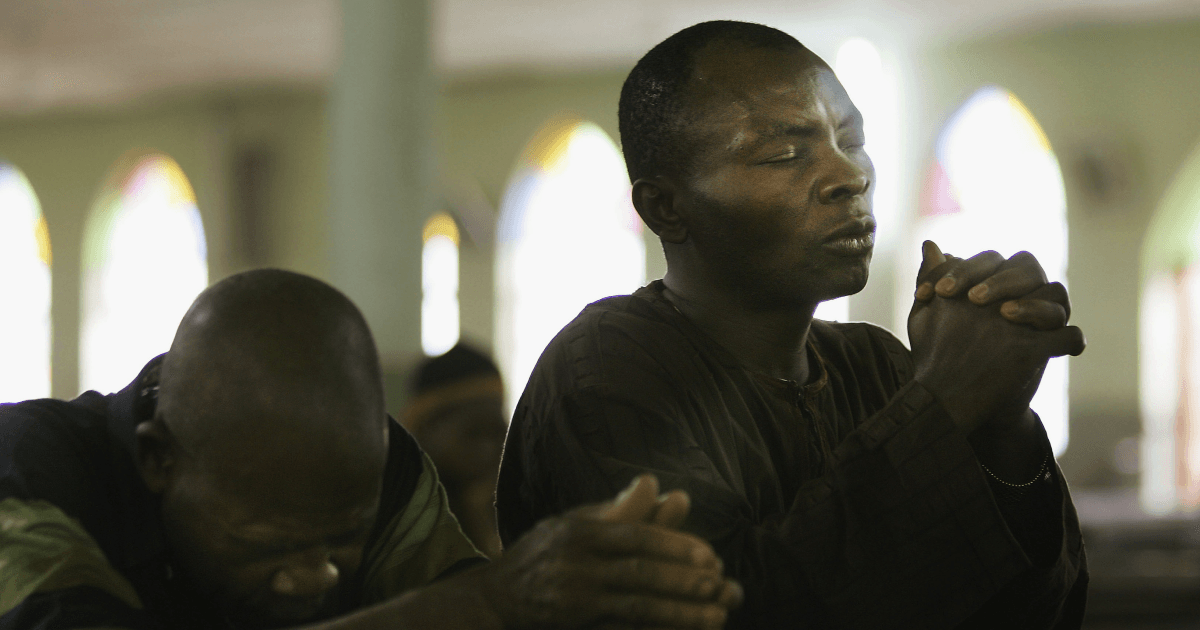

When President Trump went public last month about the potential for US military action in Nigeria to stop what he called the “mass slaughter” of Christians, it created an international media storm. Claims that the persecution of Christians was so severe it could be described as “genocide” were immediately countered by the Nigerian government. The Tinubu administration was further alarmed by Trump’s decision to designate Nigeria a “country of particular concern” — a classification denoting severe violations of religious freedom. The government’s protests against Trump’s characterisation of the country’s religious freedom record came at a time when the media both in Nigeria and internationally, as well as security experts and academics, downplayed reports of Christian persecution. All insisted this was not a religious war, and many went so far as to claim religion played only a negligible part in the violence.
The conflict in Nigeria is complex. As Africa’s most populous country, with more than 350 tribes and where more than 500 languages are spoken, it is hardly surprising that there should be many different, indeed competing, drivers of the conflict — problems compounded by the government’s troubled record on law and order.
That I was walking into an evolving, if not confusing, situation immediately became apparent earlier this year when I travelled with Aid to the Church in Need (ACN) into the north-west of the country. From there we travelled to the Middle Belt, home to some of the fiercest fighting. But the more we travelled, speaking to people and seeing for ourselves the situation on the ground, the clearer a picture began to emerge, a process of understanding enhanced by frequent contact with senior clergy and lay faithful across the region.
In November, we received first-hand accounts of the kidnapping of 25 schoolgirls in Kebbi, in the north-west, and it quickly emerged that the incident was typical of the violence in the region. The attack was reminiscent of the abduction more than a decade ago of more than 276 schoolgirls in Chibok.
The Kebbi attack also involved Christians in a predominantly Muslim area. However, unlike Chibok — whose Boko Haram assailants were avowedly anti-Christian and anti-Western education — nobody claimed responsibility for the Kebbi attack. As such, banditry with no obvious religious motive is seen as the main driver of conflict in this and other such attacks in the north-west.
But this is not to say anti-Christian attacks do not take place in the region. When I was in Sokoto, I met Tobias Yahaya, a young Christian who described how he miraculously survived being stabbed in the chest. Tobias’s attacker later reportedly told a court that he knew Tobias was a catechist from his distinctive purple cassock, and, as a staunch Muslim, wanted to stop a man whom he mistakenly called a Christian “pastor”.
In the north-east the situation is very different. Borno, Yobe and other states in the region are still reeling from the Boko Haram insurgency, whose leaders declared “a war” on Christians. A spokesman for Boko Haram stated: “We still create so much effort to end the Christian presence in our push to have a proper Islamic state that the Christians won’t be able to stay.”
Last month, ACN (UK)’s guest for the launch of the charity’s global Religious Freedom in the World Report was Bishop John Bakeni, whose diocese of Maiduguri covers the whole of the north-east. Speaking in the House of Commons at the report launch, he said that within eight years Boko Haram had “resulted in damage to over 200 churches and chapels” and that “at least 1.8 million people in north-east Nigeria’s Borno State had been displaced”.
But, with Boko Haram violence now much reduced, Bishop Bakeni’s concerns mirror those of other senior clergy whose anguish now centres on parts of the Middle Belt. Militant nomadic Fulanis are implicated in much of the fighting both in the region and elsewhere. The struggle for pasture to graze crops has been exacerbated by climate change. Ethnic tensions have been a trigger point for clashes, but in parts of the Middle Belt the violence has, according to Bishop Wilfred Anagbe of Makurdi in Benue State, been systematic and on a large scale — something he made clear in a statement to US Congress.
Amid reports that up to 500 Christians were killed in the region in three months, the Catholic Bishops’ Conference of Nigeria released a statement condemning “the utterly barbaric massacre of innocent civilians in Benue State”. And when more than 270 displaced Christians died in a massacre in Yelewata on 13 June this year, Pope Leo said he was thinking in particular of the “rural Christian communities of Benue State who have been the relentless victims of violence”. So while many factors are driving the conflict in northern Nigeria, there is in parts of the region evidence of a concerted struggle to destabilise, dislodge and potentially drive out Christian communities. Muslims who do not share the militants’ vision are also prime targets.
At a time when parts of northern Nigeria are tearing themselves apart, nothing is achieved by denying the religious component of the conflict. After all, as everyone who has been to Nigeria knows, faith is at the beating heart of the nation.