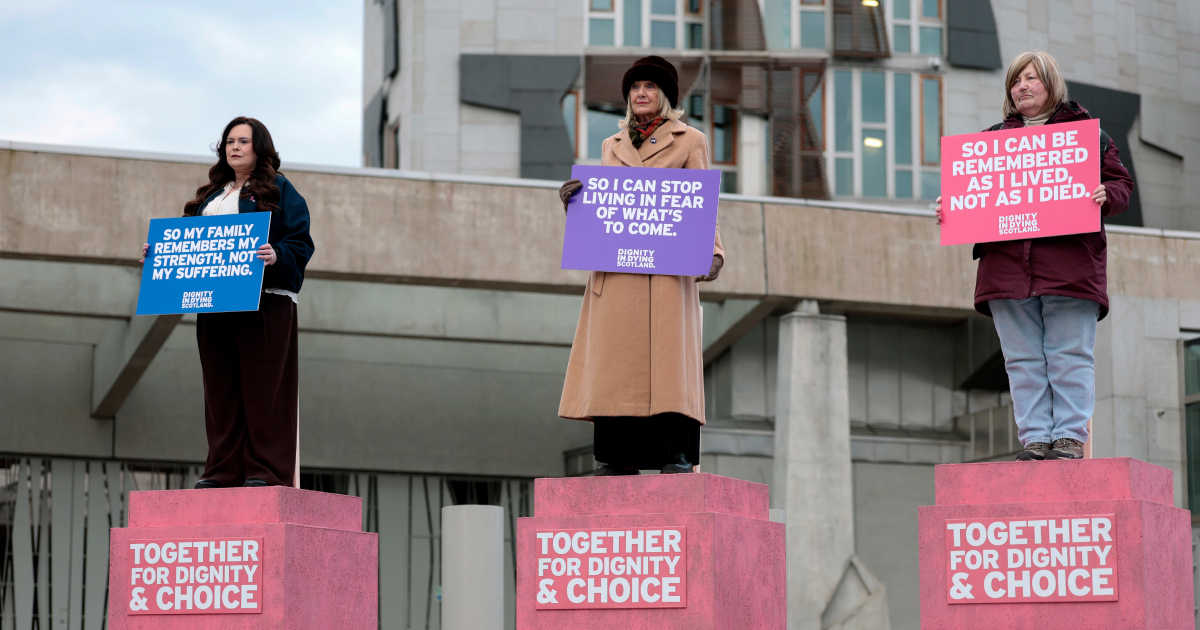


Eighty-six per cent of Members of the Scottish Parliament who expressed an opinion during speeches in the Stage 3 debate on the Scottish assisted suicide Bill yesterday spoke against it.
An analysis of the speeches on day one of Stage 3, completed by Right To Life UK’s policy team, found that of the 21 MSPs who made speeches and took a position on the Bill, 18, or 85.7 per cent, spoke against it and three, or 14.3 per cent, spoke in favour. This represents six times the number of MSPs speaking in opposition to the Bill compared with those who supported it in their speeches. The Government minister did not take a position in his speeches.
The Assisted Dying for Terminally Ill Adults (Scotland) Bill, which was introduced by Liberal Democrat MSP Liam McArthur, would legalise assisted suicide for adults resident in Scotland.
The overwhelming opposition to the Bill among those speaking in the Stage 3 debate yesterday followed the news that the leader of the Scottish Conservative Party, Russell Findlay MSP, had withdrawn his support for the Scottish assisted suicide Bill, vowing that he will now vote against it because “the risks are too great”.
This now means that the leaders of the three largest parties in Holyrood are opposed to the assisted suicide Bill.
If just seven of the MSPs who voted for the Bill at Stage 1 switch their stance and vote against it at the final Stage 3 vote on Tuesday 17 March, it will be defeated.
Russell Findlay MSP joins two MSPs who have already publicly indicated that they will be changing their vote from supporting to opposing the Bill and, according to media reports, others are set to follow.
Only four more MSPs have to move from supporting to opposing the Bill for it to be defeated.
Supporters of the McArthur assisted suicide Bill rejected a number of sensible amendments to the Bill yesterday. These rejected amendments included one to permit assisted suicide only for terminally ill people who are suffering, Amendment 136 by Daniel Johnson, as well as one to require a person to have been offered palliative care options before being eligible for assisted suicide, Amendment 138 by Douglas Ross.
Additionally, an amendment to protect vulnerable people with a history of suicidal thoughts or self-harm, Amendment 139 by Douglas Ross, was also rejected, as was an amendment to ensure that an opt-in register for medics involved in assisted suicide would be created, protecting conscience rights, Amendment 142 by Miles Briggs.
An amendment was also rejected that would have ensured that a pregnant woman could not go ahead with assisted suicide, Amendment 137 by Sue Webber.
Supporters of the McArthur assisted suicide Bill also voted to approve Amendment 107, tabled by Liam McArthur, to remove the provision in the Bill, Section 18, that provides conscience protections for health professionals.
The decision on whether there will be conscience protections in the Bill, and if so how they will operate, will now be handed over to Westminster. There will be no accountability or oversight from MSPs and those who will be directly affected by the Bill if it becomes law.
In a joint letter to Holyrood, several medical and professional bodies have warned that removing the “no duty to participate” and employment protections from the primary legislation would weaken transparency and robustness and leave key matters to a process with limited parliamentary scrutiny.
The signatories included the Association for Palliative Medicine (Scotland), RCGP Scotland, the Royal College of Physicians and Surgeons of Glasgow, the Royal College of Psychiatrists in Scotland, the Royal College of Surgeons of Edinburgh and the Royal Pharmaceutical Society.
Catherine Robinson, spokesperson for Right To Life UK, said: “It is heartening that such an overwhelming majority of MSPs who took a position spoke against the dangerous assisted suicide Bill yesterday.
“Despite this, rejecting so many common-sense amendments to the Bill directly puts vulnerable people in harm’s way and makes the Bill far more dangerous.
“We hope that MSPs continue their scrutiny of the Bill and highlight its myriad flaws with an aim to rejecting it outright at the final vote on 17 March. The safety of the people of Scotland depends on it.”
This article was originally published by Right To Life UK and is republished with permission. Read the original version of this article here.