May 18, 2026

Oxford and the surviving Marian imagination of medieval England

Jan C. Bentz
More
Related
Min read
share

There are cities in Europe where the Virgin still reigns visibly from stone and glass. The pilgrim notices it immediately: the Madonelle of Rome, Marian shrines tucked into Florentine street corners, statues of the Virgin gazing down from church façades and even civic buildings. England, after the Reformation, often feels different. Marian England became, in many places, an England of absences: smashed statues, whitewashed walls, emptied niches, mutilated rood screens, shattered marbles, destroyed shrines. One frequently encounters not Mary herself, but the trace of where she once stood.

A notable exception is Oxford, a place which remains curiously resistant to this kind of forgetting. The always-wise Fr John Saward of the beautiful little church dedicated to St Gregory and Augustine planted this idea in my head: that Oxford might possess the richest surviving concentration of medieval Marian imagery in England. The deeper one digs, however, the more careful one must become. Medieval England does not yield easily to superlatives. The monumental survivals of York and Canterbury remain overwhelming comparators, while London simply dwarfs everyone if museum collections are counted. The British Museum alone contains nearly 300 medieval objects catalogued under “Virgin and Child”.

And yet Oxford possesses something distinctive, perhaps even unique: the remarkable density with which Marian imagery permeates the collegiate world, as it always has. And this Fr Saward intuited.

This becomes obvious almost immediately at New College. Modern tourists often forget that the institution’s formal name is not “New College”, but “The College of St Mary of Winchester in Oxford”. The college itself was Marian from its conception. Above the medieval gatehouse, the Virgin still stands between the Archangel Gabriel and William of Wykeham. The Annunciation has literally been carved into the institutional façade.

The college chapel once contained an even more ambitious Marian programme: the famous Jesse Window. Although the original medieval glass was dispersed and partially lost in the 18th century, surviving studies strongly suggest that the entire west window emphasised not simply the Davidic lineage of Christ, but the lineage of the Virgin herself. This would signify an embedding of Mariology in dynastic and salvation history alike.

At Merton College Chapel, one encounters some of the oldest surviving college glass in England. The chapel preserves late-13th-century stained glass, including a surviving Annunciation scene. The survival is extraordinary when one considers the cycles of iconoclasm, reform, restoration and neglect through which Oxford passed. Merton’s archival records also reveal how extensive Marian devotional life once was before the Reformation: there were altars dedicated to the Virgin, Marian furnishings and even references to “an image of the Virgin carrying the sacrament” during the Marian restoration under Queen Mary Tudor. Much of this visual world vanished almost overnight under the theological violence of successive reigns.

The most intellectually revealing Marian imagery in Oxford may well survive at All Souls College Chapel. Its early-15th-century glass, produced during the great glazing campaign of the 1440s, includes not only a standing Virgin and Child, but the remarkable image of St Anne teaching the Virgin Mary to read. It is difficult to imagine a more Oxford image than this: Mary herself as student. In the 15th century it still seemed clear that learning and sanctity were very much not in competition but rather natural allies. The cultivation of the intellect is nourished by grace and opens the soul up to it.

One notices how frequently Marian devotion appears precisely at the intersection of theology and learning. The colleges dedicated themselves to Mary not merely because she was beloved devotionally, but because she represented wisdom, contemplation, receptivity to truth and the harmonious ordering of intellect towards God. The medieval university was not imagined as a religiously neutral space occasionally ornamented by piety; it existed beneath a sacred order.

The city churches deepen the picture. At St Michael at the North Gate survives a late-13th-century panel of the Virgin and Child embedded within the east chancel window. The image is small and easily missed. Yet its very survival feels significant. Medieval Marian England now survives largely in fragments.

At Christ Church Cathedral one finds further medieval Marian imagery, including an Annunciation scene depicting Gabriel and the Virgin within the surviving medieval glass programme. Much of the cathedral’s important medieval glass survives in the Lucy Chapel and Latin Chapel, where 14th-century glazing still quietly mediates the theological imagination of the medieval priory.

Even modern Catholic Oxford participates in this peculiar continuity of loss and recovery. In the side Chapel of the Annunciation at Blackfriars Priory there stands a small medieval alabaster Annunciation relief – the oldest work of art in the priory church. Strictly speaking, the older piece was inserted into a newer church; however, this juxtaposition does not take away from its importance or beauty. In a way, this somehow renders it even more English. Medieval Marian culture in England rarely survives untouched. More often it survives wounded: weathered statues without hands, shattered glass pieced back together, alabasters rescued from destruction, empty niches waiting for saints who never returned. The little Annunciation at Blackfriars emphasises this.

And then there are the objects no longer fully visible within Oxford itself. Manuscripts in the Bodleian Library preserve countless Marian initials, Annunciations, Coronations of the Virgin, Books of Hours and liturgical illuminations awaiting proper cataloguing within a comprehensive Marian census. The Ashmolean Museum contains major Marian works ranging from late-medieval sculptures to paintings such as Andrea Vanni’s 14th-century Virgin and Child panels. Strictly speaking, these cannot all be counted as indigenous Oxford survivals; yet they reinforce the extent to which Marian visual culture remains embedded within the city’s intellectual collections.

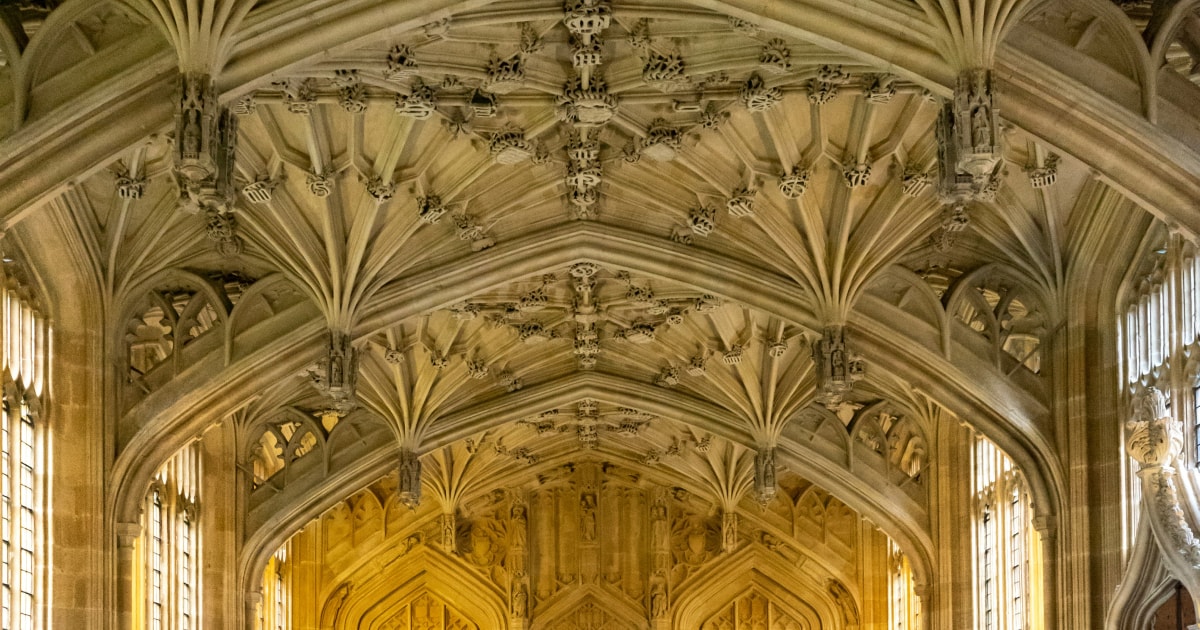
One eventually realises that Oxford’s Marian inheritance differs from that of York or Canterbury in character. Canterbury overwhelms by sheer scale: the cathedral alone preserves around 1,200 square metres of medieval stained glass. York possesses the largest expanse of medieval stained glass in England altogether. Oxford cannot compete numerically with such survivals. But Oxford offers something more concentrated and perhaps more revealing intellectually. Here Marian imagery is woven directly into the structures of scholarship itself. The Virgin appears not primarily in the context of pilgrimage, miracle veneration or civic pageantry, but in libraries, chapels, lecture halls, gatehouses and colleges. Mary is deeply intertwined with the idea of education.

Modern Oxford often appears architecturally uncertain of itself – as the recent debates surrounding the Schwarzman Centre for the Humanities have shown. Beneath the administrative feel and institutional fragmentation, the medieval city still whispers through stone and glass. One catches fleeting glimpses of it: in an Annunciation panel glowing dimly in a chapel window, in a weathered Virgin above a gatehouse, in a surviving Madonna and Child hidden high within a church wall, in St Anne patiently teaching the Virgin Mary to read.

A stronger claim – that Oxford possesses more medieval Marian imagery than any city in England – ultimately would be difficult to sustain unqualifiedly. But another claim can. Oxford may well be England’s most Marian university city. And more importantly, it preserves the memory of something modern universities have almost entirely forgotten: that learning itself once unfolded beneath the mantle of the Virgin.

Continue reading with a free account

Create a free account to read up to five articles each month
Create free account

You have # free articles remaining this month.

Subscribe to get unlimited access.
Sign up

subscribe to the catholic herald today

Our best content is exclusively available to our subscribers. Subscribe today and gain instant access to expert analysis, in-depth articles, and thought-provoking insights—anytime, anywhere. Don’t miss out on the conversations that matter most.
Subscribe