


February 5, 2026
February 5, 2026

Peter Thiel’s katechon theology: technological advancement is the enemy of tyranny

Min read
share

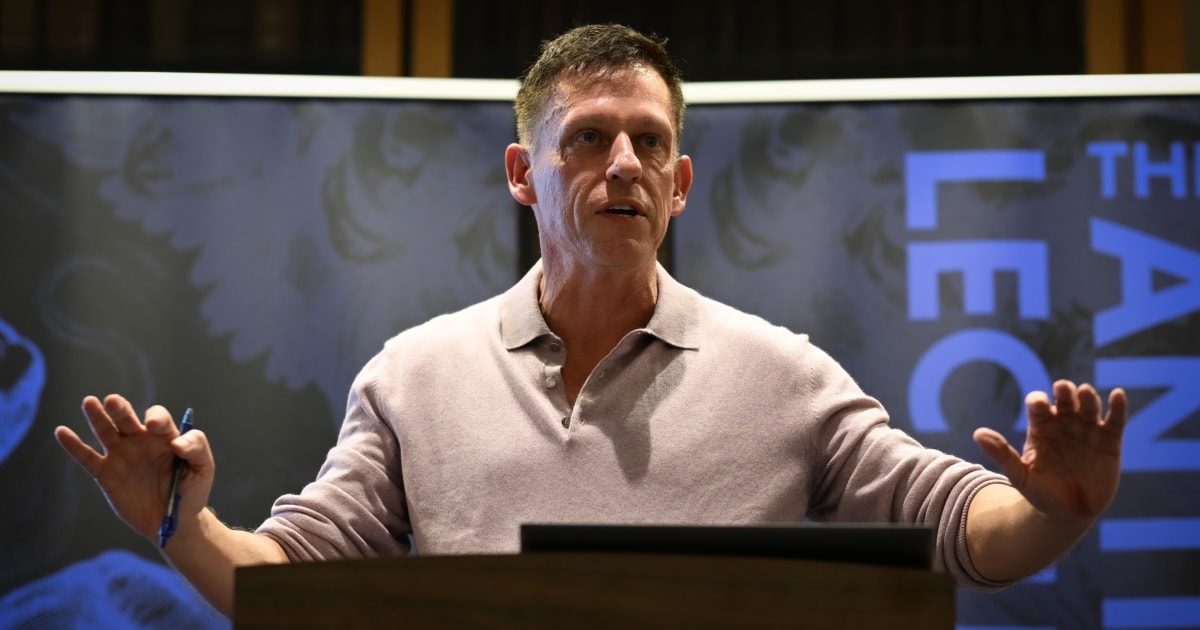
For anybody raised on the Oxbridge diet, listening to Mr Thiel speak is a little like falling into the Atlantic. The shock of the cold might just put one off altogether. But, after not moving for the first 30 seconds, some of the old hand movements begin to return.

Those old movements are balance-of-power politics, the arms race of technological advancement, Straussianism and our unfree speech, the intramural war on the Right between the traditionalists and the futurists, and the Hegelian’s omnivorous hunger for seeing nothing as insignificant to an epoch’s spirit.
All of these themes are seen through the lens of a theology, but a theology so peculiar that one might, for pun and propriety, call it Thielology. Among its heartening blasphemies are a general disdain for metaphysics, for ‘Nature’, and for what he calls the Roman Catholic Church’s Augean Stables of Thomism. He claims that it is with his tech-Right Girard that he would replace that Thomism. I suspect it is more like a future-focussed semi-Hegelianism, where seemingly all topics are knitted together, with dazzling, if at times somewhat incredible, breadth, by usually Old Testament verses. Alike to attending one of Peterson’s late 2010s extravaganzas, pre-reading exegetical commentary or De Anima would not have helped very much. Also like Peterson, whatever the scholarly orthodoxy would say about the exegesis, a seat in the lecture theatre is the envy of pundits and journalists both. No journalists are fighting their way into the Cambridge Divinity Faculty. But that is not to say that Thiel is Peterson. The stylistic similarity, of topic-knitting with the biblical needle, is more or less where it stops. Thiel is a futurist with a loose philosophy of history. And his basic message is that if we – the West – wish to survive, we had better keep walking forwards. And he does mean the forward motion of technological advancement, which, he exclaims, stopped circa 1970.

The emphasis on forward movement will disconcert the classical conservative and the classical Catholic. Members from the latter two camps might have the sense of being outflanked. Here is a tech giant doing cultural commentary. Thiel’s pro-tech message has nothing significant in common with that of any public intellectual of the past quarter century. Nothing in Peterson or McGilchrist says that technology and its advancement are existentially important to our culture. And even the New Atheists were never so bold as to suggest that science and its advancement were an essential good. They only insisted that they were true.

It is not just technology, therefore, but its advancement, which is an existential necessity to our civilisation. A frequent trope in his lectures is that something is ‘not enough any more’. That is to say, what kept the world from apocalypse has been different in different ages. There is, therefore, a kind of conception of ‘age’, in the Thielology, by which he strongly upbraids any resorting to Nature or to a transcending moral Form or law. If there is a constant imperative, then it is not of Nature. A ‘good’ action is not the inheritance of an abstract idea. Nor is the progress of age to age the intelligible or the necessary motion of an idea. What is always good, for Thiel, is in the face of Nature. What is constant about great men is their striving to dominate Nature through science. We sink or swim.

Without further elaboration, one might expect this reasoning to terminate in an aim of ever-perfected man, with no doubt an ever-centralised state. But Thiel is not a French philosopher. The aim is, in fact, that of a multi-polar world, kept safely stable by a Western hegemony.

One might be a little cruel to this, and wonder whether it is not the old Anglo-American conceit that empire is only empire when the Continent does it. He does not wish to pick between multi-polarity and Western hegemony, but sees the former as guaranteed and kept fire-retardant by the latter. This, one must remark, is Thiel at his most traditional. The Brits and the Americans have always trusted balance-of-power politics most when they are most in charge, including the Americans contra the Brits.

Where Thiel is far less traditional is in his view that technological advancement is what keeps back the formation of a tyrannical world state. Man must strive against Nature, in order to be free from his fellow men’s desire for safety and domination. That is to say, what guarantees the adequately Western multi-polarity of the world is the constant advancing of technology. What the advance of technology does is create new power. In short, technological advancement is a continual renewal of Westphalian order, albeit in such forms as no longer directly resemble 1648.

Coupled with this emphasis on new power is Thiel’s tacit premise that there is a constant pull towards world government. It seems to me that Thiel believes that it is human nature to wish to lodge all power in one place. This is a kind of principle of political decay, albeit of centralisation rather than, as in Plato, that of disintegration. The only counteracting force is the creative desire to forge new power. Each age will have new forms of power, which will constitute a new guarantee of multi-polarity. Or, in Thiel’s biblical language, each age will have its own ‘katechon’.

World history thus becomes one great uphill battle against this centralisation, which is an instinct of the human heart. This is Thiel’s doctrine of ‘sin’, one might say. It would follow, although I would not hold it against him, that ‘technology’ is interpreted semi-broadly. One might say that what held back world government in the 19th century was Romantic nationalism, and so speak of Fichte’s Reden an die deutsche Nation (Addresses to the German Nation), 1808, as a ‘technology’. And Thiel would say with the Marxists, although not in their tone of voice, that technology has expired.

Technological advancement is, in Thiel’s thought, the creation of new structures, of new possible relations to man and Nature. It renews multi-polarity by recreating its bases, contra the constant tug towards the centre. This is rather a broad view of technology, but it is not a silly one. It results in Thiel’s surprising point: the desire for scientific exploration and advance is what keeps us truly safe, namely, safe from tyranny.

Once we understand this principle of political decay, Thiel’s view of the Antichrist becomes rather more apparent. If multi-polarity is guaranteed by technological advancement, contra the human desire for world government, then fear of technology is a spectral disaster. Fear of technology will make us stop producing it. In turn, this cessation of production will mean the end of the renewal of the structures which guarantee multi-polarity, and the world shall succumb to unipolarity.

Or, in other words, Hollywood’s dystopian sci-fis are self-fulfilling prophecies.

Thiel’s Antichrist is, therefore, hostile to tech. He stands for ‘peace and safety’ (1 Thess. 5:3) from technology. But if it is technology which creates new power, then it shall keep us safe from power’s natural agglomeration. Put differently, Thiel’s claim that technological progress has slowed down, even stopped, since circa 1970 gains an apocalyptic aspect. If Thiel is right, one might still have cause to draw breath. He asks the West, as he asks traditionalists on the political Right: have you run out of steam?

For anybody raised on the Oxbridge diet, listening to Mr Thiel speak is a little like falling into the Atlantic. The shock of the cold might just put one off altogether. But, after not moving for the first 30 seconds, some of the old hand movements begin to return.

Those old movements are balance-of-power politics, the arms race of technological advancement, Straussianism and our unfree speech, the intramural war on the Right between the traditionalists and the futurists, and the Hegelian’s omnivorous hunger for seeing nothing as insignificant to an epoch’s spirit.
All of these themes are seen through the lens of a theology, but a theology so peculiar that one might, for pun and propriety, call it Thielology. Among its heartening blasphemies are a general disdain for metaphysics, for ‘Nature’, and for what he calls the Roman Catholic Church’s Augean Stables of Thomism. He claims that it is with his tech-Right Girard that he would replace that Thomism. I suspect it is more like a future-focussed semi-Hegelianism, where seemingly all topics are knitted together, with dazzling, if at times somewhat incredible, breadth, by usually Old Testament verses. Alike to attending one of Peterson’s late 2010s extravaganzas, pre-reading exegetical commentary or De Anima would not have helped very much. Also like Peterson, whatever the scholarly orthodoxy would say about the exegesis, a seat in the lecture theatre is the envy of pundits and journalists both. No journalists are fighting their way into the Cambridge Divinity Faculty. But that is not to say that Thiel is Peterson. The stylistic similarity, of topic-knitting with the biblical needle, is more or less where it stops. Thiel is a futurist with a loose philosophy of history. And his basic message is that if we – the West – wish to survive, we had better keep walking forwards. And he does mean the forward motion of technological advancement, which, he exclaims, stopped circa 1970.

The emphasis on forward movement will disconcert the classical conservative and the classical Catholic. Members from the latter two camps might have the sense of being outflanked. Here is a tech giant doing cultural commentary. Thiel’s pro-tech message has nothing significant in common with that of any public intellectual of the past quarter century. Nothing in Peterson or McGilchrist says that technology and its advancement are existentially important to our culture. And even the New Atheists were never so bold as to suggest that science and its advancement were an essential good. They only insisted that they were true.

It is not just technology, therefore, but its advancement, which is an existential necessity to our civilisation. A frequent trope in his lectures is that something is ‘not enough any more’. That is to say, what kept the world from apocalypse has been different in different ages. There is, therefore, a kind of conception of ‘age’, in the Thielology, by which he strongly upbraids any resorting to Nature or to a transcending moral Form or law. If there is a constant imperative, then it is not of Nature. A ‘good’ action is not the inheritance of an abstract idea. Nor is the progress of age to age the intelligible or the necessary motion of an idea. What is always good, for Thiel, is in the face of Nature. What is constant about great men is their striving to dominate Nature through science. We sink or swim.

Without further elaboration, one might expect this reasoning to terminate in an aim of ever-perfected man, with no doubt an ever-centralised state. But Thiel is not a French philosopher. The aim is, in fact, that of a multi-polar world, kept safely stable by a Western hegemony.

One might be a little cruel to this, and wonder whether it is not the old Anglo-American conceit that empire is only empire when the Continent does it. He does not wish to pick between multi-polarity and Western hegemony, but sees the former as guaranteed and kept fire-retardant by the latter. This, one must remark, is Thiel at his most traditional. The Brits and the Americans have always trusted balance-of-power politics most when they are most in charge, including the Americans contra the Brits.

Where Thiel is far less traditional is in his view that technological advancement is what keeps back the formation of a tyrannical world state. Man must strive against Nature, in order to be free from his fellow men’s desire for safety and domination. That is to say, what guarantees the adequately Western multi-polarity of the world is the constant advancing of technology. What the advance of technology does is create new power. In short, technological advancement is a continual renewal of Westphalian order, albeit in such forms as no longer directly resemble 1648.

Coupled with this emphasis on new power is Thiel’s tacit premise that there is a constant pull towards world government. It seems to me that Thiel believes that it is human nature to wish to lodge all power in one place. This is a kind of principle of political decay, albeit of centralisation rather than, as in Plato, that of disintegration. The only counteracting force is the creative desire to forge new power. Each age will have new forms of power, which will constitute a new guarantee of multi-polarity. Or, in Thiel’s biblical language, each age will have its own ‘katechon’.

World history thus becomes one great uphill battle against this centralisation, which is an instinct of the human heart. This is Thiel’s doctrine of ‘sin’, one might say. It would follow, although I would not hold it against him, that ‘technology’ is interpreted semi-broadly. One might say that what held back world government in the 19th century was Romantic nationalism, and so speak of Fichte’s Reden an die deutsche Nation (Addresses to the German Nation), 1808, as a ‘technology’. And Thiel would say with the Marxists, although not in their tone of voice, that technology has expired.

Technological advancement is, in Thiel’s thought, the creation of new structures, of new possible relations to man and Nature. It renews multi-polarity by recreating its bases, contra the constant tug towards the centre. This is rather a broad view of technology, but it is not a silly one. It results in Thiel’s surprising point: the desire for scientific exploration and advance is what keeps us truly safe, namely, safe from tyranny.

Once we understand this principle of political decay, Thiel’s view of the Antichrist becomes rather more apparent. If multi-polarity is guaranteed by technological advancement, contra the human desire for world government, then fear of technology is a spectral disaster. Fear of technology will make us stop producing it. In turn, this cessation of production will mean the end of the renewal of the structures which guarantee multi-polarity, and the world shall succumb to unipolarity.

Or, in other words, Hollywood’s dystopian sci-fis are self-fulfilling prophecies.

Thiel’s Antichrist is, therefore, hostile to tech. He stands for ‘peace and safety’ (1 Thess. 5:3) from technology. But if it is technology which creates new power, then it shall keep us safe from power’s natural agglomeration. Put differently, Thiel’s claim that technological progress has slowed down, even stopped, since circa 1970 gains an apocalyptic aspect. If Thiel is right, one might still have cause to draw breath. He asks the West, as he asks traditionalists on the political Right: have you run out of steam?

subscribe to
the catholic herald

Continue reading your article with a subscription.
Read 5 articles with our free plan.
Subscribe
share

subscribe to the catholic herald today

Our best content is exclusively available to our subscribers. Subscribe today and gain instant access to expert analysis, in-depth articles, and thought-provoking insights—anytime, anywhere. Don’t miss out on the conversations that matter most.
Subscribe