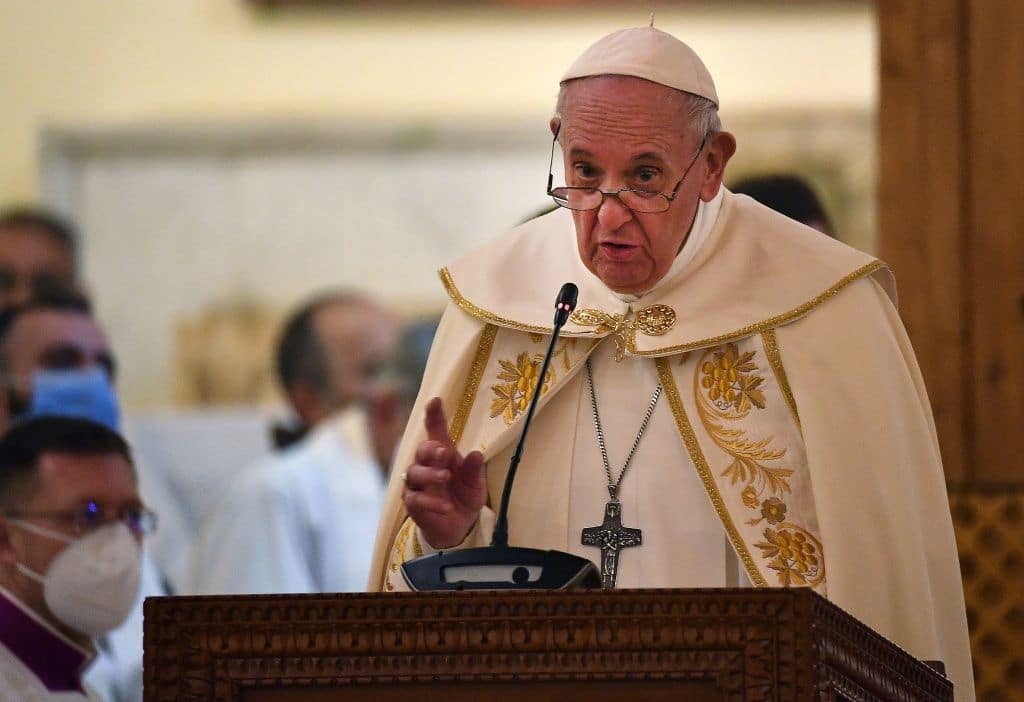


Pope Francis presided over Divine Liturgy on Saturday afternoon at the Chaldean cathedral of Baghdad, wearing Chaldean vestments and attended by dozens of clerics of various ranks in the sanctuary. The church was full as one could expect under pandemic circumstances -- perhaps more crowded than one might expect. Many more gathered in the courtyard outside the church proper. Prayers of the faithful were offered in Arabic, the Sourath dialect of Aramaic, Kurdish, Turkmen, and English. In his homily, the Holy Father preached on a threefold theme:
- The wisdom of God, which governs history -- to which we must be attuned in order to participate in its activity in our lives;
- The witness of which God is the principal author, to which we are called;
- The promises of God, to which we are heirs in Baptism, which do not disappoint, and constitute the perfect expression of our duty to one another in faith.
"Wisdom in these lands has been cultivated since ancient times," Pope Francis said, noting that the search for wisdom has always attracted men and women of every nation. "Often, however, those with more means can acquire more knowledge and have greater opportunities, while those who have less are sidelined," he went on to say, adding that such inequality – which, he further noted, has increased in our time – is unacceptable.
"On the Cross," Pope Francis continued, " proved stronger than sin, in the tomb, it vanquished death."
"The Book of Wisdom surprises us by reversing this perspective," Pope Francis explained:
It tells us that "the lowliest may be pardoned in mercy, but the mighty will be mightily tested (Wis 6:6)." In the eyes of the world, those with less are discarded, while those with more are privileged. Not so for God: the more powerful are subjected to rigorous scrutiny, while the least are God’s privileged ones.
Jesus, who is Wisdom in person, completes this reversal in the Gospel, and he does so with his very first sermon, with the Beatitudes. The reversal is total: the poor, those who mourn, the persecuted are all called blessed. How is this possible? For the world, it is the rich, the powerful and the famous who are blessed! It is those with wealth and means who count! But not for God: It is no longer the rich that are great, but the poor in spirit; not those who can impose their will on others, but those who are gentle with all. Not those acclaimed by the crowds, but those who show mercy to their brother and sisters.
Pope Francis went on to ask three questions: "f I live as Jesus asks, what do I gain? Don’t I risk letting others lord it over me? Is Jesus’ invitation worthwhile, or a lost cause?" "That invitation is not worthless," Pope Francis said, "but wise," because love, "which is the heart of the Beatitudes, even if it seems weak in the world’s eyes, in fact always triumphs." "On the Cross," Pope Francis continued, " proved stronger than sin, in the tomb, it vanquished death. That same love made the martyrs victorious in their trials – and how many martyrs have there been in the last century, more even than in the past," a palpable acknowledgment of the terrible suffering of Iraqi Christians in the very recent past, which continues to cast a shadow over the present and into the future.
For the world, it is the rich, the powerful and the famous who are blessed! It is those with wealth and means who count! But not for God: It is no longer the rich that are great, but the poor in spirit; not those who can impose their will on others, but those who are gentle with all. Not those acclaimed by the crowds, but those who show mercy to their brother and sisters. -- Pope Francis
"Love is our strength," Pope Francis went on to say, "the source of strength for those of our brothers and sisters who here too have suffered prejudice and indignities, mistreatment and persecutions for the name of Jesus. Yet while the power, the glory and the vanity of the world pass away, love remains." "To live a life shaped by the Beatitudes," Pope Francis said, "is to make passing things eternal, to bring heaven to earth." In his own words of greeting, His Beatitude Louis Raphaël Cardinal Sako, the Chaldean Patriarch, cited the unspeakable joy -- his own and that of all the faithful, and indeed of all Iraqis -- which Pope Francis's historic and unprecedented visit has brought. "Words cannot express all my joy and my gratitude -- the joy and gratitude of Christians and of all Iraqis for this, your courageous visit," CardinalS ako said, "especially for the fact that it is taking place in exceptional circumstances owing to the contests and the crises through which our nations and all nations of the world are currently living."