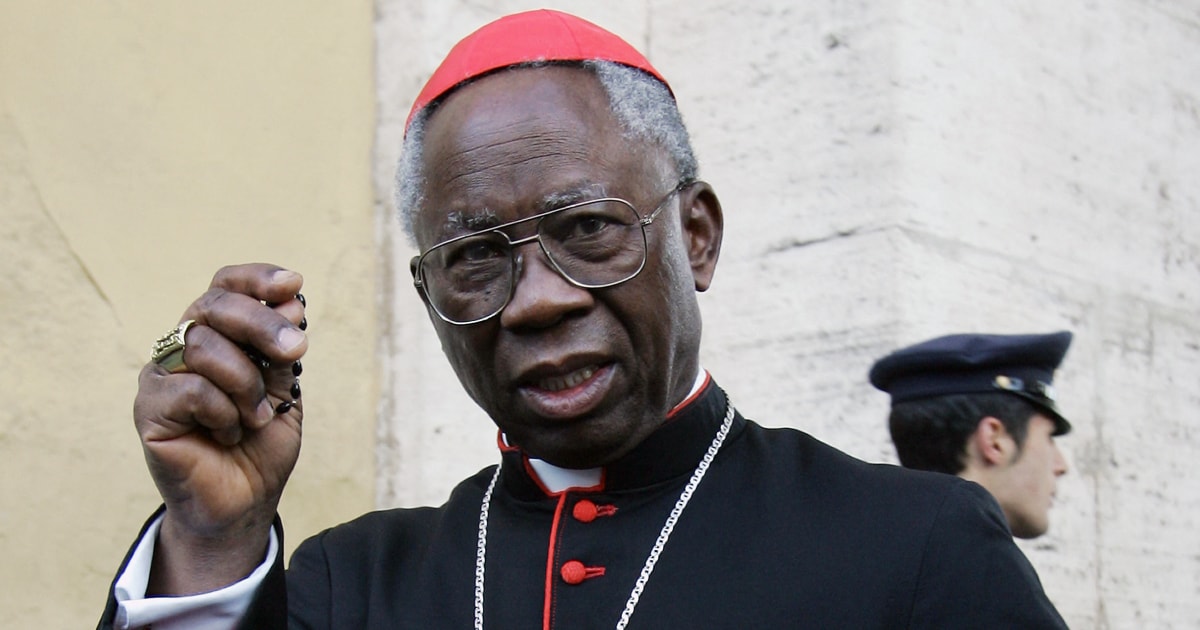


Pope Leo XIV received a senior liturgically and doctrinally conservative cardinal, and one of the last surviving Council Fathers, in a private audience on May 20, the day he delivered his latest catechesis on the Second Vatican Council’s Constitution on the Sacred Liturgy at the weekly general audience in St Peter’s Square.
The Holy See Press Office bulletin listed Nigerian Cardinal Francis Arinze as the sole private audience granted by the Pope that morning. The encounter took place on the same day that Pope Leo XIV delivered his weekly general audience in St Peter’s Square, continuing his catechesis series on the documents of the Second Vatican Council with a reflection on its first constitution, the 1963 Sacrosanctum Concilium on the sacred liturgy.
Vatican observer and liturgist Matthew Hazell drew attention to the significance of the audience with Cardinal Arinze, suggesting that it may indicate consultations ahead of key decisions at the Dicastery for Divine Worship, whose current prefect’s five-year term expires in the coming days.
In his general audience address, Pope Leo XIV placed strong emphasis on the centrality of the liturgy in the life of the Church. He declared that “the liturgy sustains the faithful” and that every Eucharistic celebration becomes “a true epiphany of the Church in prayer”.
The Holy Father recalled that “Christ Himself is the inner source of the mystery of the Church, the holy people of God, born from His side pierced on the Cross. In the holy liturgy, through the power of His Spirit, He continues to act. He sanctifies and unites the Church, His bride, to His offering to the Father.”
He stressed that in the liturgy “the work of our redemption is accomplished”, making the Paschal event – the Passion, Death, Resurrection and Glorification of Christ – sacramentally present to the faithful. The Pope reiterated the ancient principle lex orandi, lex credendi, explaining that “the rituality of the Church expresses her faith ... and at the same time shapes ecclesial identity”.
Quoting the constitution itself, he stated: “Since the liturgy is at the service of the mystery of Christ, one understands why it has been defined as ‘the summit toward which the activity of the Church is directed ... the font from which all her power flows’.”
He added: “Conversely, the liturgy sustains the faithful by immersing them ever and anew in the Pasch of the Lord and, thus, through the proclamation of the Word, the celebration of the sacraments and communal prayer, they are refreshed, encouraged and renewed in their commitment to faith and in their mission.”
Pope Leo explained that the faithful’s participation in the liturgy is both “internal” and “external”.
The Pope said this meant that the liturgy is called “to unfold in a tangible way throughout daily life, in an ethical and spiritual dynamic”, so that the liturgy celebrated “is translated into life” and “demands a faithful existence, capable of making concrete what has been experienced in the celebration”.
Pope Leo XIV invited the faithful to allow themselves “to be shaped inwardly by the rites, symbols, gestures and above all the living presence of Christ in the liturgy”, promising to continue exploring the subject in coming weeks.
He also marked the 40th anniversary of Pope St John Paul II’s encyclical Dominum et Vivificantem, urging prayers to the Holy Spirit “to awaken with His gifts human consciences, to turn them away from injustice, violence and war, and to renew the face of the earth”.
The meeting with Cardinal Arinze coinciding with such remarks is significant. Cardinal Arinze served as prefect of the Congregation for Divine Worship and the Discipline of the Sacraments from 2002 to 2008. He has long been recognised for his steadfast advocacy of reverent worship in fidelity to the Church’s tradition and the authentic intentions of the Second Vatican Council.
The cardinal has repeatedly insisted that the liturgy exists for the adoration of God, not for entertainment or self-expression. “We come to Mass not to focus on the priest, we come to Mass not to enjoy ourselves, we come to Mass not to dance, we come to Mass not to clap and applaud each other, we come to adore God,” he has taught in numerous addresses.
Speaking previously about the Extraordinary Form, he said it “stresses more relationship with God direct, it stresses more adoration, it stresses more God is super above, transcendental, and that is an element we need very much in the world of today”.
He has consistently upheld the Council’s teaching on the preservation of Latin in the Roman Rite and the pride of place due to Gregorian chant.
Cardinal Arinze has warned against reducing the liturgy to a “free-for-all experimentation field” and has emphasised the importance of the ars celebrandi – the art of proper celebration – marked by sacred silence, reverence and fidelity to the prescribed rites. He has observed that both the Ordinary and Extraordinary Forms can be celebrated with dignity or poorly, depending on the faith and reverence of the celebrant.
As migration remains a key topic in the Leonine pontificate, it is significant that Cardinal Arinze told the Catholic Herald in 2019: “It is best for a person to stay in that person’s own land – country, town, area – and work there. So the countries in Europe and America can sometimes help best, not by encouraging the young people to come to Europe as if they looked on Europe as heaven – a place where money grows on trees – but to help the countries from which they come.”
He added: “Each government has to see, for how many people can they provide? Not only their entrance: lodging, work, family, cultural insertion. Where is their future: work, family life, culture, religion? Think of all that.”
While the specific issues discussed remain unknown, Pope Leo XIV’s private audience with Cardinal Arinze follows recent meetings with other prominent churchmen known for their commitment to doctrinal clarity and liturgical continuity, including Bishop Athanasius Schneider and Cardinals Gerhard Müller, Robert Sarah and Raymond Burke. Cardinal Burke has publicly confirmed that he has asked the Holy Father to ease current restrictions on the celebration of the Traditional Latin Mass.
The day’s events are being closely watched by Catholics who cherish the Church’s liturgical heritage and who hope the new pontificate will advance a genuine recovery of the sacred in worship, in continuity with tradition.