

Art always leads to disagreement, and sacred art all the more. Christians have argued for centuries about how best to depict God, the saints and the mysteries of our Faith, oscillating between idolatry, iconoclasm and iconography.
What should sacred art emphasise: sorrow or joy, piety or ecstasy, idealised beauty or the world as it is? The truth is that no single representation can ever fully capture the nature of the sacred, and no single artwork can truly act as a bridge for all to connect with God. These disagreements show us that all sacred art has some flaws because it cannot grant us the fullness of truth, but only a portion of it.
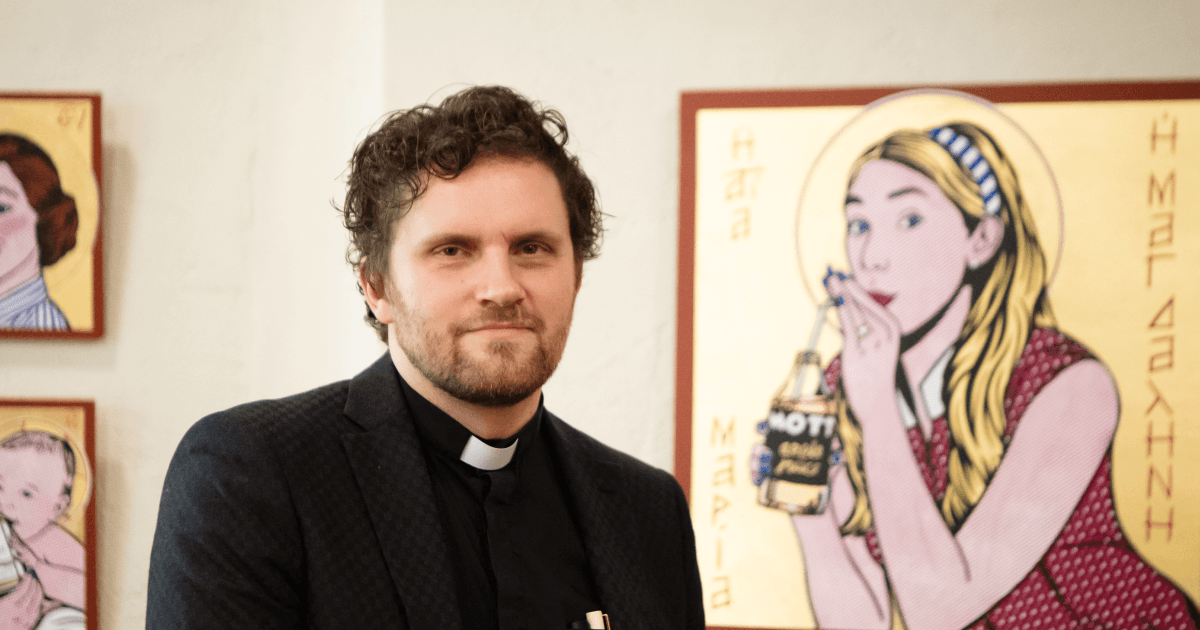
Recently, Jacqueline O’Hare wrote a critique in these pages of my recent art exhibition, Twilight of the Idols. While I disagree with many of her points, I am grateful to the Catholic Herald for inviting me to reply here and continue the conversation about sacred art.
Throughout her essay, O’Hare claims that sacred art should lead our minds upwards towards heaven rather than down to earth. I agree, but the difficulty is determining what exactly that means. If we take the Incarnation seriously, that means God decided to come down to earth and be like us and dwell among us. Christ taught through parables that were not heavenly abstractions but images and stories using everyday things: seeds, fish, bread and wine. None of these things were considered sacred in his own time, when the Temple and Torah were the only things that counted as such. As Sister Corita Kent has said, Christ was the first Pop artist who showed us how we can find faith in a lost coin or a pearl. And so the question is how earthly things can lead towards heaven.
Our Catholic artistic tradition does not offer one clear answer either. O’Hare claims that great artists have done this in the past, but fails to specify exactly whom she means. If we assume that Michelangelo, El Greco and Caravaggio would all fit the bill for today’s standard of what constitutes a sacred artist, we can see that each one accomplishes this quite differently while also contradicting one another’s theory of what sacred art should be.
Michelangelo painted nude bodies in the Vatican in his famous Last Judgment that were seen as scandalous a generation after his death and were given modest coverings. But Michelangelo found the idealised human figure, borrowed from the forms of the Greek gods, to be the closest thing to divinity we can see, because we are made in God’s image and likeness.
El Greco critiqued Michelangelo’s paintings and was ostracised in Rome, where he found favour at the Spanish court for painting surreal rather than idealised figures. El Greco’s Mannerism, which emerged from his training as an iconographer in Crete and from what he learned from Titian in Venice, went too far for some, pushing the bounds of the imagination. Later generations largely forgot about him until the Impressionists invited us to look again centuries later.
Caravaggio was infamously considered to have destroyed painting in his time because he, too, rejected Michelangelo’s idealism in favour of Baroque realism, depicting the saints as ordinary people instead of members of the pantheon. His sacred art invited us to consider the battle between light and darkness, whereas El Greco emphasised God’s presence as light itself in his work.
All three of these generally accepted sacred artists lead us towards heaven in different ways. Not everything that leads us towards God must look like Michelangelo (or El Greco or Caravaggio, for that matter). Each one shows us a different aspect of God’s Truth through artistic decisions that are always limited.
Michelangelo, El Greco and Caravaggio (along with every single artist) all tell us the Truth through lies in art. Christ is not a bodybuilder or a Greek god. Christ is not literally light. Christ does not look like the person one would see on the street corner. However, each lie has the capacity to reveal the Truth when we take the time to engage with it. One painting or style cannot capture everything about God, because God is more than that. The question is how all of these different styles still fit into the same category of sacred art.
Tradition does offer one answer as to how to engage with religious art, synthesising these different styles so that they all function as sacred art. Most of my work draws on the work of Pseudo-Dionysius the Areopagite, a Neoplatonist of the fifth–sixth century, admired by the likes of Aquinas and other orthodox theologians.
Dionysius’s Symbolic Theology articulates his position on our use of symbols. He analyses the text of Psalm 78, where God is described as a drunk warrior who wakes from sleep to defeat His enemies (Psalm 78:65–66). He claims that taking the verse literally would be false because God cannot be asleep or drunk. Furthermore, getting drunk would be a sin for God to commit, which would be impossible. It is, in fact, scandalous that scripture could say such a thing. Instead, he says that we must take these, and really all images of God, as metaphors and try to find what they can reveal to us. Thinking about God as drunk is not our normal image of God, but when we try to make the comparison work – rather than dismiss it out of hand (especially because this one is biblical) – then we might think that God is like a drunk because He is unpredictable and full of a certain spirit, for example.
Drunkenness, or any such description of God, is what Dionysius calls a “dissimilar similarity”. They are dissimilar because they are shocking when applied to God, yet they reveal a truth that leads us to Him, and so they are also similar. Dionysius, in fact, favours such dissimilar similarities over more appropriate ones, such as “luminous” or “healer”, because the dissimilar ones challenge us to realise how much we do not know about God and shake us out of our false sense of comprehension about the sacred. They invite us to know more about God beyond what we already claim to know.
For Dionysius, images or symbols like these are powerful in helping us gain a sense of who God is because images – along with words – have the power to help us know God. This also relates closely to the theology of icons in that they are written or contain a teaching. And for Dionysius, such symbols, when we are open to interpreting them, have the capacity to reveal God to us.
Furthermore, he asserts that the scriptures are the warehouse for such symbols, such as Jesus’s very earthly parables that use imagery from ordinary life, but he has no problem using non-biblical symbols to do the same work, such as the “mixing bowl” from Plato’s Timaeus or an earthworm elsewhere. And so, in my work, cigarettes, soup cans and celebrities can all be shocking when placed in the context of sacred art, but these act as new dissimilar similarities that invite us to know God more deeply.
In this framework, the job of the critic or viewer is to read art, not just look at it. What does it mean that these great artists from the past chose to depict their subjects in such a way, and how does that relate to God? For Michelangelo, Christ is like Apollo in that Christ is truly the most beautiful and is the Form of Beauty itself. For El Greco, Christ is like light, illuminating our darkness and showing us the way forward. And for Caravaggio, Christ is like a man off the street in that Christ says he is present in all those who suffer and are poor (cf. Matthew 25).
I’ll let you read the work from Twilight of the Idols for yourself. None of these artists abandoned tradition but enlarged it by giving us new ways to find God through different artistic styles and forms. So sacred art, in many forms, gives us a different perspective into Heaven, which we can lose sight of when we fail to look for it.

.png)