

Ordinary life is a mirage. Especially the idea of an ordinary life populated by ordinary people. This could be the greatest lie of secular culture, and one that aggressive modern capitalism, free of any religiosity to mollify it, leaps upon in order to maximise profit through the exploitation of the miracle that is humanity.
“There are no ordinary people,” wrote CS Lewis. “You have never talked to a mere mortal. Nations, cultures, arts, civilisations – these are mortal, and their life is to ours as the life of a gnat. But it is immortals whom we joke with, work with, marry, snub and exploit.”
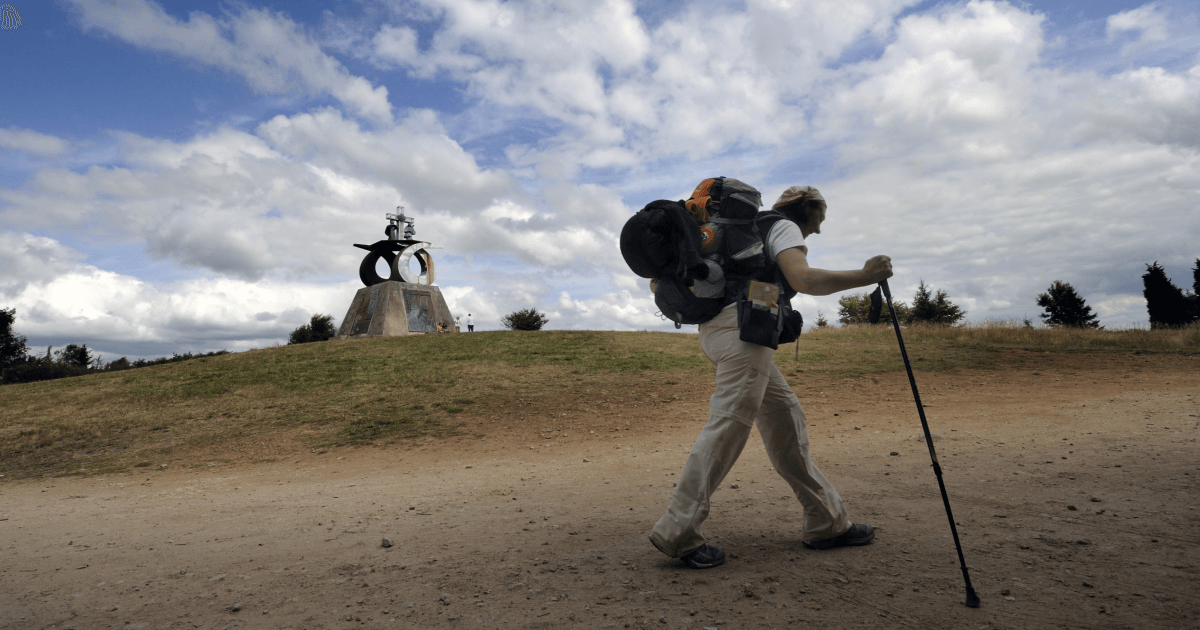
The truth of this was painfully revealed to me on the Camino Francés, the most popular of the pilgrimage routes that traverse the Iberian Peninsula. On the Camino you experience the complete opposite of everyday life – endless uplifting encounters with total strangers in which both parties open up to the other on a profound level.
I found myself connecting with other pilgrims and feeling closer to them in the space of less than 24 hours than to my lifelong friends (whom, spread across the globe, I unfortunately do not see enough of). I felt devastated when it was time to say goodbye, or when we became separated because we ended the day’s hike at different locations, in spite of the short time we shared.
It actually started to concern me. What was going on? Why was I feeling so intensely about all these people I barely knew, experiencing the full brunt of the French saying, Partir, c’est mourir un peu, which speaks to how “every goodbye is a little death”? Might it even be the start of some sort of mental breakdown, I fretted?! (I had been on the trail for months by this point, having crossed Germany and then France, experiencing the annihilation of the ego that the Camino is so effective at.)
After reading the above CS Lewis quote, taken from his sermon “The Weight of Glory”, given at Oxford University Church of St Mary the Virgin on June 8, 1941, I felt I had some sort of explanation: the lens through which I usually viewed things (and people) had been flipped on the Camino from the situation usually found in everyday life, where we increasingly treat other people – even friends and family – as objects, a means to an end, or as an obstruction, competition, etc.
“In modern industrial societies vast numbers of men and women pass their whole lives in hideous cities, are wholly dependent for their livelihood upon a capitalistic or governmental boss, have to perform manual or clerical work that is repetitive, mechanical and intrinsically meaningless,” Aldous Huxley wrote in his 1946 essay “Science, Liberty and Peace”, which was recently republished in Germany as Time of the Oligarchs.
“[They] are rootless, propertyless and entirely divorced from the world of nature, to which, as animals, they still belong and in which, as human beings, they might (if they were sufficiently humble and docile) discover the spiritual Reality in which the whole world, animate and inanimate, has its being.”
Huxley concludes: “The reason for this dismal state of things is the progressive application of the results of pure science for the benefit of mass-producing and mass-distributing industry, and with the unconscious or conscious purpose of furthering centralisation of power in finance, manufacture and government.”
But on the Camino, you manage to see the above charade for what it is – the “ridiculous game” of industrialised capitalism, as one writer puts it – and to see individuals for what they truly are – souls – which changes everything.
The implications are both uplifting and heartbreaking. It brings into sharp focus the eternal significance, as Lewis puts it, of every person you come across, with all the ramifications that has. Lewis urges us to treat others with awe, charity and seriousness, as opposed to the usual indifference and flippancy that marks so many encounters nowadays.
The Ordinary v Immortal dichotomy has severe implications for taking human dignity seriously. This is becoming increasingly apparent in modern Western societies, as I wrote about in “Sleep Walking to Eugenics”, which discusses how our society is engaging in the type of eugenic practices made infamous by the Nazis.
Led by the Great Persuader – a label you do not often hear now for Adolf Hitler, but which brilliantly captures his terrible talent that took Germany to the edge and over it – the Nazis remain the incomparable example of a regime that successfully broke down the idea of human dignity, taking it even below the level of ordinary to the point where it meant less than nothing and was actually a negative, a problem to be erased.
“The Holocaust is the unadulterated expression of that dark modernism whose theories made people solely a mass and Progress the sole category of value – and whose practices abolished all the carefully constructed barriers by which western civilisation had contained and marginalised individual brutality,” James Hawes writes in The Shortest History of Germany. “Despite the crimes of Stalin and Mao, the Holocaust has no parallel.”
The evil behaviour and choices of the Nazis – who were also fellow immortals nonetheless – tie in with another of Lewis’s points in “The Weight of Glory”:
“It is a serious thing to live in a society of possible gods and goddesses, to remember that the dullest and most uninteresting person you talk to may one day be a creature which, if you saw it now, you would be strongly tempted to worship, or else a horror and a corruption such as you now meet, if at all, only in a nightmare,” Lewis says in reference to the alternatives for souls in the afterlife.
“All day long we are, in some degree helping each other to one or other of these destinations. It is in the light of these overwhelming possibilities, it is with the awe and the circumspection proper to them, that we should conduct all our dealings with one another, all friendships, all loves, all play, all politics.”
As a result, Lewis concludes: “Next to the Blessed Sacrament itself, your neighbour is the holiest object presented to your senses.”

.png)