


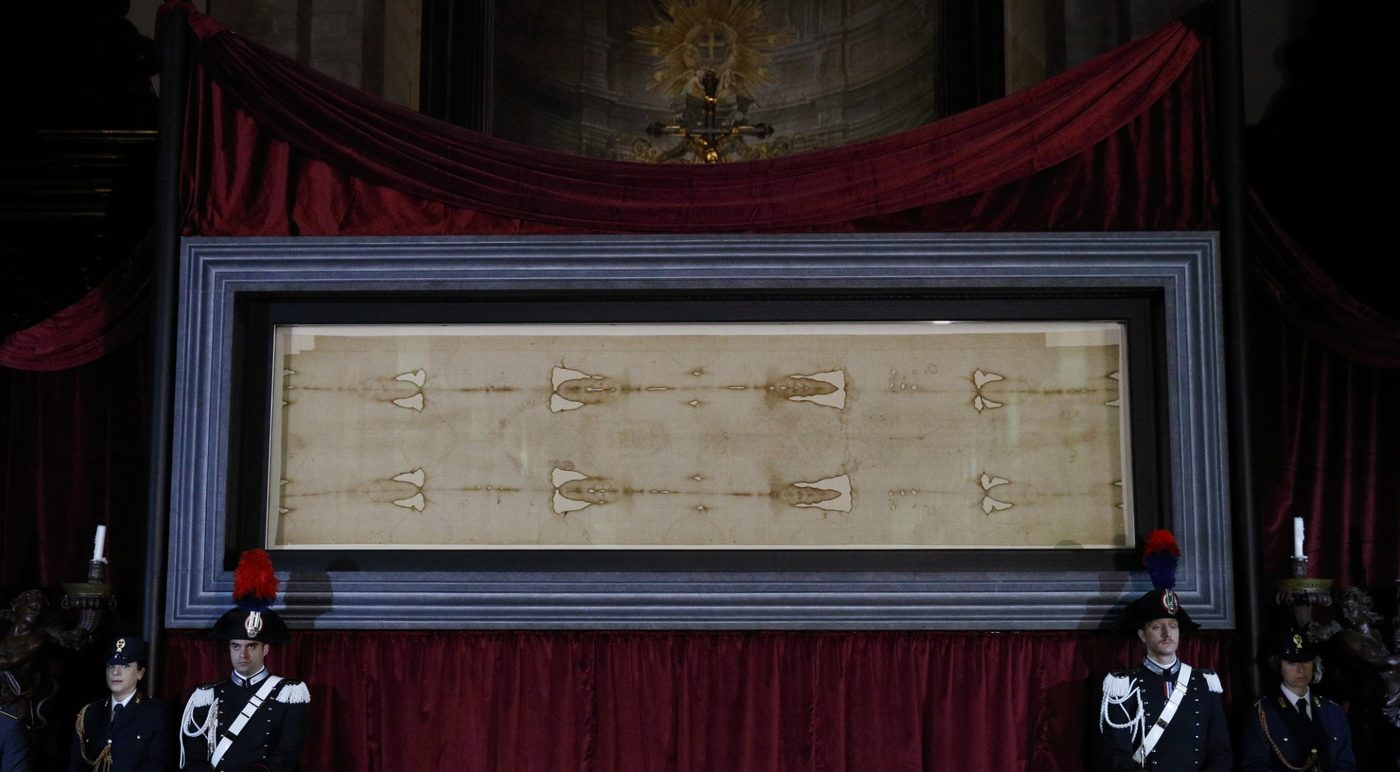
The shroud of Turin is stained with the blood of a torture victim, a study has suggested. Researchers in Italy said the linen cloth, which is believed to have been wrapped around Christ’s body after he was crucified, contains “nanoparticles” of blood that are typical of someone who has experienced violent trauma. Elvio Carlino, a researcher at the Institute of Crystallography in Bari, Italy, said the particles suggest “great suffering”. Professor Giulio Fanti, of the University of Padua, added that the particles have a “peculiar structure, size and distribution” and the blood contains high levels of creatinine and ferritin, typically found in patients who have suffered traumas such as torture. “Hence, the presence of these biological nanoparticles found during our experiments point to a violent death for the man wrapped in the Turin Shroud,” Professor Fanti said. The particles “cannot be artefacts made over the centuries on the fabric of the Shroud”, he added. The findings appear in an article titled “New Biological Evidence from Atomic Resolution Studies on the Turin Shroud” published in the American scientific journal PLOS ONE. The researchers used methods recently developed in the field of electron microscopy to analyse the Shroud. Mr Carlino said this was the first study of “the nanoscale properties of a pristine fibre taken from the Turin Shroud.” The 14ft-long piece of cloth is currently displayed at St John the Baptist Cathedral in Turin. The Church has not declared it authentic, but Benedict XVI described it as an “icon written in blood”.
1:00 PM
Shroud ‘bears the blood of a torture victim’
Staff writers

3 min read



Already a subscriber? Sign in
5freearticles every month
Continue reading with a free account. No card needed.
- Five free articles every thirty days, on any device you sign in on
- The Catholic Herald newsletter, every morning
- Subscribe whenever you like for everything: every article and the magazine
Related articles
 Newsroom
Church leaders urge Drumcree dialogue: ‘Too much is at stake’
The Catholic and Church of Ireland Archbishops of Armagh have urged a renewed commitment to peace and reconciliation amid the Drumcree stand-off
Corrie Douglas-Young Newsroom
Thousands of Irish children to join global Rosary campaign
Corrie Douglas-Young Newsroom
TikTok priest urges young people to stand with persecuted Christians
Nathalie Raffray Newsroom
Baby born at 25 weeks reunites with neonatologist two years after leaving hospital
The Catholic Herald Newsroom
Joe Biden honoured by Planned Parenthood after defending abortion rights
Christine Rousselle
subscribe to the catholic herald today
Our best content is exclusively available to our subscribers. Subscribe today and gain instant access to expert analysis, in-depth articles, and thought-provoking insights—anytime, anywhere. Don’t miss out on the conversations that matter most.
Subscribe



