
The decision of the Spanish Military Archbishopric to refuse permission for the funeral of former Guardia Civil officer Antonio Tejero Molina to be held at Madrid’s Armed Forces Cathedral has prompted controversy in Spain.
Archbishop Juan Antonio Aznárez Cobo, who serves as Military Ordinary of Spain, explained the reasoning behind his decision in a formal note released by the Military Archbishopric on March 5.
The statement emphasised that the request to celebrate the funeral in the cathedral had not followed the usual channels within the military diocese. “The request for the celebration of Don Antonio’s funeral on March 25 in the Castrense Cathedral was not consulted with its Rector nor with the Archbishopric,” the statement said, adding that the archbishop had subsequently met personally with a member of the family to address the situation and discuss possible alternatives.
During that meeting, the archbishop proposed other venues for the liturgy while explaining why the cathedral itself would not be used. The statement noted: “Yesterday, the Archbishop met with a member of Don Antonio’s family to discuss this fact and to propose alternatives in other Madrid parishes.”
The archbishopric also explained that the principal concern was that a funeral Mass held at the cathedral could acquire meanings “alien to the strict religious meaning of said celebration”. The statement suggested that such a ceremony might risk being interpreted in a way that would introduce political overtones into a purely religious act of prayer for the dead.
For Tejero’s relatives, however, the refusal has been experienced as a painful affront. In a statement issued through their lawyer, Ángeles Cañizares, the family argued that Catholic funerals exist primarily to pray for the deceased and to comfort the living. “The funeral rites constitute an act of piety and consolation for the living, not a judgment on the life of the deceased,” the statement said.
They added that the decision had been received “with great pain”, particularly given what they described as their family’s longstanding connection to the Spanish armed forces and state security institutions. The relatives insisted that no ecclesiastical reason had been provided to justify preventing the funeral from taking place in the cathedral that serves the military diocese.
“We understand that said prohibition lacks any foundation, as no ecclesiastical reason has been conveyed to us to justify depriving a faithful person of the suffrage of the Church in his own diocesan see,” the family wrote.
The statement also suggested that the decision may have been influenced by political sensitivities rather than purely pastoral considerations. The family said the refusal “appears to have been subordinated to considerations of a temporal or political nature”, adding that such a situation was painful to witness because “human fear seems to prevail over the principles of justice and truth that should govern this institution”.
Despite their criticism, the family emphasised their continuing loyalty to the Church, declaring that their faith remained “unshakable” and expressing hope for a Church that is “brave in the face of external pressures, and always welcoming to its children, without distinction”.
The dispute has inevitably drawn attention back to the figure of Antonio Tejero himself, one of the most recognisable actors in modern Spanish political history. Tejero, who died on February 25 at the age of 93, became internationally known for his central role in the failed coup attempt of February 23, 1981, an episode that tested Spain’s fragile transition to democracy following the death of General Francisco Franco.
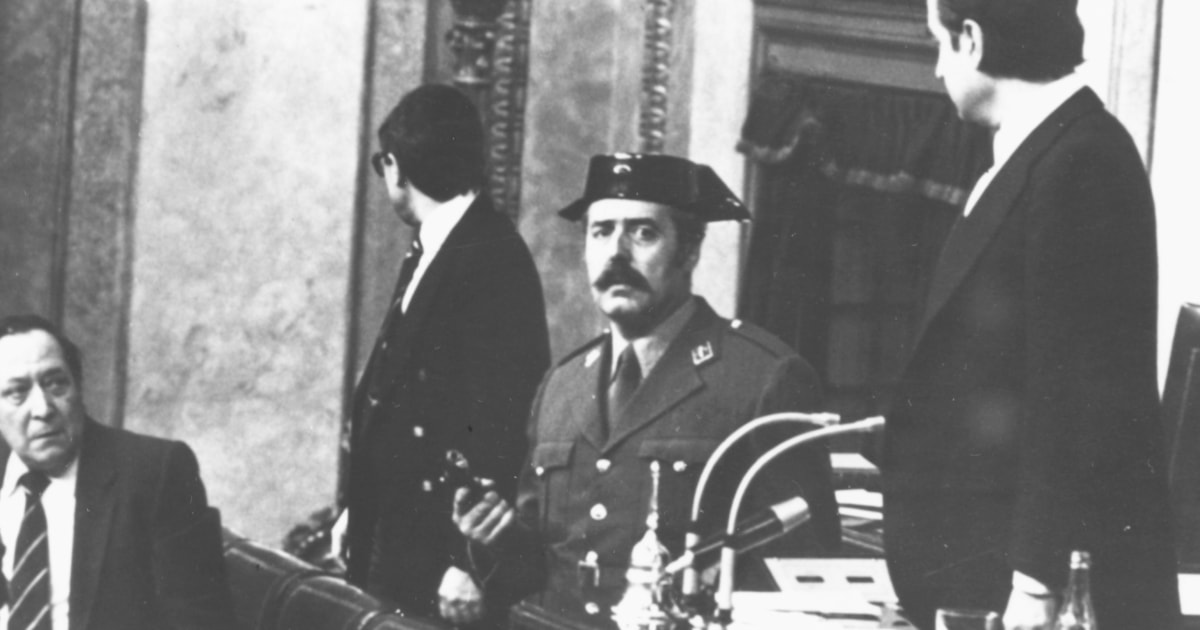
At the time, Tejero was a lieutenant colonel in the Guardia Civil. During the dramatic events of that evening, he entered the Spanish Congress of Deputies with armed officers and soldiers, interrupting a parliamentary session and taking legislators hostage. Television cameras captured the moment when he ordered those present to the floor and fired shots into the chamber ceiling.
The attempted coup lasted for roughly 22 hours. While some elements within the armed forces initially appeared sympathetic to the rebellion, decisive intervention came from King Juan Carlos I. In a nationally televised address delivered in military uniform, the monarch condemned the coup attempt and called for loyalty to the constitutional order. His intervention proved decisive in isolating the rebels.
By the following morning, it was clear that the coup had failed. Tejero and the other conspirators surrendered and were later arrested. The subsequent trial, which began in 1982, became a defining moment for the young Spanish democracy. Tejero was convicted of military rebellion and sentenced to 30 years in prison.
Although sentenced to three decades in prison, Tejero did not serve the full term. He remained incarcerated until 1993, when he was granted parole after more than a decade behind bars. His continued lack of public repentance for the coup attempt was frequently noted in Spanish public life.
In this instance, the Military Archbishopric appears to have concluded that a ceremony in the cathedral could attract interpretations beyond the strictly religious meaning of the Mass. By suggesting alternative parishes for the funeral, the archbishopric indicated that the Church did not intend to deny funeral rites altogether but rather to relocate them to a setting less likely to become a focal point for political symbolism.
The concern is understandable. Tejero remains one of the most controversial figures in modern Spanish history. As a lieutenant colonel of the Guardia Civil, he led the armed seizure of the Spanish parliament during the attempted coup of February 23, 1981. Images of him storming the Congress of Deputies with armed Civil Guards remain potent in the national memory. However, even by the archbishopric’s own admission, a Requiem has never been about political reputations. The Church’s liturgy for the dead does not celebrate a person’s achievements or endorse their conduct. It commends the soul of the departed to the mercy of God and offers consolation to those left behind.
The Church can deny funeral rites only in exceptional circumstances, normally when a public sinner’s burial would cause grave scandal among the faithful. Even then, the purpose is not to punish the dead but to avoid confusion about moral teaching. No public memorial or political ceremony in the cathedral had been proposed. The family requested a Requiem Mass in the church that serves the armed forces, the institution to which Tejero devoted his professional life. Instead, they were told the Mass should take place elsewhere because of the possible symbolism attached to the building itself.
The archbishopric may believe it has chosen the safer course, but the pastoral logic is less convincing. There have been many examples of controversial figures receiving funeral rites in prominent churches, including some whose crimes were widely regarded as more serious. The Church insists on praying for sinners as well as saints, since the purpose of the Requiem Mass is not public endorsement but supplication for the soul.
Tejero’s identity was inseparable from the military world represented by the cathedral itself. The Armed Forces Cathedral exists precisely for those who have served in Spain’s military institutions. To refuse the Requiem there risks appearing to distance the Church from that past for political reasons.